Tears and Tensions come to a head at Council
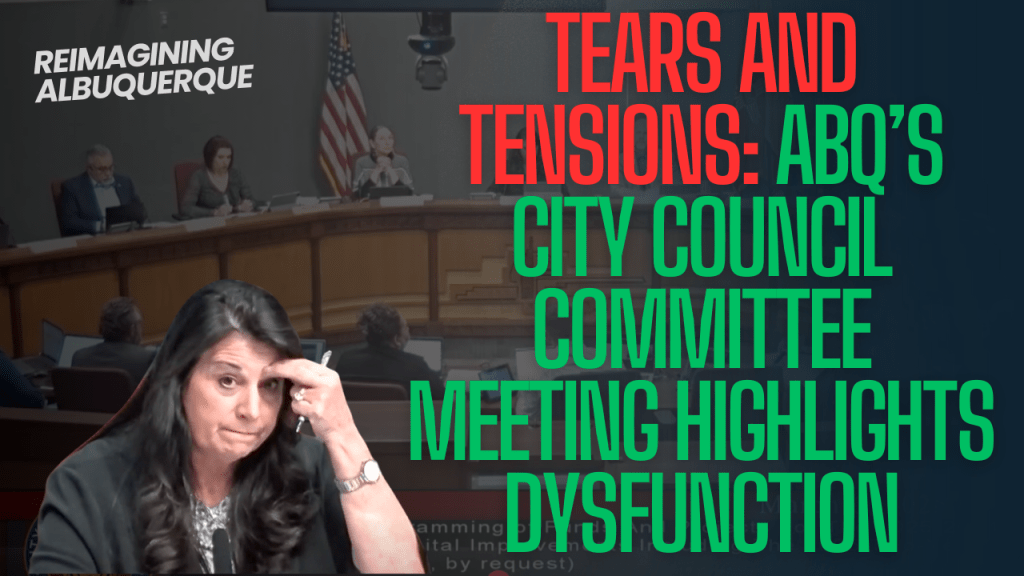
Albuquerque’s City Council Committee-of-the-Whole met on March 6 to discuss amendments to the 2025-2034 decade plan for capital improvements, including the 2025 two-year capital budget. What transpired, however, was a display of dysfunction, lack of preparation, and the deep-seated financial constraints that stem from Albuquerque’s decades of car-dependent sprawl development. The heated meeting underscored not only the accountability that public pressure brought regarding the controversial rail trail funding decision but also the pressing need to build a more sustainable tax base to avoid these annual budget battles.
Chaos and Conflict in City Hall
The meeting quickly became chaotic as Councilor Tammy Fiebelkorn pointed out that the documents provided for review were outdated, with some only being sent hours before the meeting. This led to confusion, as councilors were forced to work from differently formatted and labelled documents, creating further frustration. The atmosphere in the chambers was tense, with frequent arguments between councilors, council staff, and even the administration. The fallout from the council’s misstep on the rail trail funding decision loomed large, with councilors repeatedly invoking it as they navigated amendments.
Councilors treaded carefully, wary of shifting funding from one district’s project to another—a hesitance likely shaped by the public outcry over last month’s funding reallocation. However, their reluctance to move money between districts did not extend to criticisms of the mayor’s administration. Throughout the meeting, councilors lambasted the administration for what they saw as a lack of preparation and incivility. The administration proposed a new approach to funding capital projects: creating financial “buckets” that allow money to be allocated as projects evolve, rather than assigning rigid appropriations upfront. This idea—intended to prevent another rail trail-style debacle—prompted a particularly heated exchange between Council President Brook Bassan and Committee President Renée Grout.
Grout had attempted to earmark funds exclusively for District 9 projects, an effort Bassan forcefully opposed. In a tense vote, the amendment was struck down, with Bassan reminding her colleagues that Albuquerque voters would be approving the budget as a whole, not just for their own districts. She also warned that the council’s infighting was becoming a public spectacle, and feeding into the perception that the public has a declining confidence in their ability to govern.
Emotional Appeals and a Fractured Council
Emotions ran high throughout the meeting. District 3 Councilor Klarissa Peña critiqued the amendments, stating they were poorly crafted and she would “come back to council with more amendments on this,” after making remarks that disparaged the city’s core neighborhoods surrounding debate on improvements at Tingley Beach. Peña seemed to ignore that areas like Downtown serve as job centers, entertainment hubs, and educational spaces that benefit residents citywide—including those in her own district. Meanwhile, Councilor Nichole Rogers found herself in tears when attempting to reallocate funds from the Bullhead Park Renovation and the long-planned North Domingo Baca Aquatic Center to a food-insecurity project. While her desire to address hunger was valid, she ultimately relented after acknowledging that her colleagues were unwilling to reallocate the city’s general funds for such funding(which is typically the responsibility of state and federal governments). Instead, she chose to redirect more of her own district’s funds toward the effort.
Fiebelkorn, a committed vegan and animal rights activist, ultimately voted against funding for Tingley Beach due to concerns over animal welfare, though she and other councilors praised the city departments responsible for maintaining the space. Her opposition stood in contrast to the general acknowledgment that Tingley Beach is a key amenity for all Albuquerque residents, including from Dan Lewis, who underlined the importance of supporting the city’s most important amenities.
The Budget Squeeze: The Price of Sprawl
Beyond the theatrics, this meeting highlighted a fundamental reality: Albuquerque’s budget fights are increasingly constrained by the financial burden of maintaining its sprawling infrastructure. Councilors Peña, Sanchez, and Champine, for example, have previously opposed citywide legalization of duplexes—a simple, cost-effective way to expand the tax base and generate more revenue without raising tax rates. Their reluctance to embrace these reforms reflects the outdated, unsustainable pattern of Albuquerque’s suburban-style growth, which continues to stretch city resources thin.
The city’s history of low-density, car-dependent development means that infrastructure costs—road maintenance, utilities, and emergency services—are disproportionately high compared to the tax revenue generated by these neighborhoods. Now, as the costs of maintaining these vast, underutilized spaces mount, councilors are left making painful funding decisions, often pitting much-needed community projects against one another.
Dysfunction at the Top
The Committee-of-the-Whole’s dysfunction is a symptom of deeper issues. If the council cannot operate in a collaborative, professional manner, how can residents trust them to allocate city resources responsibly? Bassan’s warning that public confidence in the council is waning should serve as a wake-up call for them – the public’s confidence in the council IS waning. While disagreement is natural in politics, the level of infighting and lack of preparedness on display in this meeting suggests that Albuquerque’s highest legislative body is struggling to function effectively. Outside observers would not be shocked if they heard our councilors gave each other the silent treatment in the corridors of City Hall.
If councilors want to move beyond these annual budget battles, they need to address the root causes: an unsustainable tax base, an outdated approach to land use, and a tendency to prioritize political point-scoring over meaningful governance. Legalizing modest density increases, such as duplexes and fourplexes, would be a small but meaningful step toward financial sustainability, ensuring that future councils aren’t forced into these same zero-sum fights over funding.
Until then, Albuquerque residents should brace for more of the same: tense, chaotic budget meetings where essential projects are pitted against one another, and councilors spar instead of solving problems.

 Reimagining Albuquerque
Leave a comment