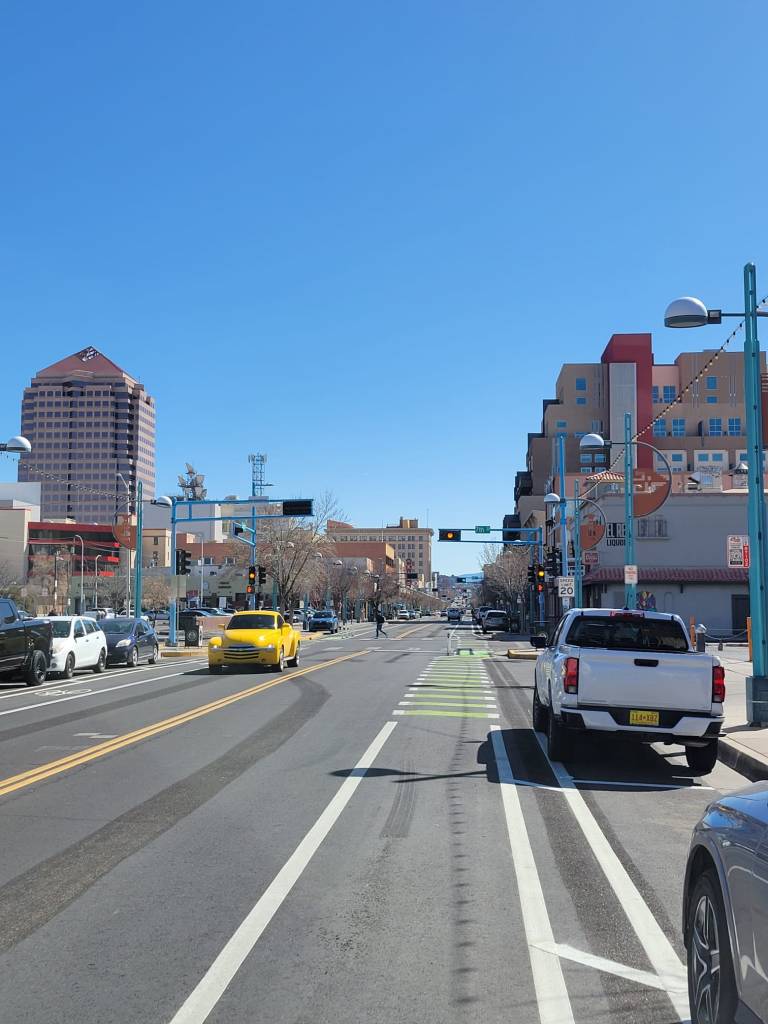
On a sunny Sunday afternoon, the new bike lanes along Central Avenue between 1st Street and the 8th Street Roundabout were already making a difference. Cyclists pedaled along comfortably, e-scooters zipped by, and pedestrians took advantage of a calmer, more inviting streetscape. For a Sunday—a day when Downtown Albuquerque often feels eerily quiet—the energy was noticeable.
The project, completed hours before its dedication ceremony, reallocated space along Central to create dedicated bike lanes and a more pedestrian-friendly environment. At the official ribbon-cutting, Councilor Joaquin Baca recounted a question from a reporter who asked if he was “worried” that the new bike lanes would bring more people downtown. “That’s exactly what we want to happen,” Baca responded.
It was a simple but powerful rebuttal to the prevailing attitude that Downtown is a problem to be solved, rather than a place to be invested in. Too often, public discourse around Downtown Albuquerque focuses on crime, vacancy, and parking, rather than the opportunities to make it a more functional, vibrant space. The new bike lanes suggest a different approach—one that prioritizes people over cars and acknowledges that a thriving city core needs more than just drive-through traffic.
A more attractive, livable Central Avenue
The most striking thing about the new bike lanes isn’t just their function—it’s how they reshape the street itself. By narrowing Central, the redesign creates a more intimate, inviting atmosphere. Rather than feeling like a fast-moving arterial road cutting through Downtown, Central now looks and feels more like the kind of street where people might want to linger.
A growing body of research shows that cities thrive when they design streets as public spaces rather than just corridors for vehicle throughput. The National Association of City Transportation Officials (NACTO) has found that reducing lane widths and adding bike infrastructure not only improves safety but also makes commercial areas more attractive to pedestrians and potential customers. The economic impact is just as clear. The National Street Improvements Study from Portland State University’s Transportation Research and Education Center (TREC) found that bike lane projects in multiple U.S. cities led to increased retail employment and higher food sales, with some corridors seeing sales rise by over 50%. Advocates in Albuquerque are taking note. “Having bike lanes on Albuquerque’s main streets like Central will make it more convenient for cyclists to patronize businesses along these avenues and contribute to the revitalization of Downtown and other historic commercial areas like 4th Street,” said Steve Pilon, who advocates on behalf of BikeABQ.
A step toward the ‘Festival Street’ vision for Downtown
The bike lanes are also a small but meaningful step toward a bigger vision for Central Avenue. In public engagement sessions held by the Metropolitan Redevelopment Agency, one of the most popular ideas from residents was transforming Central into a “Festival Street”—a space designed to accommodate street markets, special events, and a more active, mixed-use environment.
One way to advance this vision would be to raise portions of the street to sidewalk level, particularly in key areas where pedestrian activity is highest. Cities like Denver and Austin have successfully implemented this kind of design, making their downtown cores feel more like people-first environments rather than spaces dominated by cars.
Another possibility is expanding the Downtown Growers’ Market beyond Morningside Park, bringing it onto Central itself for a more integrated, city-scale experience. The market has struggled with overwhelming demand, often receiving more vendor applications than it can accommodate. A more expansive footprint—combined with Central’s emerging pedestrian- and bike-friendly environment—could allow it to grow while reinforcing Downtown as a community gathering space.
Downtown’s bike network is still incomplete—here’s how to fix it
While the new bike lanes on Central are a major improvement, they’re also an isolated piece of infrastructure in a Downtown area that still lacks a connected bike network. The best bike lanes in the world won’t reach their full potential if they don’t lead anywhere.
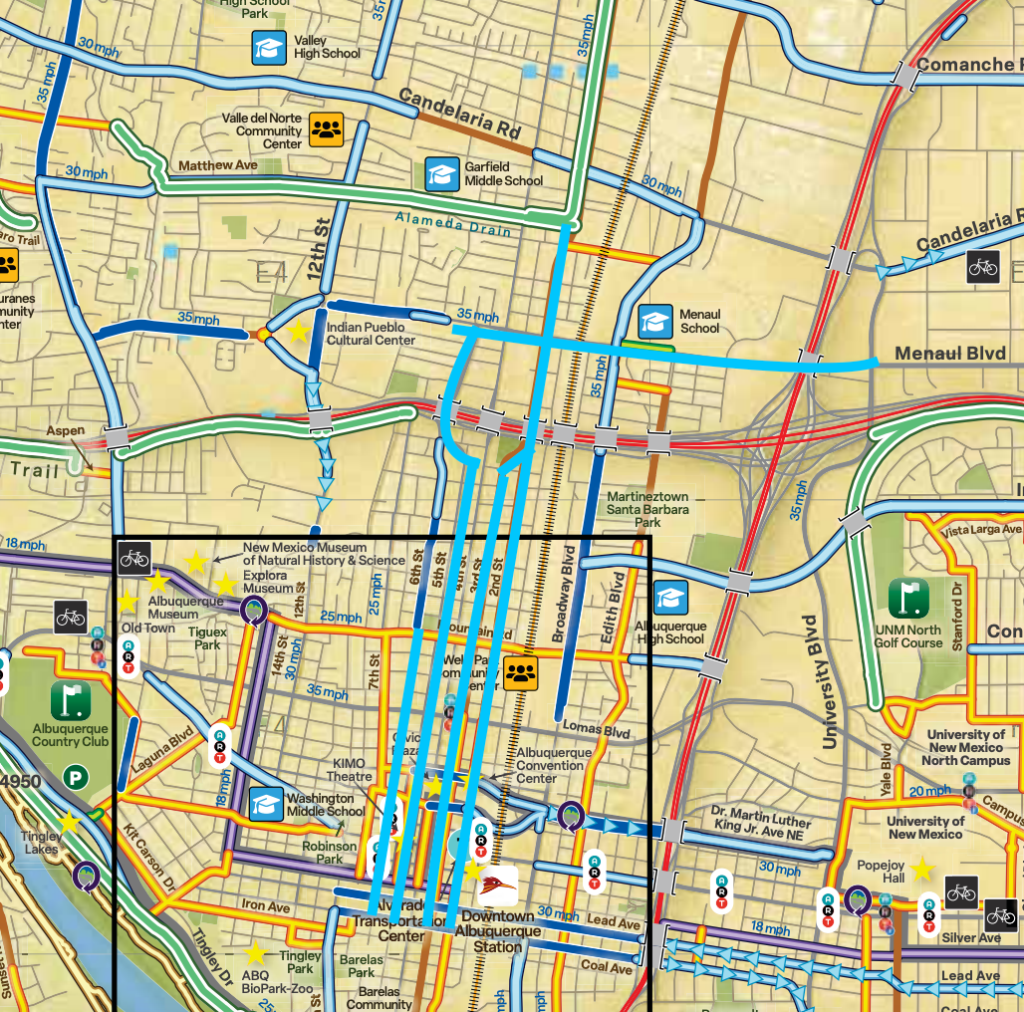
A logical next step would be extending the existing bike lane on 6th Street, which was recently reconfigured with a buffered bike lane and a new parking lane, down to Coal Avenue. It currently runs southbound between I-40 and Mountain Road. Extending it south while pairing it with a northbound bike lane on 5th Street would create a simple, cost-effective couplet that connects Wells Park and the Downtown Core.
Further east, 2nd and 3rd Streets remain designated bike routes despite being wide, fast, and intimidating to anyone outside a car. Converting them into true protected bike lanes—rather than an effective expressway—would dramatically improve connectivity between Downtown, the Rail Yards, and the 2nd Street/Alameda Drain bike trail, which already provides a comfortable route north as far as Paseo del Norte. The best part? This wouldn’t require expensive new infrastructure—just a fresh coat of paint and a shift in priorities.
A model for the future of Downtown streets
The new bike lanes on Central prove that relatively small interventions can have a significant impact. By reallocating street space, the project has already made Downtown feel more welcoming and active, even in its earliest days. More importantly, it challenges the long-standing assumption that Downtown should be optimized for cars rather than for people.
As Albuquerque continues its efforts to revitalize Downtown, the next steps should be just as bold. A more connected bike network, a more pedestrian-friendly streetscape, and a commitment to designing Central as a true public space—not just a road—could transform the area into the vibrant urban core the city deserves.
The shift is already happening. The question is: will Albuquerque embrace it?
https://www.koat.com/article/central-avenue-bike-lanes-completion-celebrated/64112833
 Reimagining Albuquerque
Leave a comment