A Mayoral Race Without Vision
So far, Albuquerque’s mayoral race offers little hope for voters who want real solutions to the city’s biggest challenges. The leading challengers are running on misconceptions, fear, and reactionary rhetoric, rather than policies that would actually move Albuquerque forward.
Throwing her hat into the ring to challenge Mayor Keller, fellow Democrat Mayling Armijo presents herself as an alternative, but her campaign is built on flawed assumptions about homelessness. She openly claims that substance abuse is “the direct link to homelessness,” ignoring the fact that the fastest-growing demographic of unhoused people are working families priced out of housing. While she nominally supports rapid rehousing and vouchers, she never acknowledges that homelessness is, first and foremost, a housing problem. Instead, her platform focuses on emergency shelters without any plan to address the root cause: the city’s lack of affordable housing.
If her stigmatizing, anti-homeless rhetoric isn’t troubling enough, the other candidates are even worse—openly criminalizing homelessness and pushing a dystopian vision of Albuquerque’s future. Their perspective isn’t one where the city is succeeding, growing, or full of opportunity—it’s one where the primary goal is forced removal of unhoused people rather than real solutions to poverty and affordability.
The Keller Conundrum
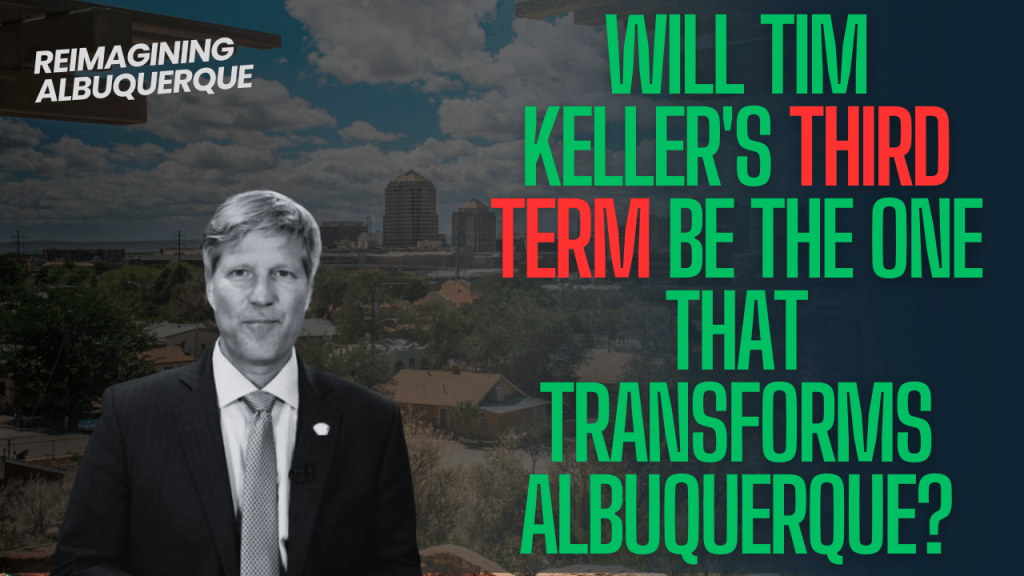
Tim Keller’s mayorship has often lacked vision. He has struggled to advocate for Downtown and Central Avenue, hesitated on housing and transit, and failed to consistently take strong stances on urban issues. But unless something big changes in the race, he remains the most forward-thinking candidate on the ballot. And that raises the question:
If Keller is likely to win another term, will he finally embrace bold leadership? Or will he continue to play it safe, allowing his policies to be watered down by opposition and inaction?
The answer will determine whether Albuquerque’s next four years are marked by real progress—or just more incrementalism and missed opportunities.
Keller’s Urbanism: Ambitious Ideas, Incomplete Execution
Tim Keller’s urbanist policies have been among the most forward-thinking in Albuquerque’s history—but ambition without sustained leadership has left many of them half-baked. While he has introduced promising reforms in transit, housing, and public space, his administration has struggled to champion these ideas effectively, allowing opposition to dictate the terms of debate. The result? A city where progress remains fragile, and where policies designed to improve urban life often lose steam before achieving their full impact.
Transit: Big Moves, But Hesitation at Crucial Moments
One of Keller’s biggest missteps came early on when he dismissed Albuquerque Rapid Transit (ART) as a “lemon.” At a time when the city needed leadership to bolster public confidence in its largest transit investment, his administration wavered. Instead of defending ART’s role in reshaping Albuquerque’s transit future, he hesitated, allowing critics to frame the system as a failure before it had a chance to succeed.
But here’s the irony: ART has, against the odds, become a success. Depending on the month, it ranks as the fifth or sixth busiest bus rapid transit (BRT) system in the United States—an impressive feat for a metro area of Albuquerque’s size. It punches above its weight, carrying ridership numbers that many similarly sized cities would envy. And that’s despite its frustratingly limited service hours—buses stop running at 10:00 p.m. on most nights, curbing its potential as a true high-frequency transit spine.
Yet you won’t hear these accolades from Keller’s administration. Instead, ART’s success is more likely to be praised by urbanist YouTubers like Ray Delahanty of “CityNerd” than by the mayor’s office. Why isn’t the city taking ownership of this narrative? This could be a rallying point for expanding ART, improving service frequency, and advocating for further investment in ABQ Ride. But rather than using ART’s growing ridership as a political asset, Keller remains hesitant to champion the system, missing a golden opportunity to make transit a cornerstone of his urbanist legacy.
His administration has made some moves in the right direction, such as implementing fare-free transit—a well-intended step toward accessibility. But without paired improvements like increased frequency, extended service hours, or long-term funding commitments, the impact has been limited. Bus service remains free but inconvenient, reinforcing the perception that public transit is a social service rather than essential infrastructure.
More recently, the ABQ Ride Forward initiative aims to rebalance the network, a much-needed step in making bus routes more functional and frequent. But it doesn’t actually expand service—it just reallocates existing resources. Rebalancing is, of course, pivotal, but we DO need more investment as well. And while COVID-19 disrupted transit ridership everywhere, Keller’s unwillingness to strongly advocate for transit has kept Albuquerque’s system from emerging stronger post-pandemic.
Could he turn this around? Absolutely—but it will take more than incremental changes. A serious transit commitment in a third term would mean:
- Extending ART service hours so it functions as a real high-frequency corridor. This also requires determination in handling the city’s labor shortage.
- Advocating for new local, state, and federal transit funding, not just redistributing what already exists (Given the current federal climate, it will also require creativity and grit).
- Treating transit as economic infrastructure—not just an afterthought.
Keller has the opportunity to take transit from a neglected public service to a city-defining asset. The question is: will he finally take the lead on transit?
Housing Reform: Pushing the Conversation, But Not Steering It
Keller has evolved on housing, but his administration’s approach has been reactive rather than proactive. His Housing Forward initiative was a necessary step toward addressing Albuquerque’s housing shortage, legalizing casitas (ADUs), reducing parking mandates, and permitting denser development. However, his most ambitious reforms—like allowing multiplexes citywide—were stripped away after vocal opposition from neighborhood groups.
Rather than forcefully defending these policies, Keller largely let the city council weaken them without sustained pushback. His administration failed to lay the groundwork with councilors who needed political cover to support these changes, meaning many only heard from angry homeowners flooding their inboxes. Other cities have seen mayors proactively engage council members, providing them with data, public messaging strategies, and a clear case for why density is essential for affordability. Keller, instead, rolled out Housing Forward as a series of policy proposals without a long-term campaign to build momentum or sustain support.
That’s beginning to change. His recent efforts—such as hosting community conversations on housing & homelessness and securing funding for the Rail Trail—suggest he’s starting to recognize the need for long-term advocacy. But much of Albuquerque’s movement toward middle-density zoning has been driven by public outcry from young people priced out of homeownership rather than by a clear mayoral push. If housing reform is to succeed, it will need a mayor who not only proposes change but aggressively campaigns for it.
Downtown: Missed Opportunities and Half-Measures
Keller has rightly identified Downtown revitalization as a key issue, but his execution has been inconsistent. He is now pushing to bring UNM Downtown, advocating for TIF (Tax Increment Financing) and BID (Business Improvement Districts)—smart policies modeled after Tucson’s successful approach. But here’s the problem: Albuquerque already has a UNM Downtown presence through Innovate Albuquerque, a project launched under his predecessor. Instead of building on that foundation, Keller has largely ignored it—much like he initially distanced himself from ART, only to circle back years later.
His slow response times may have also doomed a pivotal Downtown housing project. The Downtowner, a plan for small, affordable units by local developer Jay Rembe, appears dead in the water. In a recent Instagram Q&A, Keller casually dismissed the project, saying he’s now “looking at another developer.” Meanwhile, the site has been turned into a temporary dog park.
Yes, The Downtowner faced challenges—COVID didn’t help, and these projects are always tough to finance. But in other cities, when a transformative project stalls, mayors use their office to bring it across the finish line. Had Keller treated this project as essential to Downtown’s future—rather than just another stalled proposal—it might not be on life support. The plan would have delivered over 200 desperately needed units in a neighborhood short more than 5,000 homes. Instead, it joins a growing list of ambitious ideas that failed due to waffling, lack of urgency, and weak follow-through.
A Leadership Gap That Could Still Be Filled
Keller’s pattern is clear: he launches bold policies but lacks the full-throated leadership to see them through. Despite Albuquerque’s strong mayor system, he often lets the city council and outside forces dictate outcomes rather than using his office as a platform for decisive action. That hesitation has allowed critics to water down major urban reforms, delay key projects, and limit Albuquerque’s ability to grow into a more sustainable, affordable city.
But the story isn’t over. A third term could be Keller’s chance to shift from introducing bold ideas to actually delivering on them.
- What would it take for him to step up as the urban leader Albuquerque needs?
- What if, instead of playing defense, he actively pushed back against opposition?
- What if, instead of distancing himself from projects like ART or Innovate ABQ, he built on their momentum?
- What if, instead of letting housing policy be shaped by reactionary voices, he made it a cornerstone of his administration?
If his first two terms have been about laying out ideas, his next term must be about finishing the job.
A Third Term Could Be His Chance to Lead Boldly
If Keller truly wants to “get things done”—as he put it in his campaign announcement—he needs to shed his tendency to play it safe and instead embrace a more proactive, urbanist vision. His energetic push for Rail Trail funding shows that he can be an effective champion for big ideas when he chooses to be. The question is: Will he bring that same level of advocacy to transit, housing, and safe streets? Or will he continue to let opposition set the terms of the debate?
What a Stronger, More Visionary Keller Could Do:
- Supercharge Housing Forward – Expand missing middle zoning, further reduce exclusionary barriers, and actively push back against neighborhood opposition that prioritizes “sameness” over progress. The city’s affordability crisis demands more than half-measures. Other mayors—like Michelle Wu in Boston—have directly confronted homeowner resistance to zoning reform, framing housing growth as a moral and economic necessity. Keller must do the same.
- Fix Transit—For Real – ART is succeeding despite itself, but its early stigma still lingers. Beyond rehabilitating ART’s public image, Albuquerque needs a real transit vision—one that integrates land use planning with service expansion. Other cities have invested in Bus Rapid Transit as a core urban strategy, not a standalone project. A mayor who truly wanted transit to thrive would champion higher service frequencies, later hours, and better walkability near stations—not let YouTubers be the only ones celebrating ART’s success.
- Make Safe Streets a Priority, Not an Afterthought – Vision Zero has been a talking point, not a guiding principle. If Keller is serious about pedestrian and cyclist safety, he must do more than make symbolic gestures—he must push for road diets, enforce reckless driving laws, and redesign dangerous intersections. That means directly confronting outdated engineering standards that prioritize vehicle throughput over human lives. It means pushing back against officials who insist that roads like Menaul, Lomas, or University “don’t need” road diets, even as they remain some of the most dangerous streets in the city. Albuquerque is one of the deadliest cities in the country for pedestrians and cyclists. This isn’t an inevitability—it’s a failure of leadership and design. Every lost life is a policy choice. Other mayors—like Anne Hidalgo in Paris—have used their executive power to rapidly implement safety and active transportation measures. They haven’t waited for outdated traffic models to justify slowing cars down. Keller needs to stop treating traffic violence as inevitable and start treating it as a crisis. The city has the tools to make streets safer. The question is whether Keller will finally use them.
- Revitalize Downtown Through Mixed-Use Development – Downtown revitalization should not be piecemeal—it needs a comprehensive strategy. Right now, many city councilors resist Downtown investment, arguing it’s “unfair” to their districts. But Keller must shift the conversation: A thriving, active Downtown benefits the entire city. Instead of treating Downtown as a special project, he must make it clear that it is Albuquerque’s core economic engine.
- Other cities—such as Oklahoma City under Mayor Mick Cornett—have rallied broad support for downtown revitalization by framing it as essential for economic growth citywide. Keller should push for incentives that encourage infill development, adaptive reuse, and active streetscapes—rather than leaving projects like The Downtowner to languish in bureaucratic purgatory.
- Other cities—such as Oklahoma City under Mayor Mick Cornett—have rallied broad support for downtown revitalization by framing it as essential for economic growth citywide. Keller should push for incentives that encourage infill development, adaptive reuse, and active streetscapes—rather than leaving projects like The Downtowner to languish in bureaucratic purgatory.
- Take a Stand Against NIMBY Backlash – The Mark Twain Neighborhood Association’s recent move to annex part of a neighboring area to maintain control over zoning rules is a perfect example of how anti-housing forces operate. Keller must reject the false neutrality that has characterized his approach to these battles. If he wants Albuquerque to grow and thrive, he must clearly and unapologetically state that more housing is not just an option—it’s a necessity. Other mayors, such as London Breed in San Francisco, have directly challenged anti-housing narratives, calling out neighborhood groups that use “character” as a proxy for exclusion. Keller must start leading this conversation rather than passively watching it unfold.
Will Keller Seize the Opportunity?
A third term should not be about preserving the status quo—it should be about seizing the moment to create lasting, transformative change. The pieces are in place for Keller to be the mayor who reshapes Albuquerque into a more livable, walkable, and sustainable city—but only if he’s willing to truly fight for it.
The best urbanist mayors don’t just propose good ideas—they change the conversation. They don’t wait for public support—they build it.
This isn’t a left-right issue—it’s about leadership and execution.
- Michelle Wu took on entrenched housing and transit challenges in Boston, using her office to rally public support for zoning reform and fare-free transit.
- Anne Hidalgo transformed Paris by defying opposition to pedestrianization, turning once car-dominated streets into thriving public spaces.
- Mick Cornett, a conservative Republican, led a dramatic reinvention of Oklahoma City by prioritizing urban revitalization, walkability, and downtown investment.
What’s stopping Keller? Albuquerque’s city council is more conservative than Keller, but that shouldn’t be an excuse. Even within a politically divided landscape, public pressure can shift council opposition, as we’ve seen with middle-density zoning. Some councilors may oppose urbanist policies out of habit rather than conviction—which means a strong mayor could shape the debate instead of reacting to it.
Keller has claimed he “wants to get things done.” If that’s true, he must fight for housing, transit, and safe streets with the same energy he’s shown for the Rail Trail.
- If he wants Downtown to succeed, he must reframe it as an investment that benefits all of Albuquerque.
- If he wants to lead, he must stop compromising preemptively—and start advocating unapologetically.
- If he wants to influence the council, he must engage in the kind of strategic advocacy that has made urbanist policies succeed elsewhere—even in cities with far more entrenched political resistance.
The coming months will reveal whether Keller intends to be a bold leader or if he will once again take a cautious, incrementalist approach. If he chooses the former, he could leave behind a legacy that sets Albuquerque up for success for generations to come. But if he chooses the latter, the city risks more stagnation at a time when ambitious action is desperately needed.
The choice is his—but the stakes belong to all of us.

 Reimagining Albuquerque
Leave a comment