Downtown Today: Vibrancy at Night, Vacancy by Day
Walk down Central Avenue on a Saturday night and you’ll catch glimpses of what Downtown Albuquerque could be. Bars buzz with conversation. Music spills into the streets. The sidewalks — for a moment — feel alive. But visit during the day, and that energy evaporates. Empty storefronts, vacant lots, and fading “for lease” signs line the corridor, not to mention barred and boarded windows, reminders of decades of big plans and missed opportunities.
Despite having some of the most permissive zoning in the city — no parking minimums, no height limits, and a form-based code that actively welcomes new development — private investment has lagged. Why? Persistent perceptions of crime, weak foot traffic, and the lack of a critical mass of residents keep Downtown stuck in neutral.
Other cities have faced similar challenges, only to break through with strategic public investment. A downtown performing arts center could be the signal Albuquerque needs — a clear, visible commitment to building a vibrant, inclusive urban core.
Why Past Efforts Failed (and What’s Changing)
Albuquerque has tried before. Under Mayor Jim Baca, a movie theater was brought downtown in the hope it would spark revitalization. It shuttered during the pandemic, another casualty of fragile momentum. Grand plans to revive the old Franciscan Hotel never materialized. Even the ART system, a bold investment in mobility, has struggled with pandemic-era service cuts and lack of investment by the city.
But not all attempts have failed. The Imperial Building — home to a grocery store, housing, and retail — stands as proof that well-executed, mixed-use development can succeed here. Across the street, after years of recession-induced delays, townhomes and apartments are finally filling a once-empty lot. The long-awaited Rail Trail is beginning construction, with the potential to connect downtown to surrounding neighborhoods in new, walkable ways. And the ART? It’s there, bringing thousands of Burqueños within walking distance of a one-seat ride to downtown — we just need to leverage it. The pieces are beginning to fall into place — slowly, but steadily.
Leadership: The Missing Ingredient
So what’s holding Albuquerque back? In large part, fractured leadership. For too long, squabbles between the mayor’s office and city council have derailed progress. While peer cities like Tucson and even Las Cruces have benefited from unified leadership and clear, coordinated visions for their downtowns, Albuquerque has often felt rudderless.
Without that leadership, big ideas fade into reports on shelves. Projects stall. Developers hesitate. Residents grow skeptical. If Albuquerque is serious about becoming a dynamic city — one that attracts talent, retains young people, and builds community pride — this leadership gap has to be closed.
Addressing the Skepticism
Skeptics are right to raise concerns. Across the country, cities have poured hundreds of millions of dollars into downtown stadiums, convention centers, and mega-projects that ultimately underdeliver on promises of revitalization. Albuquerque’s own political history reflects this caution. In the 1990s, frustration with big, flashy projects that failed to deliver led voters to amend the city charter, requiring a public referendum for performing arts center spending over $10 million.
So the question is fair: Why should this be different?
First, Councilor Joaquin Baca’s proposal doesn’t stand alone. He’s proposing a tax levy that would fund amenities across the entire city, ensuring that downtown investment happens alongside improvements in other neighborhoods. At the same time, he’s placed on the ballot a proposal to remove that outdated charter language — a sign that he’s willing to ask voters for trust, rather than circumvent their voice.
Second, Albuquerque’s downtown is falling behind. New development is clustering around areas of the city where sustained investment and incremental improvements have paid off. Meanwhile, growth is increasingly spilling into sprawling developments in Rio Rancho and the metro’s outer edges, stretching infrastructure and reducing overall livability. Downtown remains underleveraged, underbuilt, and underperforming.
A performing arts center — if paired with smart policies and incremental support — has the potential to turn that tide. It signals that Downtown Albuquerque is not just a weekend destination, but the beating heart of a city approaching one million people. It can recenter our tax base, attract housing and businesses, and offer something the suburbs simply can’t: density, walkability, culture, interesting architecture, and daily vibrancy.
That doesn’t mean we should ignore the cautionary tales. But unlike stadiums that sit empty most of the year, performing arts centers can host frequent, diverse programming — from community theater to national touring acts — that brings people downtown again and again. In Albuquerque’s case, the cultural energy is already here; what’s missing is a venue that showcases it.
The Proposal: Bold, Focused, and Achievable
City Councilor Joaquin Baca has stepped forward with a proposal that could finally tip the scales. He’s advocating for a tax levy that would fund citywide amenities — among them, a downtown performing arts center. He’s also pushing for a ballot measure to remove the outdated city charter restriction requiring a public referendum for performing arts center spending over $10 million.
It’s a big ask — but it’s grounded in what has worked elsewhere. Investments in cultural anchors have transformed downtowns in Pittsburgh, Muskegon, and South Bend. In these cities, local governments didn’t just wait for big developers; they subdivided large parcels, made small lots available to local builders, and jumpstarted incremental growth.
Downtown Albuquerque is poised to do the same. Our permissive zoning lowers barriers, but action matters most. The city could purchase long-empty lots, create a land bank, and offer small parcels to local developers. Combine that with cultural investment, and we have the recipe for sustained, organic growth.
But more than that, this proposal matters for what it signals. For too long, Downtown Albuquerque has been treated as a problem to manage, not a core worth building around. A performing arts center — alongside land management tools and the enforcement of our new vacancy ordinance — would send a clear message: Albuquerque values its downtown. This investment builds more than a building. It builds confidence.
Why This Time Could Finally Be Different
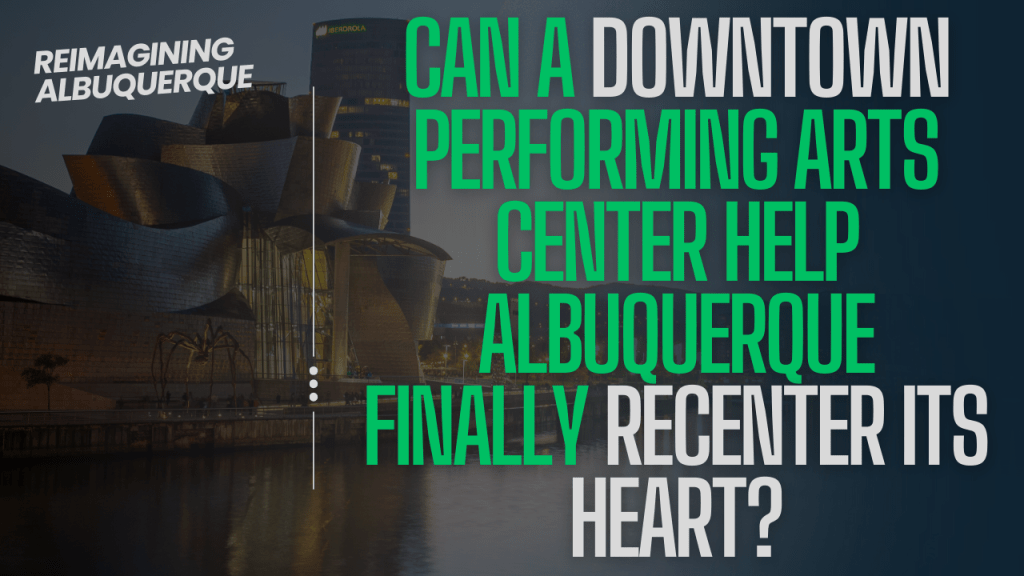
Councilor Baca points to Bilbao as an inspiration — and that choice matters. The Guggenheim Museum Bilbao wasn’t just a cultural investment; it was a bold statement that repositioned an entire city on the global stage. For Albuquerque, approaching one million people in its metro area, thinking big is both appropriate and overdue.
But Albuquerque isn’t starting from scratch. The groundwork is being laid:
- The Rail Trail is under construction, linking Downtown with surrounding neighborhoods.
- The Railyards Market continues to draw thousands each weekend it is held.
- The ART system will soon benefit from the ABQ Ride Forward System Recovery Network, improving bus routes and bringing more people Downtown with one-seat, frequent rides.
- New bike lanes along Central Avenue signal a shift toward streets designed for people.
Councilor Baca has shown he understands this ecosystem. His advocacy for the vacancy ordinance and attention to pedestrian and cycling infrastructure demonstrate leadership at both the policy and street level. We have the pieces. The question is whether Albuquerque’s leaders will seize the moment with bold vision and the persistence to stay the course.
A Downtown That Competes on Experience, Not Sprawl
Families and businesses choosing between Uptown, Nob Hill, or Rio Rancho often bypass Downtown. Uptown has benefited from sustained investment in hotels, retail, and public space. Nob Hill continues to evolve with small improvements that make it lively and appealing.
Downtown has rarely received that same focus. A performing arts center can help change that. It tells residents and businesses that Downtown is where culture and community converge. It becomes part of a feedback loop of confidence and investment — the same cycle that made Nob Hill and Uptown successful.
We can’t compete with Rio Rancho on outward expansion. We shouldn’t try. Albuquerque’s competitive advantage lies in building density, culture, and opportunity inward, in the heart of the city.
Claiming Albuquerque’s Place as a Cultural Powerhouse
New Mexico is known for its arts. But the spotlight too often shines on Santa Fe and Taos. Albuquerque boasts public art, music, festivals, and performance — but lacks a world-class venue to anchor that identity. A downtown performing arts center could help Albuquerque claim its rightful place as a cultural powerhouse and recenter the city’s identity around creativity and urban vibrancy.
What It Will Take (Beyond a Building)
Of course, a building alone won’t solve systemic challenges. Downtown Albuquerque needs:
- Housing — and lots of it — at all price points.
- Safe, walkable streets for pedestrians, cyclists, and transit riders.
- Transit-oriented development that builds on ART, the Rail Trail, and a restructured bus network.
- Consistent, visible leadership that champions human-centered urban design, every day, in big and small ways.
But beyond these elements, it needs structures that outlast any one mayor or councilor. Political champions are essential — but they come and go. Downtown’s success needs to be safeguarded by tools that institutionalize vision.
Right now, Downtown is on the cusp of establishing two critical mechanisms: a Business Improvement District (BID) and a Tax Increment Financing (TIF) district. Cities like Tucson — whose resurgence Downtown Albuquerque News has covered extensively — have shown how BIDs and TIFs can create steady, predictable resources and accountability. These tools ensure that the investment and care we show Downtown today will continue through multiple administrations, becoming part of the city’s long-term DNA.
But vision alone isn’t enough. We also need dedicated staff and programming capacity to keep our city’s cultural spaces active, accessible, and vibrant. Downtown already has valuable assets — the KiMo Theatre, the National Hispanic Cultural Center, and smaller venues across the core. Yet too often, these spaces go underutilized, with sporadic programming and missed opportunities to create energy and foot traffic.
If we want to build and sustain a world-class performing arts center, we first need to prove that we can support and maximize what we already have. That means training and empowering staff dedicated to venue management, event coordination, and community partnerships. It means ensuring that the KiMo doesn’t sit dark for weeks at a time — as it often has post-pandemic — but instead becomes a reliably active hub for local theater, music, film, and community gatherings.
A new performing arts center will not succeed in isolation. It needs to be part of a larger ecosystem — one where small and mid-sized venues thrive, build audience loyalty, and support local talent. In doing so, we cultivate not just infrastructure, but an expectation of vibrancy and cultural activity that will carry into the larger venue when it opens its doors.
In other words, this is about building habits — for the city, for artists, and for audiences. And that work needs to start now.
The Leadership Test Albuquerque Must Pass
The next two years will be pivotal. Mayor Tim Keller, if he wins a third term, will need to decide whether to fully commit to Downtown or allow it to remain an unfulfilled promise. If another candidate becomes mayor, that leader will need to be convinced — and that could prove even more difficult, given that several current contenders seem openly antagonistic to the very best practices that Albuquerque urgently needs. Councilor Baca’s proposal will test whether the city council can rally around a shared vision — especially as some suburban councilors worry about “privileging Downtown.”
Baca’s decision to structure the tax levy for citywide amenities is a smart step toward easing those concerns. But ultimately, Downtown’s vitality is not just a Downtown issue — it’s a citywide issue. Downtown generates more tax revenue per acre than any other part of Albuquerque. The districts that feel they are “subsidizing” Downtown are, in fact, subsidized by it. Jobs, cultural amenities, entertainment venues, and business opportunities radiate outward from the core. A thriving Downtown lifts the entire metro area, just as a struggling Downtown holds the city back.
Albuquerque stands at a crossroads. We can either chase the illusion of growth through sprawl, as Rio Rancho does, or embrace our true advantage: building density, culture, and opportunity at the city’s heart. Real strength comes from reinvesting in our core — where infrastructure already exists and where every dollar spent can create more value, more vibrancy, and more long-term resilience. Outward expansion often looks like progress, but in reality, it pulls energy and resources away from the places that should be most alive.
Councilor Baca faces the unenviable task of being Downtown’s loudest ambassador. He has to make the case that this isn’t about special treatment — it’s about protecting and growing the very heart that keeps Albuquerque’s economy pumping. His advocacy on the vacancy ordinance, his attention to small urban details like bike lanes and pedestrian safety, and his willingness to think big with this proposal all show that he’s up to the challenge. But he can’t do it alone.
What Downtown needs now is sustained, generational commitment — leadership structures like BIDs and TIFs that keep that vision alive no matter who sits in the mayor’s office or on the council dais.
This is Albuquerque’s moment to break the cycle of small thinking and fear-based politics. The performing arts center could be the spark. The BID and TIF could be the fuel. And a citywide understanding of Downtown’s value could be the wind at its back.
But to truly seize this moment, we also need to let go of the self-defeating belief that “things don’t work in Albuquerque like they do elsewhere.” They can — and they will — if we choose vision over cynicism, action over hesitation, and long-term investment over quick fixes.
Downtown is our heart. If we invest in it — together — the dividends will reach every corner of this city. It’s time to believe we deserve that future.
 Reimagining Albuquerque
Leave a comment