
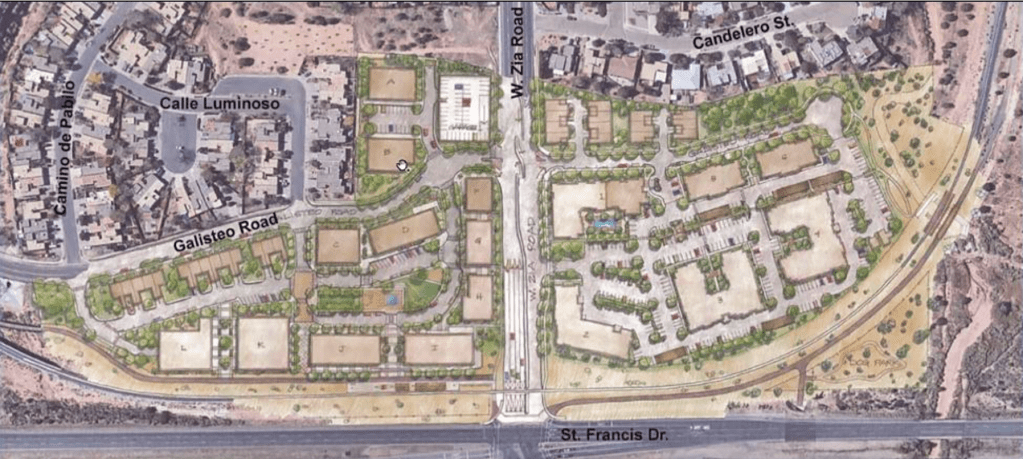
In a state struggling with a worsening housing crisis, there’s perhaps no clearer symbol of bureaucratic dysfunction and local obstruction than the Zia Road Rail Runner station in Santa Fe. Originally envisioned as a modest example of transit-oriented development (TOD) as far back as 2008, the station’s opening was delayed nearly a decade due to disputes with neighboring property owners and weak local resolve. The station itself didn’t open until 2017, and the actual housing development around it is only now, seventeen years later, finally breaking ground.
A Symbol of Bureaucratic Paralysis
This delay wasn’t inevitable. TOD plans were drawn up around numerous Rail Runner stations in the years leading up to and then following the line’s construction. But as the Legislative Finance Committee noted in its 2019 evaluation report, “most TOD plans created around the time of the Rail Runner’s opening have not come to fruition.1”
While Santa Fe’s Railyard District stands as a successful TOD example, albeit one initiated before the Rail Runner existed, Zia has been a cautionary tale: a kiss-and-ride station without the development it was designed to anchor.
Now, in 2025, progress is finally underway. A mixed-use housing complex has been approved adjacent to the station, including 244-unit mixed-income development with 24 affordable units. Across the street, a further 160 units, including townhomes and lofts await final approval2. This long-delayed progress is welcome, but it exposes how the combination of local NIMBYism, legal ambiguity, and timid planning culture can stall essential housing for nearly a generation.
The Consequences of Delay
The Zia Road station sits in one of the most unaffordable cities in the country. Santa Fe’s housing costs have surged post-pandemic, and homelessness has visibly increased. This makes the seventeen-year delay not just a missed opportunity, but a direct contributor to human suffering—a consequence of a system that is working exactly as designed.
As Jerusalem Demsas argues in her article The Labyrinthine Rules That Created a Housing Crisis In The Atlantic3, the problem isn’t simply NIMBYism—it’s the institutional scaffolding that allows a small group of obstructionists to hijack public decisions with regional consequences.
Demsas: “The rules that govern land are the foundation of our lives. Americans should take a closer look into how they are determined.”
She describes how America’s land-use system, far from being democratic, is riddled with veto points, opaque processes, and unaccountable local bodies. What we call “public participation” is, in practice, a procedural minefield where the most well-resourced or litigious voices dominate, and the broader public interest is sidelined. Even minor projects can be derailed for years by neighbors invoking subjective concerns over shadows, traffic, or “neighborhood character.”
Demsas: “We’ve delegated power over land use to the hyperlocal level under the false assumption that this makes the system more democratic. In reality, it has created stasis and sclerosis.”
The Zia Station project embodies that stasis. Despite being transit-adjacent, mixed-income, and aligned with city and state policy goals, it was delayed for over a decade by disputes rooted in local resistance, bureaucratic risk-aversion, and a legal system designed to say no.
Demsas writes that this system doesn’t fail because the public demands it; it fails because power has been insulated from democratic accountability. Voters may want more housing, but they have little influence over unelected zoning boards or development review committees. The result is a policy regime that rewards those with time, money, and access to say “no”, and punishes everyone else.
The 2025 New Mexico legislative session offered a chance to confront this imbalance. Lawmakers floated proposals to preempt exclusionary zoning, streamline approvals, and support housing near transit nodes like Zia. But none of those bills passed—many were never even scheduled for hearings. Once again, the interests of delay won out over the needs of working families.
This kind of inaction isn’t neutral. It’s structural. And it’s a choice. Until New Mexico and other states dismantle the hyperlocal veto power that governs land use, stories like Zia will keep repeating—while housing prices rise, homelessness grows, and the promise of equitable transit-oriented development remains out of reach.
Rail Runner: A Strong System Undermined by Land Use
This failure to coordinate land use with transit investment threatens to undercut one of New Mexico’s most promising public transportation systems. The Rail Runner Express, despite operating in one of the most sparsely populated commuter rail corridors in the country, has had one of the strongest post-pandemic ridership recoveries in the U.S. According to the 2024 LFC progress report, Rail Runner ridership reached 77.4% of pre-pandemic levels, ranking second among its peer systems4.
We’ve built a solid regional rail backbone. But we’re starving it of riders by banning housing next to stations.
To its credit, the Rio Metro Regional Transit District has responded with smart adaptations: midday and weekend service, and fare reductions. But these improvements can only go so far without dense, walkable housing near stations—the exact kind of development Zia Station was meant to support. When station-adjacent land is locked up or underzoned, the entire system underperforms.
Some cities have taken initiative. Los Lunas, for example, has proposed a town center and over 200 new housing units near its station. But this is the exception—not the rule.
This isn’t just a Santa Fe story. In Albuquerque, a proposal to modestly reclassify the Menaul Multi-Modal Corridor, a major east-west route, to a Major Transit Corridor is already facing familiar resistance. The change would allow slightly more residential and mixed-use density near high-frequency transit, aligning with the city’s new ABQ Ride Forward Program, which prioritizes service improvements along key corridors like Menaul. And yet, some neighborhood groups have already mobilized in opposition, citing traffic, height, and “contextual fit,” the same language that stalled Zia Station for nearly two decades. Without statewide reforms or stronger political resolve, even modest planning improvements remain vulnerable to the same veto points that have long undermined transit and housing coordination across New Mexico.
NIMBYism, Hypocrisy, and Regional Harm
The Zia Station saga exposes more than just Santa Fe’s dysfunction. It lays bare the hypocrisy of NIMBY politics—both locally and nationally.
Opponents of housing developments often claim they aren’t anti-housing, just that new homes should be “in the right place,” near transit, and include affordable units. But this project does all of that and still faced years of obstruction.
When even affordable, transit-connected housing is opposed, what we’re really seeing is raw obstruction—not principled concern.
Their objections have shifted—from traffic to legal technicalities to vague concerns about “neighborhood character”—but the goal has remained the same: stop the project. At a certain point, we have to stop treating these folks as honest brokers. They are obstructionists. And they’re standing in the way of the public good.
We don’t need more rounds of outreach. We need spine.
Housing Is a Regional System
This is not just about Santa Fe. Housing failures are regional failures. When Santa Fe refuses to build, pressure spills into Albuquerque, Rio Rancho, Española—and perhaps most visibly into Los Alamos, where an artificial shortage has pushed workers into exhausting, dangerous commutes.
As journalist Stephanie Nakhleh has written across Boomtown, the Los Alamos Reporter, and the Santa Fe New Mexican, the inability to house workers close to their jobs is not just a planning failure—it’s a public health risk.
Housing isn’t just a local issue—it’s a regional economy (and as we were reminded during the height of COVID, a national economy, too). When one city fails, we all suffer.
Long commutes mean more road deaths, more fatigue, more rage. A string of collisions along northern commuter corridors makes it clear: the human cost of housing obstructionism is measured in fatalities, not just rent increases.
Nakhleh: “Commuting kills: Build housing instead”
Twice in the span of a single week has Los Alamos seen serious car crashes during the morning commute. The first was on Feb. 27, when a head-on collision on the truck route killed one commuter and left two other people hospitalized with severe injuries. Six days later, a head-on collision on the other commuter artery, Main Hill Road, sent several people to the hospital, their conditions still unknown.We treat this routine trauma as the cost of doing business. Long, dangerous, polluting drives to work are accepted as a fact of nature.
They absolutely are not.5
What We Need Now
Santa Fe’s seventeen-year delay should not be seen as a local quirk. It is the logical outcome of a system designed to fail—one that prioritizes neighborhood veto power over the basic needs of the public.
If we want to solve New Mexico’s housing crisis, we need a state-led strategy that:
- Legalizes TOD statewide
- Preempts exclusionary zoning
- Rewards communities that build
- Stops placating obstructionists
This doesn’t require new ideas. It requires courage. The state has already invested in the bones of a regional transportation system. It’s time we build the housing to match it—and stop letting landed NIMBYs sabotage the future.
- https://www.nmlegis.gov/Entity/LFC/Documents/Program_Evaluation_Reports/Cost,%20Effectiveness%20and%20Operations%20of%20the%20New%20Mexico%20Railrunner.pdf
↩︎ - https://www.masstransitmag.com/technology/facilities/news/55297174/nm-progress-on-contentious-zia-station-development-moves-forward-despite-neighbors-complaints ↩︎
- https://www.theatlantic.com/ideas/archive/2024/09/jerusalem-demsas-on-the-housing-crisis-book/679666/?utm_source=apple_news ↩︎
- https://www.nmlegis.gov/Entity/LFC/Documents/Program_Evaluation_Reports/ALFC%20102224%20Item%2021%20Rail%20Runner%20Progress%20Report.pdf
↩︎ - https://www.santafenewmexican.com/opinion/my_view/commuting-kills-build-housing-instead/article_c04600f6-dc94-11ee-b7a7-9f2946574b22.html ↩︎
 Reimagining Albuquerque
Leave a comment