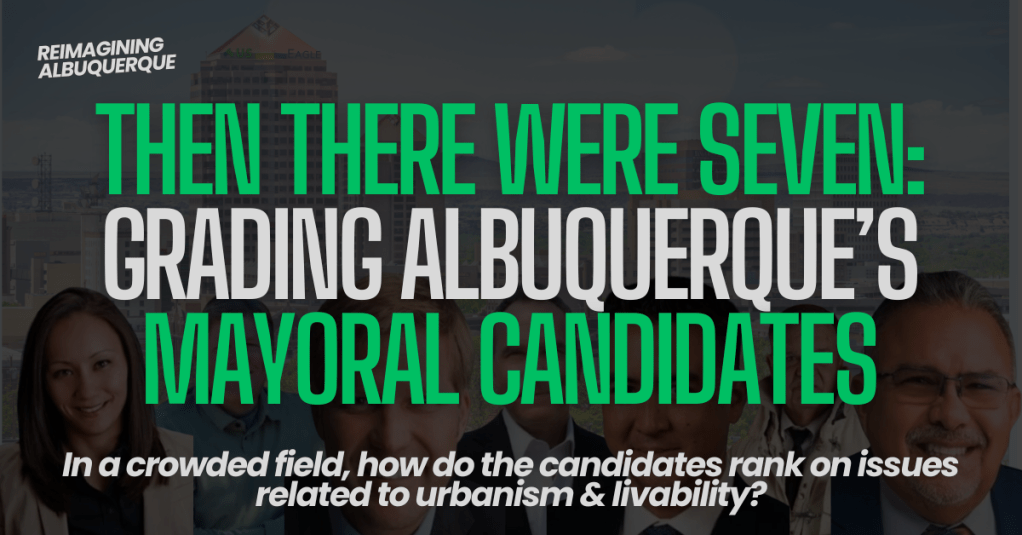
Albuquerque’s next mayor will inherit a city at a crossroads: housing shortfalls, struggling transit, and a Downtown ready for reinvention. But not all candidates are offering the same vision. From the bold structural reform of Alex Uballez to the cautious pragmatism of Tim Keller, and from the law-and-order framing of Darren White to the anti-growth record of Louie Sanchez, the field splits sharply between builders and blockers. Here’s how they stack up on housing, livability, transit, and the politics of possibility.
Why Housing Is the Election (Or should be)
In a mayoral field consumed with talk of crime, homelessness, and economic stagnation, what’s too often missing is the most fundamental truth of all: it’s the housing, stupid.
Every candidate wants to address homelessness. Every candidate talks about revitalizing Downtown or reducing crime. But too few seem to understand the structural root of these problems nor are they ready to pursue the kind of bold, systemic reforms that cities like Minneapolis, Austin, and Sacramento have shown are both possible and necessary.
The Housing Theory of Everything argues that housing isn’t just about shelter, it’s the foundation of public safety, mental health, economic mobility, and even climate resilience. When housing is scarce, people are pushed into homelessness. When it’s unaffordable, families face stress, disconnection, and impossible tradeoffs. When it’s segregated or underbuilt, entire neighborhoods wither taking businesses, transit access, and opportunity with them.
Albuquerque is living proof of this theory. Our housing shortage feeds our homelessness crisis. Our long permitting timelines, high parking minimums, and zoning codes and overlays often block the kind of infill and density that make safer, more vibrant communities. And our continued sprawl drives car-dependence, isolates residents, and strains city finances.
That’s why this election must be a housing election.
Not just a housing subsidy election. Not just a crime-and-cleanup election. But a serious reckoning with how we regulate, restrict, and delay housing in this city and what it would mean to truly unlock our land for people, not just cars and asphalt.
The cities that are thriving didn’t get there by accident. Minneapolis eliminated single-family zoning. Austin tied housing growth to abolished parking minumums, easy permits, and to new, planned transit. Sacramento is following suit, eliminating parking minimums while streamlining approvals and moving beyond single-family zoning. These cities didn’t just set the stage toward more housing they also set the table for livability, economic vitality, and better public safety. Already, dividends are beginning to show. Austin has seen rents fall over 22%, has more housing starts than any other city in the country, and because these reforms make all types of housing easier to build, it is also leading the country in capital-A affordable housing construction.
Albuquerque deserves the same.
If candidates want to lead this city, they need to show they understand this. Housing is not a side issue: it is the structure beneath everything else. And the candidates most willing to speak clearly about zoning reform, transit-oriented development, and the policies of abundance are the ones best equipped to build the safer, more prosperous Albuquerque we all want.
Alex Uballez: A-/B+
Alex Uballez is the only candidate in the race who puts zoning and land-use reform front and center in his campaign—and that alone sets him apart. While others gesture vaguely at affordability or enforcement, Uballez speaks clearly about the need to fix our broken regulatory framework, expand housing supply, and build a city where people can actually live, work, and thrive.
His “Housing for All” platform includes a slate of reforms Albuquerque urgently needs: ending exclusionary zoning, reducing minimum lot sizes, removing parking mandates, streamlining approvals, and enabling more mixed-use, transit-supportive development. He is fluent in the Housing Theory of Everything—and unlike his competitors, he understands that housing is infrastructure, and housing is connected to everything: crime, economic opportunity, climate, and health.
He’s also the only candidate talking substantively about transit. While he stops just short of calling for an expansion of the ART system, he’s clearly engaged with the system’s current weaknesses—specifically its lack of frequency and limited operating hours, which make it functionally inaccessible for many. If he can take the ABQ Ride Forward rebalancing plan and layer in real operational investment, he could help convert our skeletal transit network into a true mobility system—at least on key corridors. Pair that with strong land-use reform, and it’s possible to imagine an Albuquerque that, in 8 years, looks and feels like a different, more connected, more functional city.
Uballez also stands out for not leaning on carceral rhetoric. While many candidates rely on tough-on-crime posturing or call for a return to broken-window policing, Uballez emphasizes the role of the Community Safety Department, housing-first strategies, and community-based public safety. He doesn’t flatten homelessness into a problem of visibility or disorder. Instead, he acknowledges that solving homelessness requires long-term, systems-level change—not miracle cures.
That said, his platform isn’t without red flags (or maybe yellow flags). Most notably, his proposal for citywide inclusionary zoning (IZ) raises serious concerns. While he gestures toward public subsidies and density bonuses to offset its effects, the track record of poorly designed IZ policies in other cities is clear: they often depress housing production, raise costs, and undermine the very housing abundance his plan otherwise supports. We want to see much more detail here—and a stronger commitment to making sure IZ doesn’t sabotage private-sector development.
We also took note of Uballez’s recent City Council comments opposing an Industrial Revenue Bond for Jim Long’s Sawmill development. While skepticism of subsidies is valid, this project aligns with many of his own goals—transit-adjacent, jobs-rich, and in the urban core. The opposition sends mixed signals and highlights a tension between ideology and execution we’ll be watching closely.
Additionally, while his campaign names exclusionary zoning as a problem, some of his proposed solutions appear to focus primarily on key corridors rather than being truly citywide. We hope to see his platform expand into a more comprehensive, neighborhood-wide vision for reform.
Still, none of the other candidates have shown this combination of clarity, boldness, and fluency in the structural challenges facing Albuquerque. While others look for quick fixes to crime or homelessness, Uballez acknowledges the depth of our problems and insists on real solutions. He’s not afraid to name politically tricky issues. He lives Downtown. He wants a big, catalytic project Downtown, understanding the ecosystem and the current need to prove that investment in our most urban neighborhood is both viable and worthwhile. And he sees housing and land use as foundational—not incidental—to solving what ails the city.
Though Tim Keller shares many of these structural understandings, including an early willingness to challenge zoning orthodoxy, his incrementalism and cautious political style have too often caused him to pull back when bolder leadership is needed. That contrast may become one of the defining dynamics of this race.
Finally, we love that Uballez not only names the problem but is willing to talk about permitting and red tape—issues that have stalled infill and delayed development across the city. His simple rallying cry of “Build, build, build!” is more than a slogan—it’s a clear, unapologetic call to action that reflects the scale of the moment.
If the race remains unchanged, Uballez is the clear favorite for those who want a more abundant, more functional, more fearless Albuquerque.
- Housing: A-
- livability: A-
- Transit: B+
- Jobs: B+
Tim Keller: B
Tim Keller hasn’t taken many bold swings on housing but the direction he’s nudging the city toward could, if fully realized, reshape Albuquerque for the better. Under his administration, the city has legalized accessory dwelling units (ADUs), reduced barriers to casitas, and begun chipping away at exclusionary zoning. These are incremental reforms but they point toward a more abundant, livable Albuquerque, if Keller is ever willing to fully embrace the structural change they require.
At various points, Keller has signaled openness to abolishing single-family zoning altogether and embraced the language of housing abundance. His Housing Forward initiative moved key reforms forward, and his team has shown some understanding of the structural forces shaping housing scarcity.
But in recent years, that momentum has stalled, and Keller has grown more cautious, sometimes even absent, when it matters most.
He declined to sign O-24-69, the landmark zoning reform bill that legalized more housing near transit corridors. Though the bill became law, Keller’s silence was telling. Similarly, he did not comment on the proposed tax to fund a Downtown performance arts center, despite its potential to anchor a cultural and economic renaissance in the city’s core. These aren’t just missed PR opportunities, they’re missed chances for executive leadership.
As we wrote earlier this year, his greatest weakness is a lack of boldness and executive vision. Keller has shown he can govern but can he lead?
The opportunity to prove that may not be over. According to Downtown Albuquerque News, the Downtowner Housing Project, a 200+ unit development on city-owned land, may still be alive. If Keller can help piece together the funding and push the project over the finish line, it would go a long way toward showing that he still cares about Downtown and still understands the connection between public land, housing policy, and city vitality.
On transit, the picture is similarly mixed. Keller deserves credit for getting the ART bus rapid transit line operational. Despite early technical issues, the system is now one of the most successful BRTs in the country, with growing ridership and high service frequency. Yet Keller continues to avoid public association with ART, even as he promotes the ABQ Ride Forward plan to restructure and improve the broader system. At the start, he infamously called ART “a lemon.” He then went on to cancel studies on system expansion. And now, he remains silent on ART—its success, its high ridership, and its needs for improvements. That silence reflects the same caution we’ve seen elsewhere—a reluctance to take ownership of controversial but necessary projects.
Keller has also invested heavily in livability: parks, lighting, libraries, and the Community Safety Department have all expanded under his leadership. These efforts deserve credit and they’re a big reason why we rate his livability score highly.
But when it comes to the kind of bold, structural change Albuquerque needs—on housing, on Downtown, on transit—Keller’s track record is incremental by design. If he wins a third term, we can expect more slow progress. That’s not nothing. But it’s also not the vision Albuquerque needs to meet the scale of its challenges.
- Housing: B
- Livability: A-
- Transit: B
- Jobs: B
Mayling Armijo: C-
Mayling Armijo enters the mayoral race with a background in economic development and a message tailored toward cutting red tape for small businesses. She’s at her best when talking about how permitting delays and bureaucracy can stifle local entrepreneurship.
But when it comes to housing, that regulatory insight vanishes.
Her platform ignores Albuquerque’s housing shortage, offering no acknowledgment of the need to build more homes or reform exclusionary zoning. Instead, she focuses narrowly on shelters, supportive housing, and service expansion—important but insufficient tools that treat the symptoms of scarcity without addressing the root causes.
Even more concerning is her enforcement-first lens on public safety and homelessness. Her messaging emphasizes “cleaning up the city,” “restoring order,” and reducing “nuisance activity”—language that blurs the line between poverty and criminality. It’s a punitive approach, disconnected from the systemic failures that produce disorder in the first place.
Nowhere is this worldview more stark than in her transit and urban planning positions. Armijo supports ending the city’s fare-free transit program—not out of concern for system funding or service quality, but because she believes free fares lead to crime. There is no data to support this claim. And while experts like Jarrett Walker have raised thoughtful critiques of zero-fare models, Armijo’s reasoning reveals a deeper issue: she sees transit as a threat, not as infrastructure.
She offers no proposals for improving service frequency, hours, or reliability, and no vision for expanding access through transit-oriented development. Instead of investing in mobility, her platform treats transit as something to police.
Perhaps most revealing of all is her belief that Downtown Albuquerque needs more parking. In a city with vast amounts of underutilized surface parking—and a dire need for housing, jobs, and public life—this is a fundamental misunderstanding of how cities grow and thrive. It signals a failure to grasp basic urbanist principles: that great downtowns are built for people, not for cars. Adding more parking is not revitalization—it’s surrender.
In short, Mayling Armijo gets the red tape problem—but only when it affects business owners. When it comes to housing, mobility, or the built environment, she offers no structural reforms, no long-term thinking, and no break from the punitive policies that have failed cities for decades.
- Housing: C-
- Livability: C
- Transit: D
- Jobs: B-
Daniel Chavez: D-
Daniel Chavez entered the race with momentum. He was the first candidate to qualify for the ballot, thanks to a strong early signature drive and a self-funded campaign that helped him hit the ground running. A local business owner and lifelong Albuquerque resident, Chavez has styled himself as a no-nonsense candidate who understands what it takes to get the city “back on track.”
He speaks forcefully about crime and disorder, often framing them as existential threats to Albuquerque’s future. He pledges full support for APD, state police, and the sheriff’s office. His message is simple and direct: support law enforcement, restore order, and rebuild local pride.
But beyond those talking points, Chavez’s actual policy vision remains murky at best.
There is no housing platform—no mention of Albuquerque’s deep housing shortage, no plans to reform zoning, no recognition that the city’s permitting processes are a major barrier to infill development or affordability. Chavez talks about homelessness as a crisis and suggests job creation and enforcement as the response. But without any commitment to building more housing, supporting shelter infrastructure, or addressing land-use barriers, it’s a hollow solution. He doesn’t mention permanent supportive housing, transitional housing, or even market-rate production. It’s a crisis response with no foundation behind it.
There is also no discussion of transit or mobility. While other candidates at least acknowledge that Albuquerque’s bus system is underperforming or that ART has become a backbone for high-frequency service, Chavez has said nothing about public transportation, frequency, service hours, or capital investment. We’re still waiting to hear whether he supports ABQ Ride Forward, how he views the role of transit in economic growth, or if he even sees transit as part of the city’s future at all.
Similarly, there’s no strategy for Downtown investment or revitalization. While Chavez references crime and economic decline in the urban core, there’s no indication that he sees zoning, housing, arts, or public infrastructure as tools to bring it back. He hasn’t weighed in on projects like the Rail Trail, the proposed Downtown performance arts center, or the use of city-owned land for housing. We’re left wondering: What does “rebuilding Albuquerque” mean in practice, beyond stronger policing?
He also hasn’t spoken to livability, walkability, or how to make neighborhoods work better for people. There’s no mention of parks, lighting, placemaking, or community infrastructure. No engagement with the systems that shape opportunity—just a promise to bring “order” and “support businesses.”
That said, Chavez has a strong brand and message discipline. He has emphasized pride, order, and returning the city to a place residents feel good about. But as of now, that message is all framing and no structure. There’s still time for him to build out his vision—but without a housing agenda, without land-use reform, and without a mobility strategy, his campaign so far lacks the tools to deliver on its promises.
- Housing: ?
- Livability: C
- Transit: ?
- Jobs: C
Darren White: F
Darren White’s mayoral campaign is built on a single message: enforcement first. From his website to public appearances, White focuses almost exclusively on crime, disorder, and a return to punitive responses to homelessness and poverty. But what’s missing is just as important as what’s said.
There is no housing plan. No mention of Albuquerque’s housing shortage, no proposals for building more homes, legalizing ADUs, or reforming exclusionary zoning. There is no transit policy, no nod to infrastructure investment, or even acknowledgement that our city’s design patterns shape the very public safety challenges he wants to solve.
His campaign rollout made this approach unmistakably clear. His introductory video was filmed as he walked through an encampment—using the visible suffering of unhoused residents as a backdrop to frame his candidacy. It was a choice both calculated and callous, reflecting a worldview that treats people experiencing homelessness as a political prop, not as human beings in need of housing, services, or compassion.
White’s plan frames homelessness almost entirely as a law enforcement problem. He pledges to end safe outdoor spaces, prioritize removal over services, and enforce laws “on day one.” There is no mention of permanent housing solutions or systemic reform—and certainly no acknowledgment that our housing shortage is a policy failure, not a policing problem.
He also offers no livability agenda. No vision for placemaking, walkability, or community design. No understanding of how zoning, permitting, or investment in public space could shape a safer, more inclusive city. His vision of Downtown isn’t one of vibrancy—it’s one of vacancy, surveillance, and displacement.
Outside of the categories we use to evaluate urbanist alignment—housing, transit, jobs, and livability—we find the broader implications of a Darren White administration deeply troubling. His career in law enforcement has been marked by militarized approaches, opposition to oversight, and consistent alignment with carceral, anti-poor policies. His likely dismantling of the Community Safety Department and rollbacks of public health–oriented responses would represent a serious step backward for Albuquerque.
In a time when the city needs healing, housing, and structural investment, Darren White offers a crackdown. His approach is not just hostile to urbanist values—it’s hostile to basic human rights.
- Housing: F
- Livability: F
- Transit: F
- Jobs: D
Eddie Varela: F
Eddie Varela’s campaign is rooted in his identity as a retired firefighter and city worker—a familiar, working-class image backed by promises to restore order, support city employees, and “take the city back.” But beneath that narrative is a platform that is almost entirely focused on enforcement, with no meaningful engagement on the structural challenges Albuquerque actually faces.
On housing, Varela offers nothing. His campaign materials and public statements make no mention of zoning reform, ADUs, permitting barriers, or the city’s housing shortage. There’s no recognition that scarcity, regulatory dysfunction, and underbuilding are driving homelessness and displacement. His approach assumes the problem is behavioral, not systemic, and proposes to fix it with citations and curfews.
On homelessness, Varela leans hard into a carceral mindset. He proposes youth curfews, increased citations, and rapid enforcement to “clean up” the city. Like others in the field, he conflates homelessness with criminality, offering no mention of permanent supportive housing, shelter infrastructure, or service expansion. There is no plan to address the root causes—just a promise to enforce against the symptoms.
His vision for Downtown, public space, or community design is nonexistent. He never mentions transit, walkability, or public investment beyond policing. Livability is framed almost entirely in terms of control, not inclusion. He promises to support businesses and city workers, but his economic strategy begins and ends with policing and bureaucracy reduction—not investment, housing, or job access.
Outside of his law enforcement priorities, Varela’s campaign includes opposition to public campaign financing, a move that signals skepticism of civic reform but offers little in the way of alternatives. His platform reflects a deeply reactionary mindset—a desire to reset Albuquerque to some imagined prior order, not to build a better, more resilient future.
Ultimately, Eddie Varela has no housing agenda, no land-use vision, and no policy framework to address the root causes of Albuquerque’s intersecting crises. His enforcement-first approach may appeal to frustration, but it leaves nothing behind to build from.
- Housing: F
- Livability: D
- Transit: F
- Jobs: D
Louie Sanchez: F
As a sitting city councilor, Louie Sanchez has already had the chance to shape Albuquerque’s future—and at every critical juncture, he’s chosen obstruction over progress. His record and rhetoric both reflect a platform rooted in enforcement, resistance to change, and a deep skepticism of structural reform. When it comes to housing, land use, and transit, his vision is either absent or actively regressive.
Sanchez was one of only two councilors to vote against O-24-69, the landmark zoning reform that legalized more housing along transit corridors. Despite overwhelming evidence that Albuquerque faces a housing shortage, he sided with status-quo voices defending exclusionary zoning. His vote didn’t just oppose technical provisions—it rejected the principle that Albuquerque should grow up, not out.
On transit, Sanchez has similarly aligned himself with anti-urbanist politics. He has expressed skepticism of the ART system and broader transit investment, often framing transit in opposition to public safety—rather than as a tool for economic mobility, access, and sustainability. His platform contains no proposals to expand or improve service, no acknowledgment of ABQ Ride Forward, and no vision for multimodal infrastructure. In a city where transit is critical to opportunity, Sanchez offers no plan.
His homelessness approach is rooted in surveillance and removal. Like others in the race, he conflates public disorder with criminality and offers no structural proposals to expand housing, improve shelter access, or invest in upstream services. His language centers on “cleaning up” neighborhoods and “enforcing laws,” not addressing the conditions that produce homelessness in the first place.
Worse, he’s among the loudest voices calling for an end to fare-free transit—not out of operational concern, but because he views free bus access as a public safety risk. There is no evidence to support this claim, and it reflects a dangerous willingness to stigmatize transit users, particularly unhoused people.
When it comes to Downtown, zoning, and city planning, Sanchez has shown no interest in legalizing more housing, streamlining permitting, or supporting density. Instead, he continues to defend a reactive, car-centric, and exclusionary status quo.
For a city in need of structural change, Louie Sanchez offers only a retreat.
- Housing: F
- Livability: D
- Transit: D
- Jobs: D
Recommendations: What We Hope to See Next
This is a critical election—and there’s still time for candidates to rise to the moment. Whether you’re leading the field or trailing in the polls, the question remains the same: can you offer more than just a message? Can you bring the structural thinking this city needs?
Here’s what we hope to see from each candidate going forward:
Alex Uballez
You’re setting the pace. But great ideas need follow-through. We’d love to see more detail on implementation: How exactly will you fund and structure your proposed inclusionary zoning policies? How will you ensure they don’t backfire by suppressing badly needed development? And how will you expand your zoning reforms beyond corridors to make sure change is felt citywide? This is a strong foundation—now build on it.
Key recommendation: Deepen your policy specifics. Address the tradeoffs and show how you’ll turn bold rhetoric into executable change.
Tim Keller
You understand the issues. You’ve moved the city incrementally in the right direction. But now is not the time to be cautious. We want to see you own a vision again—fight for Downtown, fight for housing, fight for a big project that matters. The bones are there. What’s missing is urgency.
Key recommendation: Be bold. Say what you believe and show us you’ll lead, not just govern.
Mayling Armijo
You clearly understand the pain points of small business. That insight could translate into real systems reform if you’re willing to see how red tape also holds back housing, transit, and public life. Right now, your message stops at cleanup and control. It doesn’t have to. Talk about building again. Talk about systems. And reconsider the framing of public safety—crime and disorder are symptoms, not the disease.
Key recommendation: Expand your lens. If you understand business ecosystems, apply that logic to the housing ecosystem too.
Daniel Chavez
The brand is clear, but the platform is still missing. You were first to qualify. You bring real energy. Now show us the depth. What’s your take on zoning? Do you believe in transit? What’s your Downtown vision? Right now, your campaign is all posture, no plan. That can change—but time is running out.
Key recommendation: Fill in the blanks. Say something—anything—about housing, transit, and the structures that shape the city.
Eddie Varela
You’ve served this city. You know how systems break down under stress. So bring that knowledge into your housing and safety agenda. You talk about curfews and citations. But you know—better than most—that the best fire is the one you never have to fight. What if we designed a city where fewer people fell through the cracks to begin with?
Key recommendation: Move from reaction to prevention. Build systems that work so enforcement becomes the exception, not the rule.
Darren White
You’ve made a career in public safety. But safety without humanity is just control. Your launch video used unhoused people as scenery. Your plan centers punishment, not healing. Albuquerque deserves better. Start by acknowledging that people are not problems to be removed—they are citizens to be served.
Key recommendation: Embrace a human-centered lens. Shift from enforcement to opportunity.
Louie Sanchez
You’ve had a chance to lead—and you often chose to obstruct. But every leader has the chance to grow. If you want to be mayor, show us how your thinking has evolved. Acknowledge that your vote against O-24-69 was a mistake. Lay out a different path. Tell us what you’ve learned, and how you’ll govern differently than you did on council.
Key recommendation: Show growth. Own your record and explain how being mayor would change your approach.
Further Reading and a Final Hope for This Election
If you’re new to these ideas or want to dig deeper into the thinking that connects housing to everything from climate to justice to opportunity—here are a few essential reads:
- “Abundance” by Ezra Klein & Derek Thompson
A powerful essay (and podcast episode) about how American progress is held back not by bad ideas, but by our inability to build. The authors explore why we must “do things” again—from housing to transit to green energy—and how systemic inertia and veto points are stifling our future. - “On the Housing Crisis” by Jerusalem Demsas
In this searing piece for The Atlantic, Demsas dismantles the myths and political evasions that prevent real housing reform. She challenges both the left and right to stop pretending scarcity is neutral and to stop hiding behind proceduralism, fake localism, or aesthetic fears. - “The Housing Theory of Everything” by Sam Bowman & John Myers & Ben Southwood
This is the essay that names what so many candidates seem to miss: that housing isn’t just about shelter, it’s the structure underneath everything we care about. From wages to fertility rates to public health to inequality, the cost of housing touches it all. - “The High Cost of Free Parking” by Donald Shoup
This is the book that uncovers the hidden force shaping our cities: parking. Shoup shows how our obsession with “free” parking isn’t free at all; it drives up housing costs, worsens traffic, hollows out Downtowns, and locks us into car dependence. If candidates want to understand why so much of Albuquerque feels broken, and how to fix it, they need to start with the asphalt beneath our feet.
We hope this election becomes defined by that theory; by the idea that legalizing homes and lowering housing costs is the most immediate, most effective, and most inclusive way to improve life in Albuquerque.
When housing is abundant, rents stabilize. When rents fall, it feels like a raise in your pocket. When people can live where opportunity is, everything works better: transit, jobs, families, neighborhoods, climate, even public safety.
We don’t need a miracle, we need permission: Permission to build, permission to grow, permission to reimagine a city that works for everyone, not just the lucky few who got in before the ladder was pulled up.
Let’s make this the Housing Election Albuquerque finally deserves.
 Reimagining Albuquerque
Leave a comment