In 2018, Mayor Tim Keller called Albuquerque Rapid Transit (ART) a “bit of a lemon1.”
Today, with over 10 million rides logged and more than $800 million in new development permits issued along the corridor, it’s clear that ART is no lemon2. It’s a lifeline. And it may just be the most important investment in Albuquerque’s future that nobody is talking about.
It wasn’t always obvious. ART’s first years were rocky: legal challenges, faulty buses, construction impacts, and political backlash. But what has emerged is a Gold-Standard bus rapid transit (BRT) system—one that connects neighborhoods, calms traffic, saves lives, and catalyzes walkable development in the heart of the city.
As Albuquerque faces stagnant growth, high car dependence, and a hollowed-out core, ART offers a glimpse of a better model: one where we grow up, not just out; where we connect people to opportunity instead of pushing them further apart.
And if we let it, ART can be the foundation for a more connected, more prosperous, and more resilient Albuquerque.
Rebuilding the Case for ART
To understand what ART is accomplishing, we have to begin with what it replaced.
The old Rapid Ride lines on Central looked fast but weren’t. They lacked dedicated lanes, signal priority, and level boarding. Buses bunched, ran late, and crawled through congestion. During peak times, stops like UNM and Alvarado saw massive delays, long boarding lines, and inconsistent service.
In 2011, the City of Albuquerque began studying how to modernize Central Avenue transit. At the time, Rapid Ride buses were already overburdened—delayed by congestion, slow boarding, and inconsistent headways. Though “rapid” in name, the system fell short of actual rapid transit.
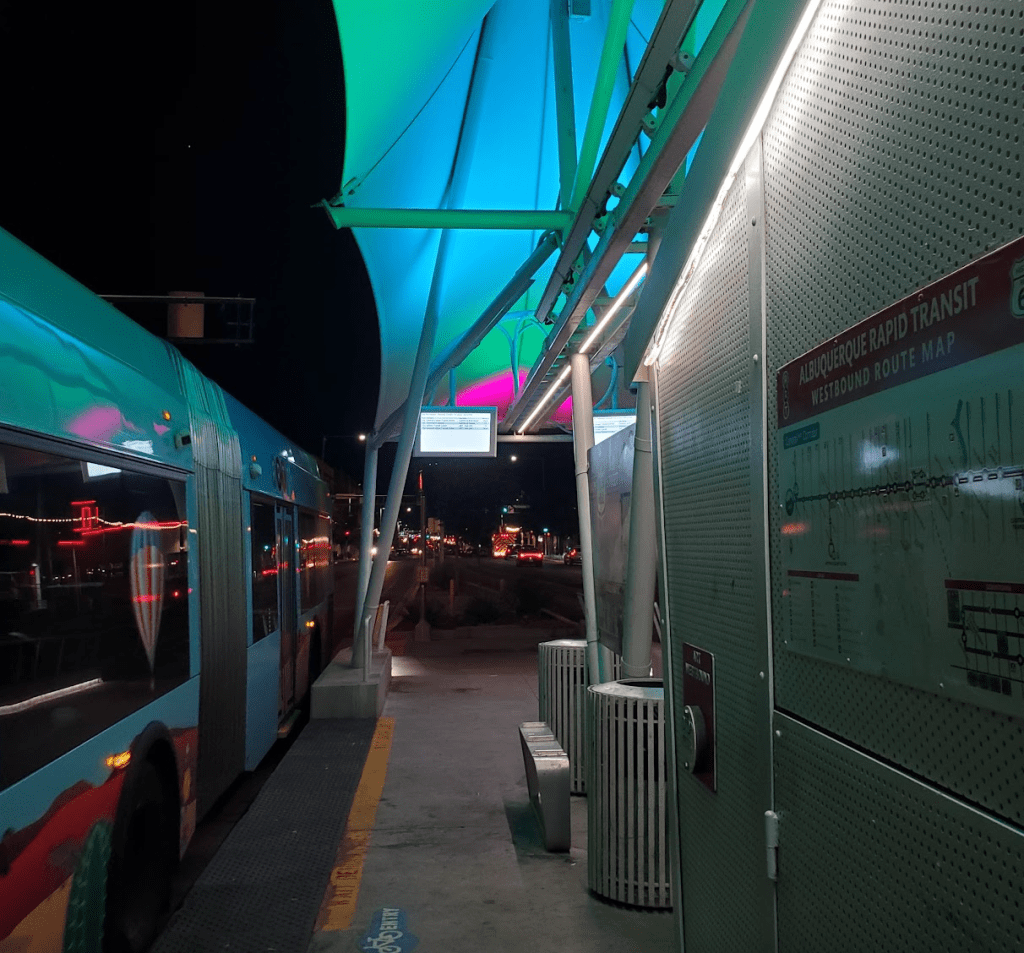
ART emerged as a solution grounded in global best practices: center-running bus lanes, level boarding platforms, off-board fare collection, and signal priority. The vision wasn’t just to improve transit, it was to redesign Central itself into a safer, more vibrant, and more development-ready corridor. Despite political controversy and lawsuits, the city pushed forward, breaking ground in 2016 with a bold goal: create the country’s first Gold-Standard BRT in a midsize city.
That investment, once ridiculed, is now proving its worth.
ART was designed to solve those problems—and it has. By building dedicated center-running lanes, off-board fare payment, and level boarding platforms, ART reduced delays, improved reliability, and boosted accessibility for wheelchair users and families with strollers.
Even more importantly, ART changed the way Central Avenue works. Car lanes were narrowed. Left turns were restricted. Crossings became safer. Buses got signal priority. Pedestrians gained shade, sidewalks, and HAWK signals.
This wasn’t just a transit upgrade. It was a corridor redesign. And it paid off.
Safer Streets, Stronger Corridors
According to UNM professor Nicholas Ferenchak, serious and fatal injuries on Central Avenue declined by 65% after ART3. This wasn’t a coincidence. It was design.
The combination of slower vehicle speeds, protected crossings, and better lighting created safer streets for everyone. And unlike many safety interventions that privilege wealthier neighborhoods, ART brought those changes to a diverse set of communities: West Central, Barelas, Downtown, the International District, and Nob Hill.
Some critics still argue ART should have been built on Lomas or another arterial, but Central Avenue was no accident. It already carried the city’s highest ridership, cut across its densest neighborhoods, and connected cultural, educational, and economic hubs. The goal was clear: put rapid transit where it would help the most people, and where it could shape the most future growth.
These improvements are especially meaningful for residents who walk, bike, or use mobility aids—many of whom live in lower-income or immigrant-heavy neighborhoods. In this way, ART is a model of how infrastructure can serve equity, not just efficiency.
A National Standout
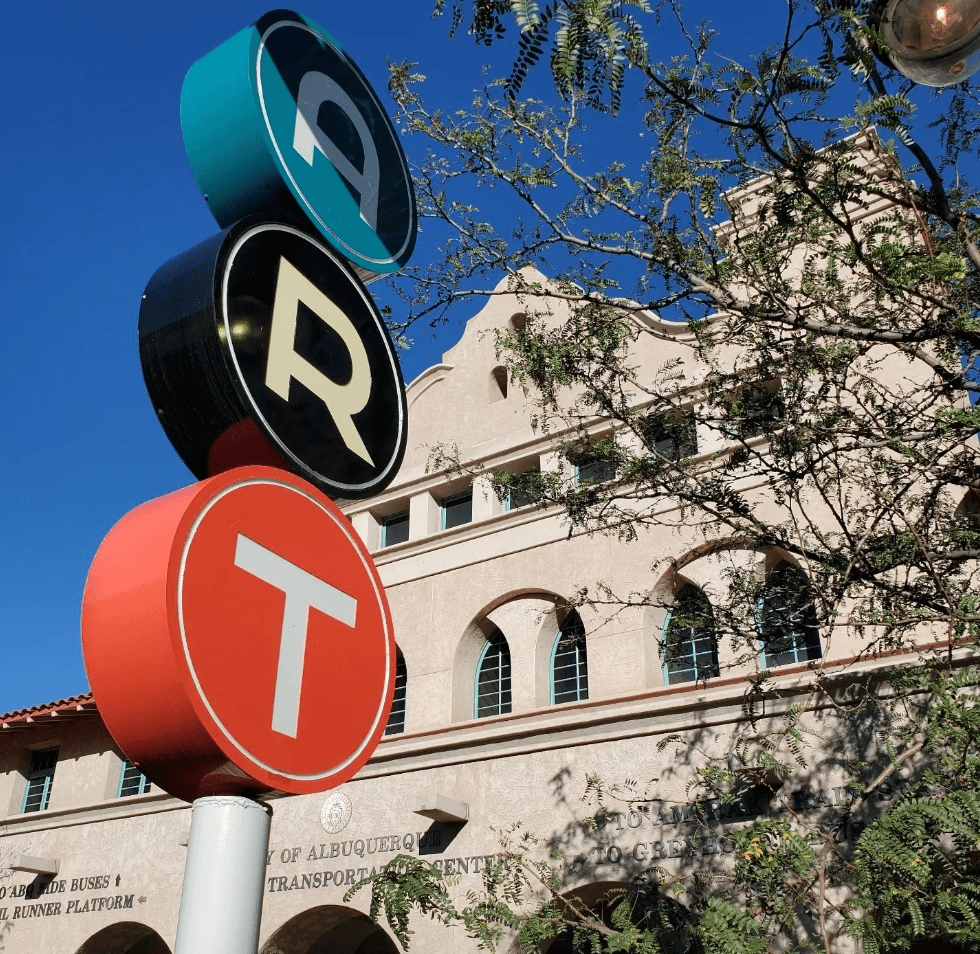
ART now delivers over 2 million rides a year and accounts for about 30% of the city’s total ridership. In the first half of 2025 alone, ART surpassed 1 million rides. That makes it the 6th busiest BRT in the country, ahead of systems in Cleveland, Richmond, and Indianapolis—all while operating in a city with fewer than a million people.
These numbers are especially impressive given that Albuquerque has cut service across much of its bus network due to staffing shortages. Despite those cuts, ART’s ridership has not only recovered from the pandemic—it’s thriving.
And it’s doing so without relying on downtown office workers. Unlike some BRT systems, ART connects to hospitals, universities, schools, hotels, nightlife, and dense housing—making it a more resilient backbone for a post-COVID city.
The Value of Zoning for Transit
Opponents of recent zoning changes—like the ones proposed for the Menaul corridor—often argue that you don’t need to change land use to improve transit.
But ART tells a different story.
Before ART was built, the City passed reforms in 2016 to legalize more mixed-use, higher-density development along Central. The result? Since ART launched, the city has issued more than $800 million in new construction and renovation permits within half a mile of the corridor. That’s nearly three times the value captured elsewhere in the city. Recent changes such as O-24-69 will help leverage these investments further.
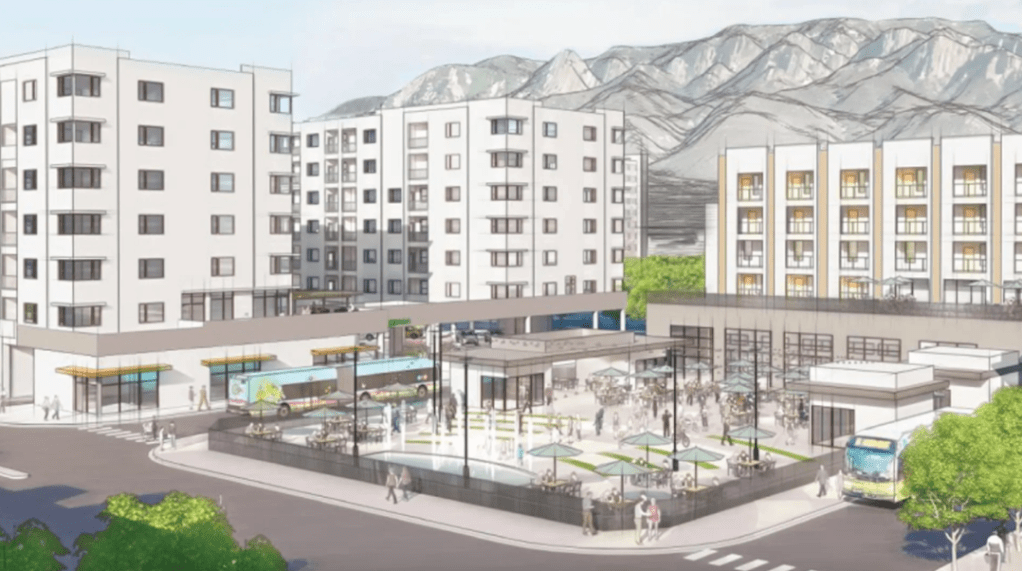
Projects like Broadstone Nob Hill, Hiland Plaza, and the upcoming Uptown Transit Center redevelopment are directly tied to ART’s presence. Without legalizing more housing and mixed-use development along the corridor, that momentum wouldn’t have materialized.
So yes: zoning matters. Transit alone won’t fix our city. But when you pair high-quality transit with land use reform, the result is powerful.
A 24-Hour Economy Needs 24-Hour Transit
If the city is serious about revitalizing nightlife, supporting shift workers, and promoting a 24-hour economy, it’s time to extend ART’s hours.
Many of Albuquerque’s largest employers operate around the clock: hospitals, hotels, restaurants, and UNM. ART already connects these job centers. But without late-night service, many workers—especially low-income workers—are forced to rely on expensive Ubers, buy a car, or face unsafe walks.
Late-night ART could also reduce drunk driving, make nightlife more accessible, and support local businesses. It’s a low-cost way to expand the benefits of a system we’ve already built.
What’s Next: Expansion, Not Stagnation
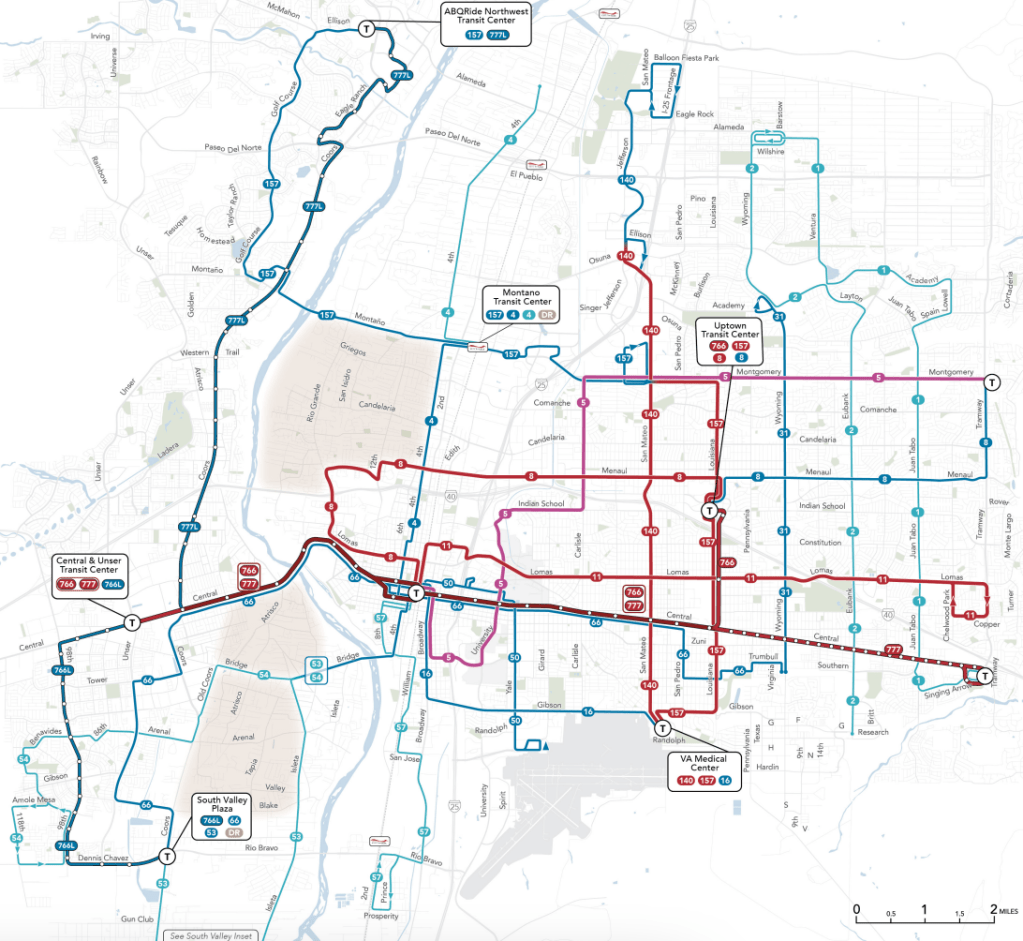
Right now, the city plans to expand ART service west to Cottonwood Mall and south to Coors and Rio Bravo without any new infrastructure. That’s a good start.
But we shouldn’t stop there. Albuquerque deserves a full ART network. Imagine ART service to:
- Journal Center
- The Sunport
- Montgomery corridor
- North 4th Street
These corridors already have major job centers or untapped development potential. Extending ART could catalyze new housing, reduce cross-town car trips, and connect more people to opportunity.
Paired with smart zoning reforms and continued pedestrian investments, ART expansion could seed new urban villages throughout the metro area. We’re already seeing it in Uptown. Cottonwood and Mesa del Sol could be next.
Urban Villages on the Horizon
As ART expands to the Westside—toward Cottonwood Mall, Coors, and Rio Bravo—the potential is not just for better transit access, but for reimagining how we grow altogether.
With the right land use and planning tools, these extensions can catalyze the creation of urban villages: compact, mixed-use districts where housing, jobs, retail, and amenities are all reachable without a car. Albuquerque is already seeing this in Uptown, where new apartment buildings, hotels, and infill development are gradually transforming the area into a true urban center. If the Winrock Town Center project fulfills its promise and the Uptown Transit Center is rebuilt as planned, we’ll have a blueprint for what’s possible.
The Cottonwood Mall area could be next. This Westside crossroads connects neighborhoods from Coors to Corrales and sits near schools, employers, and the Southwest Indian Polytechnic Institute. But today, it’s dominated by parking lots and car-only access. A reimagined ART Green Line (or Blue Line, should ABQ Ride resurrect it) could transform this into a dense, transit-served hub—reducing cross-river commutes and anchoring the Westside with new jobs, homes, and services.
Currently, ABQ Ride plans to extend ART service to these areas without any new construction4. That’s a pragmatic start—but long-term, these routes deserve more. By retrofitting key intersections with queue jumps, signal preemption, and pedestrian-friendly infrastructure, as well as building level-boarding stations modeled after those on Central, we can improve speed, reliability, and accessibility.
Pair that with targeted zoning reforms and planning for true transit-oriented development, and the Westside can become both more resilient and more sustainable—without needing to rely on costly car-centric expansion. These kinds of improvements also allow ART to remain budget-neutral through increased ridership and value capture from adjacent development.
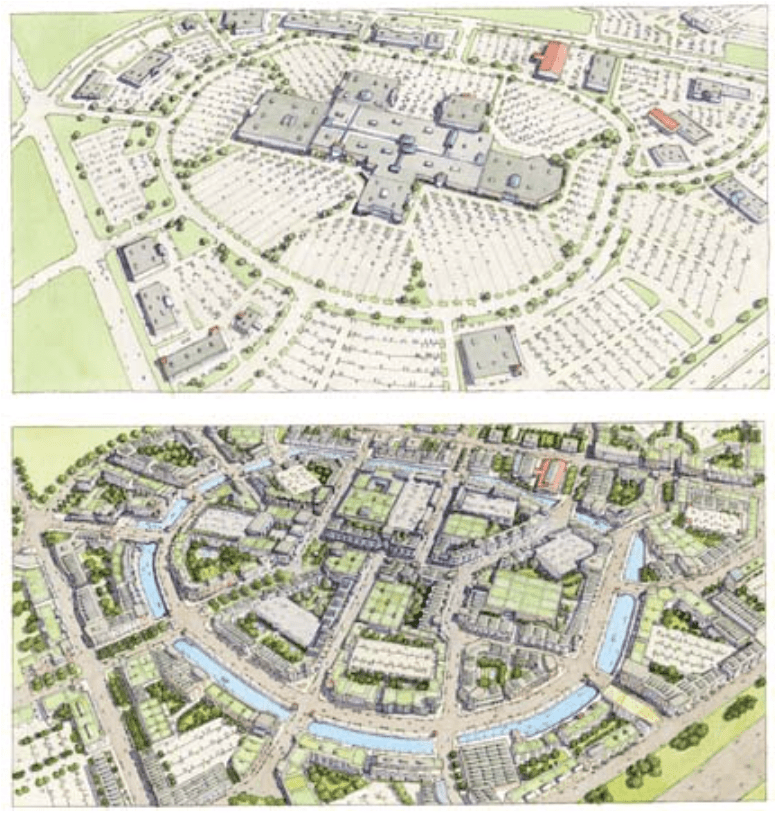
The images found in tools like the Sprawl Repair Manual5 show how auto-oriented commercial zones can be remade into people-oriented places. With strategic investments, zoning reforms, and corridor-level planning, Albuquerque can seed these urban villages across the metro—each connected by high-quality rapid transit.
A well-planned ART network doesn’t just move people. It helps us imagine a different kind of city—where every part of town can grow stronger, walkable, and more self-sustaining.
Regional Transit, Local Impact
As Rail Runner service improves over the next decade, Albuquerque will become even more important as a regional hub. ART can help close the gap between rail stations and jobs, services, and hospitals throughout the city.
For rural and suburban New Mexicans traveling to Albuquerque for care, education, or work, an expanded ART network could reduce costs, stress, and car dependence. It could also ease I-25 congestion and cut emissions.
Good transit inside the city enables better transit to the city. ART can be the backbone of that vision.
We don’t have to look far for models. Salt Lake City is already pairing frequent, bi-directional, all-day service on its FrontRunner regional rail line with improved connections to TRAX light rail, creating a seamless, multimodal network that serves both local and regional travel. As ABQ Ride Forward begins upgrading local bus frequency and reliability within the city, we have the chance to build something similar.
And crucially, we can do it for far less than what we currently spend on highway expansion. Just one I-25 interchange project now costs more than the entire construction budget for ART. Yet for that single road upgrade, we get more traffic, more pollution, and more barriers between neighborhoods. With ART, we’ve already seen the opposite: reduced crashes, increased development, and improved mobility.
Investing in regional rail, high-frequency buses, and smart land use isn’t just the affordable choice: it’s the value-maximizing one. These systems connect our region without cutting it apart with 250-foot-wide rights-of-way. They serve the people most dependent on public infrastructure, while benefiting everyone with cleaner air, lower costs, and stronger economic connections.
A stronger Rail Runner and ART network isn’t a luxury. It’s a smarter future—one we can afford to build, and one we can’t afford to ignore.
ART Is Just the Beginning
ART works. It moves people, saves lives, and drives development. It reimagines what Albuquerque can be.
But ART should be seen not as a finished product, but as a launchpad. With continued investment, smart land use decisions, and a vision for expansion, ART can help Albuquerque reverse decades of sprawl, stagnation, and auto-dependence.
ART’s success is worth celebrating but it’s not the end of the story. While ART ridership has rebounded and even surpassed pre-COVID levels, ABQ Ride as a whole still hasn’t recovered. Nor has the system come close to matching the ridership peaks it saw between 2010 and 2013—even with the introduction of free fares in 2022.
If Mayor Keller and other city leaders are beginning to come around on ART, that’s a good sign. It shows that attitudes are changing, and that the city is starting to understand the return on investment transit can deliver. But recognizing the value is only the first step.
To truly build on ART’s success, we need to:
- Extend operating hours to support a 24-hour economy.
- Implement ABQ Ride Forward to strengthen the entire transit network with more frequent, legible service.
- Invest in additional ART corridors to bring rapid, high-quality service to more of the city.
- Pair transit investments with zoning and land use reform so that people can live, work, and shop near transit.
- Explore bold policy tools, like congestion pricing or tolling on major highways, to both fund transit and encourage mode shift—just as cities like New York, Stockholm, and Singapore have done successfully. These aren’t the only places considering this, either. The entire state of Indiana has now moved toward tolling its interstates.
We’ve seen what one well-designed transit corridor can do. It’s time to apply those lessons citywide and give Albuquerque the connected, resilient, and affordable future it deserves.


 Reimagining Albuquerque
Leave a comment