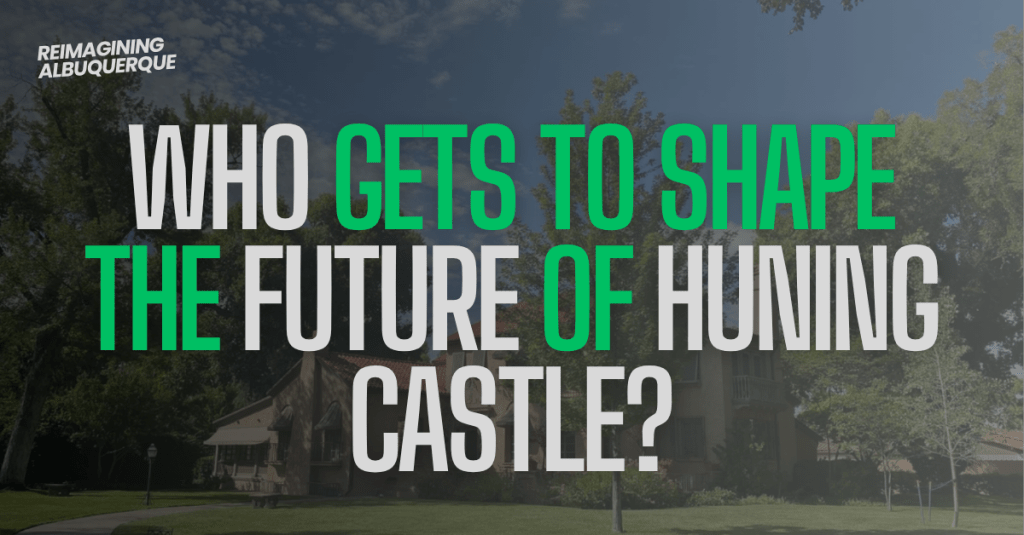
Huning Castle, a country-club-adjacent neighborhood, is pushing for a “small area” designation; one of the many tools historically used to keep out new neighbors.
The Huning Castle Neighborhood Association says this is about aesthetics. Maybe charm. Maybe “neighborhood character.” But beneath the quiet streets and red-tile roofs is a familiar story—one that reaches back more than a century to the roots of American zoning. In the wake of O-24-69, the city’s new law to allow more housing near transit and along major corridors, Huning Castle is pursuing a “small area” plan. It would reduce building heights from 30 to 26 feet and expand setbacks. That might sound technical, but the result is clear: it makes it much harder to build housing—especially the kind Albuquerque needs most.
What we’re witnessing isn’t new. As Neighborhood Defenders1 documents, zoning in America has always carried the fingerprints of exclusion. When the Supreme Court struck down race-based zoning ordinances in Buchanan v. Warley (1917), cities didn’t abandon segregation—they adapted. Birmingham’s 1925 ordinance sought to “restrict the negroes to certain districts” under the guise of protecting property values and shielding homeowners from “promiscuously” located grocery stores and manufacturing plants. Atlanta’s rewritten code pursued what planners called “controlled segregation,” this time without naming race at all.
The federal government encouraged the pivot. In the 1920s, Herbert Hoover’s Commerce Department launched a national campaign urging cities to adopt zoning ordinances that would keep “low-income families out of middle-class neighborhoods”—a euphemism for maintaining both racial and economic exclusion (Einstein et al., 2019, p. 40; Nodjimbadem, 2017). These weren’t fringe ideas. They were embedded in federal planning models.
When challenged, the Supreme Court upheld economic zoning. Justice George Sutherland wrote that “very often the apartment house is a mere parasite, constructed in order to take advantage of the open spaces and attractive surroundings created by the residential character of the district.” He went further, describing apartments as “very near to… nuisances” (Rothstein, 2017, pp. 52–53).
That language—parasite, nuisance—was never just about buildings. It was about people, and similarly, words like vibe and character play the same role. The people seen as intrusions in neighborhoods designed to exclude them.
That legacy lives on. Minimum lot sizes, height caps, and setback requirements remain tools of exclusion. And that’s exactly what Huning Castle is now trying to deploy. Their proposal would shrink the legal building envelope—from 30 feet to 26. That seemingly small change makes it nearly impossible to construct the kinds of small-scale multifamily homes Albuquerque needs most: triplexes, fourplexes, stacked flats.
The neighborhood association says they’re not trying to block growth. Regardless of stated intent, the effect is the same: making new housing infeasible in one of the city’s wealthiest, most transit-accessible, and resource-rich areas.
At a public meeting on July 2, Diane Souder put it plainly. The goal, she said, was to “safeguard the single-family vibe” of the neighborhood2. That phrase—“vibe,” “character,” “balance”—might sound innocuous. But as Neighborhood Defenders notes, these softened terms are part of a modern vocabulary of exclusion. They avoid explicit opposition while achieving the same result: stopping housing through procedure, delay, and design.
Historic preservation has also become a key tool in this conversation. In Stuck3, writer Yoni Appelbaum traces how historic districts—once rare—expanded rapidly during the late 20th century. In Charleston, South Carolina, preservationists created a historic district in 1931 explicitly to restore the city’s antebellum look. Over the following decades, officials used zoning and eminent domain to remove Black residents and preserve a curated version of the past. In modern cities, preservation has often been used less to honor meaningful history and more to resist change. In Washington, D.C., an entire neighborhood, including a 1930s strip mall parking lot, was landmarked to stop a new building above a Metro station. In Manhattan, where over a fifth of the borough is labelled a historic zone, when a neighborhood is declared historic, new construction drops by roughly 20%.
These efforts aren’t rooted in a love of the past so much as in fear of the future. They are about fixing a neighborhood in place, holding change at arm’s length, and deciding who gets to live close to opportunity.
Huning Castle isn’t applying for historic designation—yet—but it’s drawing from the same playbook: using legal mechanisms to freeze a neighborhood in time. As Appelbaum notes, when affluent neighborhoods are well-organized, they can exert enormous influence over land use decisions. What matters isn’t always a building’s architectural value, but how strongly its neighbors oppose change.
And the impact doesn’t stay local. When high-opportunity areas block housing, the pressure doesn’t go away, it gets redirected. Appelbaum documents how, in Los Angeles, wealthier neighborhoods succeeded in downzoning, while working-class areas without the same political capital were upzoned. Development still happened—it just happened elsewhere. The consequences fell hardest on those least able to shape the process.
The same risk exists here. If Huning Castle opts out, it sends a message that participation in the city’s housing vision is optional for the well-off and that the burden of growth, of housing new generations, of meeting our own affordability goals, should fall elsewhere.
That’s not good planning. That’s not equity. That’s not sustainable.
Preservation has its place. So does growth. Albuquerque has a chance to get both right—by welcoming new neighbors, by making room in places with access to transit and opportunity, and by building a future that includes everyone. The council has already taken a bold step with O-24-69. It’s time to hold the line. Those who speak out against displacement should focus here: where restrictive zoning quietly preserves privilege at the expense of everyone else.
The future of Huning Castle—and the future of Albuquerque—should be shaped by more than fear. It should be shaped by possibility.
- Neighborhood Defenders: Participatory Politics and America’s Housing Crisis, Katherine Levine Einstein, Boston University, David M. Glick, Boston University, Maxwell Palmer, Boston University ↩︎
- Downtown Albuquerque News, July 15th, 2025 ↩︎
- Stuck: How the Privileged and the Propertied Broke the Engine of American Opportunity, Yoni Appelbaum ↩︎
 Reimagining Albuquerque
Leave a comment