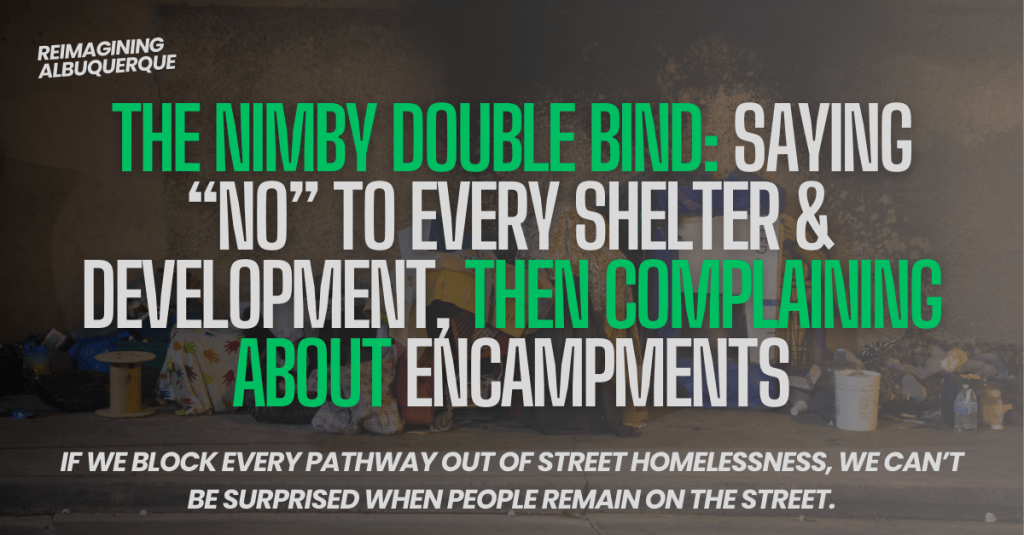
If we block every pathway out of street homelessness, we can’t be surprised when people remain on the street.
On a hot August afternoon, you can smell the asphalt on Second Street before you hear the traffic through Wells Park. A cluster of tents huddles in the thin strip of shade beside a chain-link fence. Across the street, a shuttered storefront stares back, its windows boarded over for years. This is the point in the conversation when someone will say the city has “failed.”
In city after city, the conversation about homelessness repeats itself. Encampments spark outrage. A proposal for a shelter, a sanctioned camping area, zoning reform, or affordable housing draws even louder objections. The plan is delayed, watered down, or killed. The cycle continues.
Albuquerque has been stuck in this loop for years. A recurring fight is over safe outdoor spaces: small, managed encampments run by nonprofits, churches, or community groups with sanitation, rules, and access to services.
When these sites were first proposed, opponents warned they would become magnets for crime. The Council responded by creating onerous requirements on safe spaces. Now, with only one site operating in the entire city, many of the same voices point to street encampments as proof the city’s approach is failing, as the Council begins to reconsider some of the regulations they previously imposed.
This is the double bind: reject every available tool, then condemn the results of having no tools left.
“We can’t have encampments, but we also can’t have…”
The record is clear:
- Emergency shelters have been fought in almost every proposed location.
- Permanent supportive housing has been fought, often with appeals and lawsuits.
- Hotel conversions for housing have been fought as a “threat to neighborhood character.” Some well-meaning opponents have even said these conversions are sub-par and those that they serve deserve better, as if no housing is better than imperfect housing.
- Zoning reform that would legalize more housing types citywide has been fought, especially ending R-1 single-family exclusivity.
- Mixed-use buildings (homes over small businesses) are still illegal in most of the city because R-1 zoning blocks them, and opposition keeps it that way.
- Safe outdoor spaces have been fought as “mini-encampments,” even when they are managed and safer than the alternatives.
The through line is consistent: anything that changes the current landscape is treated as a threat, whether it’s a duplex on the next block or a shelter that might house people currently living, and dying, outside.
Denying the housing shortage
Many of the same opponents insist Albuquerque doesn’t have a housing crisis at all. They frame homelessness as only a matter of personal responsibility or service refusal.
At a recent zoning meeting, a man in a golf shirt told the council the problem wasn’t housing, it was “accountability.” He said this as if the numbers — the vacancy rate, the rising rents, the record-high count of people without homes — were just another opinion to be weighed.
The numbers tell a different story:
- 2,740 people experiencing homelessness in Albuquerque in 2024, the most ever recorded.
- A 20.5 percent jump in statewide homelessness from the year before.
- Rents that have outpaced wages for more than a decade.
- Low vacancy rates that make it harder to find any home, let alone an affordable one.
And “refusing services” often means refusing shelters that are unsafe, overcrowded, split families, or won’t allow pets or possessions. Without other options, people remain outside.
…and Blaming the Investors
A familiar argument among critics blames the housing shortage on big investment firms—claiming they “buy up homes, worsen the shortage, and push prices up.” It has a certain appeal: blaming a faceless Wall Street giant is more satisfying than unpacking the real, sticky problem—our own refusal to build. It is easier, of course, to point at BlackRock than to admit you’d fight the duplex someone else might build next door or worry about how the corner at the end of the block could become a small apartment building without the Neighborhood Association’s notarized approval.
But the facts tell a different story.
- The U.S. has around 140 million housing units, including approximately 80 million stand‑alone single‑family homes. Of those, only about 15 million are rentals, and just 300,000 of those are owned by institutional investors—barely a rounding error in the national picture.1 2
- Experts point out that institutional investors respond to high prices—not cause them. They enter markets where housing supply is tight and demand is high, not the other way around.
- Mainstream research clearly shows that the fundamental driver of unaffordability is a mismatch between supply and demand, not investor activity. Even the Reason Foundation notes that less supply creates scarcity which both raises prices and attracts investors.
- In some local news and commentary, it’s even observed that institutional investors help boost rental supply, lower vacancy rates, and provide more rental stability, especially in neighborhoods previously underserved by landlords.
All this means that if the loudest critics actually cared about reducing homelessness and boosting affordability, they’d be demanding more housing, not scapegoating the few actors responding to scarcity. As Derek Thompson puts it eloquently: “The real villain isn’t a faceless Wall Street Goliath; it’s your neighbors and local governments stopping the construction of new units.“
Safe outdoor spaces as harm reduction
No one claims a sanctioned camping site solves homelessness. But it is better than the chaos of unmanaged street camping.
Safe outdoor spaces can offer toilets, handwashing, basic security, and a regular point of contact for outreach workers. They can stabilize people enough for them to move toward permanent housing. The small site at New Creation Church shows what’s possible: residents share meals, plant flowers, and build a community.
They will not fix everything but they are cleaner than the drainage ditch, safer than the arroyo at night, quieter than the alley behind the old gas station.
The danger of magical thinking
Some believe that banning both street camping and sanctioned sites will make homelessness disappear. In practice, people scatter into more hidden and often more dangerous spaces.
The history of Coronado Park is often misused as proof that sanctioned sites fail. But Coronado Park was never managed. It had no rules, no limits, and no clear path out. That’s the opposite of what a well-run site looks like.
Local political blogger Pete Dinelli has been one of the most vocal opponents of Safe Outdoor Spaces. In a recent post, he warned that expanding the program would “transform the city into a shanty town” and create “mini Coronado Parks” across Albuquerque.
Dinelli’s rhetoric reflects a broader pattern: consistent opposition to housing and homelessness policies, even when they represent modest improvements. He has criticized the city’s Housing Forward initiative, opposed R-167, and routinely frames density and affordability measures as threats to “neighborhood character.” Like many NIMBY commentators nationwide, Dinelli leans heavily on anti-developer narratives that cast any private-sector role in housing as suspect while ignoring that without more homes of all types, affordability will remain out of reach.
It is easier to picture the tents gone than to picture where they will go. Easier still to believe they can vanish without anyone lifting a finger, without the noise of construction, without a new neighbor in a duplex, without any of us having to change a thing.
What a functional approach requires
Cities that have reduced homelessness don’t choose between harm reduction and housing. They scale up every rung of the ladder: emergency shelter, transitional housing, permanent supportive housing, deeply affordable homes, and yes, market-rate housing built at-scale.
For Albuquerque, that means:
- Building permanent supportive housing and deeply affordable units. Vouchers are meaningless when there is nowhere to use them.
- Legalizing mixed-use and ending R-1 single-family zoning so that duplexes, fourplexes, courtyard apartments, and small shops can exist citywide.
- Improving safety and accessibility in shelters.
- Creating small, well-managed sanctioned sites for people who won’t or can’t use shelters.
- Encouraging more high-density development along Central, San Mateo, Menaul, and other important transit corridors. And yes, allowing these developments to exist more than 600 feet from these corridors, too.
- Accelerating market-rate production in places like Nob Hill and Downtown, as well as creating new “nodes” of high activity.
Every one of these steps has been fought by the same people who demand the “problem” be removed from sight.
Breaking the cycle
If the goal is fewer encampments, the only path forward is more exits from the street. That means saying yes to more housing types, more shelter options, and more harm reduction strategies. It means allowing safe outdoor spaces to exist without being suffocated by expensive regulations meant to prevent them in the first place.
Saying no to everything while complaining about the results isn’t a strategy. It’s a way of making sure nothing changes.
We can keep saying no until the city is nothing but locked gates and vacant lots, the sidewalks empty except for the people we swore we were trying to help. Or we can say yes, and watch what happens when the exits are open.


 Reimagining Albuquerque
Leave a comment