
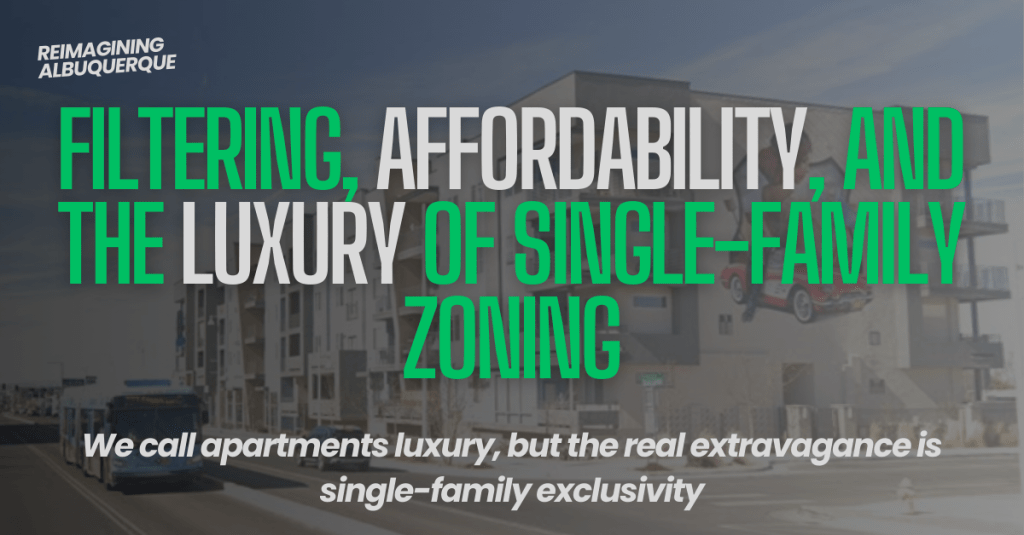
We call apartments luxury, but the real extravagance is single-family exclusivity
In Albuquerque’s housing debate, one refrain comes up again and again: subsidized, “capital-A” Affordable Housing will save us. Be it from the affordability crisis, homelessness crisis, or from livability issues, if it isn’t an Affordable development, it is sure to be (extra) controversial. Subsidized units matter, but the waiting lists tell a different story. Most families will never access them. For the vast majority of people, affordability comes from the ordinary housing market. When new buildings rise, households move, and older homes and apartments open up. Economists call this process filtering, and while it isn’t glamorous or immediate, it has historically been the most important way housing becomes affordable in America.
Researchers and journalists have shown that new apartments don’t exist in isolation. They set off long chains of moves across the market, touching households at all income levels. That makes restrictive policies like single-family zoning, defended as “traditional” or “modest,” look more like luxury policies, since they cut off huge portions of the city from this process. By contrast, allowing more apartments, “gentle density,” and mixed-use housing is one of the most reliable ways to create affordability at scale.
What the Research Shows
When people hear about new apartments, the refrain is predictable: they’re too expensive, they’ll just cause gentrification, they won’t help people who need housing the most. It’s a refrain that feels intuitive but it’s wrong. As journalist Jerusalem Demsas has argued, the myth that new housing doesn’t help is one of the most damaging misconceptions in our politics.1 The research tells a very different story: what hurts working families is not the presence of new homes, but the absence of them.
One of the clearest illustrations comes from economist Evan Mast, who tracked tens of thousands of households across 12 metro areas. He found that when 100 new apartments are built, 45 to 70 openings appear in lower-income neighborhoods within three years.2 The mechanism is straightforward but powerful: higher-income households move into new units, freeing up older homes for middle-income families, who in turn open up housing for working-class renters. A single building sets off dozens of moves across the city. Far from being irrelevant, new apartments are the very thing that keeps the whole system in motion.
Other researchers have looked at how this plays out nationally. Dowell Myers found that between 2000 and 2006, filtering created about 69,000 low-income units per year. That’s three times as many as HUD’s direct subsidy programs, and almost as many as the LIHTC program, which is the backbone of subsidized housing production. The lesson isn’t that subsidies don’t matter because they absolutely do—but that filtering operates on a scale subsidies can’t match.3 If subsidies are targeted relief, filtering is the background system that touches nearly everyone. Myers points out, as we will again explore later, that this process relies on production.
The process also shows up in annual data. Stuart Rosenthal calculated that rental housing typically becomes more affordable at a rate of about 2.5 percent per year as it ages.4 That’s not fast, but over time it’s significant. The catch, though, is that this requires a steady flow of new housing at the top of the ladder. Without it, the churn stops, and instead of moving down the affordability chain, older units get bid up by households who have nowhere else to go.
That’s exactly what Jonathan Spader found in more recent years. From 2015 to 2021, in many U.S. markets, filtering didn’t move downward at all—it moved upward. Scarcity was so severe that modest homes were snapped up by wealthier buyers. Houses that once would have been attainable for working families were suddenly out of reach.5 This is the consequence of treating new apartments as a threat. When supply is strangled, it’s not the wealthy who lose—it’s the very families opponents claim to protect.
This is why the stakes are so high in Albuquerque. The evidence is clear: when we block new housing, affordability collapses for everyone. And yet, NIMBY arguments show up at nearly every council and land use, planning, and zoning (LUPZ) hearing, often led by neighborhood associations that oppose not just market-rate development, but even subsidized, capital-A Affordable Housing on their block. The irony is hard to miss. Groups that claim to defend affordability routinely fight the very projects that would expand it! And they show up week after week telling us that they do, actually, support affordable housing. Just not here, there, or… Well, anywhere. If we want stability for working families, we need to stop treating new housing as the problem and start recognizing it as the foundation. That means making it easier to build all types of housing: market-rate, mixed-income, and subsidized because without it, the research shows affordability simply cannot be delivered.
Affordable Housing is Waitlisted Housing
Subsidized housing is critical, and in many cases life-saving. But it is also rationed. In Albuquerque, as in most cities, the waitlists are long, the eligibility rules are strict, and very few families will ever get access to a subsidized unit. For most people, this kind of housing will always be out of reach. Unfortunately, this fact about Affordable housing is rarely discussed.
Even for the lucky few who do access subsidized housing, the system has traps. Income-restricted programs like LIHTC are meant to serve households at specific income levels. But when a family earns a raise or a promotion that pushes them above the threshold, the jump in rent can be staggering. Instead of moving smoothly into the next tier of housing, they often face a cliff. Without enough market-rate options to grow into, some people end up turning down opportunities at work, paying a massive increase in rent, or leaving the city altogether. We shouldn’t be punishing people for doing better in life. Avoiding this punishment requires building a city that has a diverse market with places to live at every stage of our lives and careers.
For the vast majority of households, the real source of affordability is not the handful of new subsidized developments each year, but the gradual process by which yesterday’s high-end apartment becomes today’s middle-market option. The key isn’t just that these new apartments exist but that they keep the ladder moving. When higher-income households move into new housing, they leave behind units that others can afford. Without this churn, older homes don’t become more affordable and they get bid up by households with nowhere else to go.
In practice, 95 percent of Americans will never live in subsidized housing. They rely instead on this secondhand affordability. The point isn’t to diminish the value of subsidies (they are essential for the lowest-income families) but when we treat them as the only answer to affordability, we consign the rest of the city to rising rents and tighter competition.
This leaves out a huge share of people: newcomers moving to Albuquerque, families who earn too much to qualify for a subsidized unit, or households trying to purchase their first home. These residents all need options too. The reality is that single-family homes, the so-called “normal” housing many NIMBYs defend, are themselves market-rate luxury housing. They demand enormous down payments, are supported by hidden subsidies like mortgage interest deductions, and remain accessible only to households who already have wealth or income to spare.
Meanwhile, apartments and townhomes come with fewer barriers. They could allow people to move here, to start fresh, to build a life without a $50,000 or $100,000 lump sum upfront, or to move from renting to owning. That mobility is part of affordability too. We need capital-A Affordable housing, but we also need to recognize that affordability functions across the entire market. It is not just about lottery access—it is about making sure people at all stages, incomes, and backgrounds have a place. And many of the loudest opponents know this. The fight against new housing isn’t just about buildings or so-called “character,”—it’s about keeping people out and choosing who lives next door.
Broadstone vs. the “Luxury” of Ownership
Albuquerque has its own version of the “luxury apartment” debate. Take the Broadstone Nob Hill apartments, often criticized as too expensive. A two-bedroom there rents for about $2,250 a month.6 That’s not cheap—but let’s compare it to homeownership nearby:
- A single-family home on Marquette Avenue with similar amenities costs nearly $2,900 a month in mortgage payments, plus a $98,000 down payment.7
- Even a fixer-upper on Jefferson Street, in the adjacent Highland Neighborhood, requires $55,000 down and monthly costs above $1,600, not including taxes, insurance, or repairs (interior and exterior).8
Another recent luxury addition, the new De Anza Motor Lodge adjacent to the ART Station on Central and Washington, had rents for 2 bedroom units even lower—$1800 per month, bringing “luxury” housing within the same price-range as a fixer-upper in need of deep renovations and repairs.9 What about older apartments? Nearby 2-bedroom units on Morningside Drive showed listings as low as $1,200 per month.10
The real luxury isn’t Broadstone. It’s the ability to come up with tens of thousands of dollars upfront, finance a mortgage, and own a large parcel with wide setbacks, a big driveway, and off-street parking. In Santa Fe, this divide is even sharper: renting is often far more affordable than buying, even in buildings labeled “market rate.” And the implications go beyond one city. Demsas has points out the housing shortage doesn’t stay contained within local borders:
“It’s a local issue what new housing gets built in your community … but when California, when New York City, when Washington, D.C., or Boston or L.A. don’t build enough housing, that becomes a national problem both for labor markets and for housing markets. People who can’t afford homes in those cities flood into moderately priced places like Phoenix, Austin, or Nashville—and the people living there get priced out of the homes they once could afford.”11
We’ve seen this same dynamic in New Mexico. Santa Fe’s shortage spills into Albuquerque, raising prices here. Los Alamos’s housing scarcity affects Española, Rio Rancho, and beyond. During the pandemic, people priced out of other states relocated here, adding more pressure to a market already constrained by underbuilding. Albuquerque doesn’t exist in a vacuum—our housing decisions ripple across the region, and the choices made elsewhere ripple back onto us.
When we dismiss new apartments as “luxury housing,” we are missing the bigger picture. For many families, renting in a new building is far more attainable than buying even a modest home. With median prices in Albuquerque and the State of New Mexico continuing to climb, this isn’t a trend likely to change soon. That’s why it matters that we make housing easier to build, legal to build, and stop throwing up barriers. The benefits ripple outward to everyone—and it requires legislators to act, not stall, and for all of us to recognize that new supply is what keeps housing affordable.
Single-Detached Zoning as Luxury Policy
If filtering is how affordability spreads, then exclusionary single-family zoning cuts it off or kills it entirely. Detached homes on large lots are not neutral defaults. They are the most expensive, land-intensive form of housing we have, supported by decades of hidden subsidies.
As Demsas also points out, filtering only works when there is a steady stream of new housing. When production collapses, the chain seizes up. That is exactly what happened in Albuquerque after the 2008 financial crisis. Housing permits cratered and have never returned to pre-recession levels. The COVID Pandemic and ongoing demographic changes, such as smaller households, have exacerbated the need. For nearly two decades, we’ve been under-building, and the results show up in higher rents, older homes being bid up, and fewer affordable options for working families.
Defending single-family exclusivity in the name of “character” or “tradition” is defending a luxury. It keeps most of the city’s land locked away from the kinds of housing that actually make affordability possible.
We see this contradiction every time new apartments are proposed. For Broadstone Nob Hill, critics label it “luxury housing,” too expensive, out of touch with what Albuquerque needs, or a symptom of gentrification. But the truth is that almost all of us already live in “luxury” by that definition because almost all of us live in market-rate housing. A single-family house in Nob Hill or the Heights is market-rate housing. A casita in Barelas rented out by a landlord is market-rate housing. The difference is that these “normal” homes don’t look like gleaming new apartments, so they escape the label.
That’s the hypocrisy at the core of much NIMBY opposition. The same neighborhood associations that rail against “luxury apartments” often fight Affordable Housing projects too. The issue isn’t really whether housing is affordable but it’s who gets to live nearby. By freezing vast swaths of land into single-family exclusivity, they preserve their own version of market-rate housing while blocking others from building theirs.
And the problem isn’t just opposition to projects like Broadstone. Albuquerque’s zoning code still locks most neighborhoods into large-lot single-family development. That means we aren’t just blocking apartments but also the missing rungs of the housing ladder: condos, fourplexes, townhouses, and smaller-lot homes (think the craftsman homes or other “starter homes” of the early 20th century) that could provide affordable ownership opportunities as well as rental options. These are the types of housing that allow filtering to actually function. Without them, the chain is broken.
If we want Albuquerque to stay affordable, we have to see through this false distinction. New apartments are not a threat to affordability but a key component of the same system we all rely on. And so are townhouses, fourplexes, and small-lot homes. The real luxury is being able to lock away most of the city’s land for detached homes and then point at everything else as the problem.
Not All Criticism of “Luxury” Housing Is About Affordability
When new apartments (or alternative housing types) are proposed, they often become scapegoats for broader frustrations. Two persistent myths muddy the debate: 1) that adding housing somehow drives up prices, and 2) that private equity firms are responsible for the affordability crisis.
In reality, both are distractions, and they undermine the real solution: building more housing (and provide a smokescreen for NIMBYs to hide behind when they show up against zoning changes or a site plan at the EPC).
Demsas explains the concept of “supply skepticism,” or the belief that adding housing will increase costs—is not grounded in data. It’s a widespread bias, affecting 30–40% of Americans, despite overwhelming economic evidence that additional supply eases pressure on prices.12
The narrative blaming private equity firms has become politically compelling because it can be hard to refute and it is easy to assign blame, especially to faceless firms headquartered far away. But it doesn’t hold up to scrutiny. Institutional buyers account for only a small fraction of the total housing stock nationally. Even in markets with high investor activity, their influence remains limited to specific neighborhoods, not systemic to affordability across whole cities.
Targeting private equity alone misdirects attention. The real bottlenecks lie in underbuilding, restrictive zoning, expensive & confusing permitting, and public resistance to change—especially exclusionary single-family zoning that prevents a full range of housing options.
Putting it plainly: The housing crisis isn’t driven by new apartments or shadowy investors but by a lack of housing overall. We fix that by letting more homes get built, in more forms, in more places and not by shaming apartments or painting developers (or Wall Street) as villains.
Building for Affordability
Filtering works. For every 100 new apartments, dozens of homes become available further down the chain. Subsidized housing is vital, but it will always be waitlisted. And single-family zoning—presented as modest—is in reality the most extravagant housing policy we have.
If Albuquerque is serious about affordability, we need to stop pretending that doing nothing is neutral. Stasis is a luxury. The real path forward is to allow more housing of all kinds, let filtering do its slow but steady work, and reserve subsidies for those who need them most. Anything less is an illusion of affordability, propped up by scarcity and defended by nostalgia. The real extravagance isn’t new apartment buildings, townhomes, or multiplexes. It’s a zoning code that locks nearly 70% of our land into single-family exclusivity while families and young people scramble for options.
- https://www.theatlantic.com/ideas/archive/2022/11/us-housing-supply-shortage-crisis-2022/672240/ ↩︎
- https://www.sciencedirect.com/science/article/abs/pii/S0094119021000656 ↩︎
- https://www.nmhc.org/globalassets/research–insight/research-reports/filtering-data/nmhc-research-foundation-filtering-2020-final.pdf ↩︎
- https://www.aeaweb.org/articles?id=10.1257%2Faer.104.2.687 ↩︎
- https://nlihc.org/resource/new-study-examines-filtering-dynamics-us-housing-supply ↩︎
- https://www.broadstonenobhill.com/Floor-plans.aspx?oll_ilm=paidsearch&oll_gad_source=1&oll_gad_campaignid=20549592236&oll_gbraid=0AAAAAqOaNnMzRUow4NPQdtG9PZ6XL_iCO&oll_gclid=Cj0KCQjwzt_FBhCEARIsAJGFWVmWa1Efp4QgYE67YV6Po0k-B4zr_CxCUOVtnMF5Qd1JCDBuDG65YoAaAhCmEALw_wcB ↩︎
- https://www.zillow.com/homedetails/4401-Marquette-Ave-NE-Albuquerque-NM-87108/6740768_zpid/ ↩︎
- https://www.zillow.com/homedetails/309-Jefferson-St-NE-Albuquerque-NM-87108/6740956_zpid/ ↩︎
- https://www.apartmentguide.com/rent/4305-Central-Ave-Ne-Albuquerque-NM-LV203244968/ ↩︎
- https://www.apartmentguide.com/rent/301-Morningside-Dr-Se-Albuquerque-NM-LV2387570093/ ↩︎
- The New Bazaar (Podcast): The meaning of gentrification, with Jerusalem Demsas, https://podcasts.apple.com/us/podcast/the-meaning-of-gentrification/id1580156414?i=1000536375987 ↩︎
- https://www.theatlantic.com/ideas/archive/2022/11/us-housing-supply-shortage-crisis-2022/672240/ ↩︎
 Reimagining Albuquerque
Leave a comment