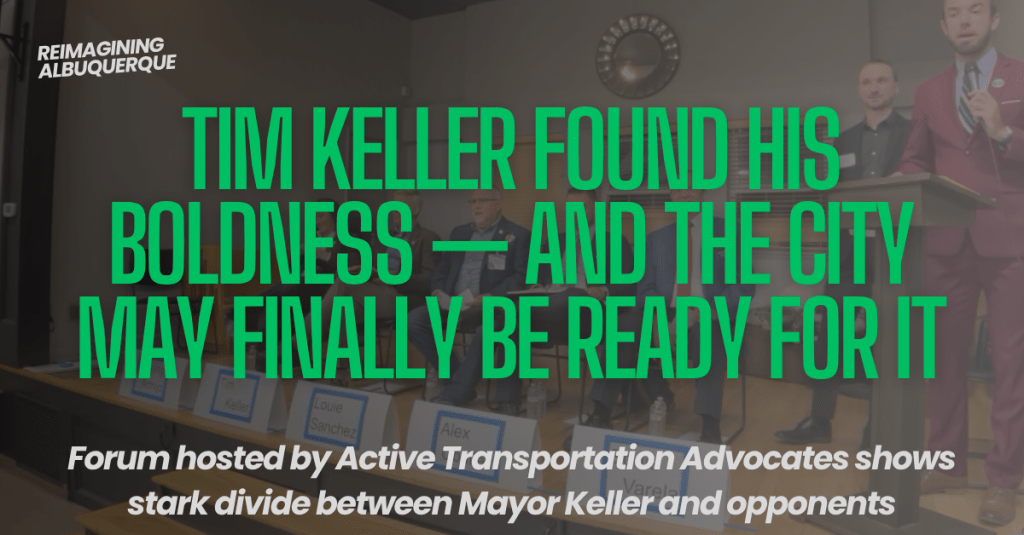
Forum hosted by Active Transportation Advocates shows stark divide between Mayor Keller, his progressive challenger, and the other candidates vying for mayor.
Back in March, we asked: Will Tim Keller’s Third Term Be the One That Transforms Albuquerque?
Seven months later, that question may have been answered — not in campaign slogans or glossy mailers, but in the unglamorous fluorescent light of a church hall where BikeABQ and Strong Towns ABQ hosted the mayoral candidate forum (The forum is available on YouTube, Here).
If the man who showed up that night is re-elected, Tim Keller could become the most YIMBY mayor Albuquerque has ever had.
From Defensive to Decisive
Keller’s two previous terms have often been marked by contradictions — a mayor who talked about innovation but too often governed through caution. We’ve been harsh critics for that, questioning his unwillingness to confront entrenched interests and the slow pace of reform on zoning, housing, and street safety.
But the Keller on stage October 7 was different. Gone was the hesitant incrementalist. In his place stood a mayor who seemed almost relieved to talk policy in detail — someone who now sees abundance not as a slogan but as a governing philosophy.
He leaned fully into zoning reform, defended upzoning as “bold but gentle,” and was the only candidate to raise his hand when asked if he supported the current IDO amendment to legalize duplexes citywide.
“I know that that is not popular,” Keller said. “I sent it to EPC. It is bold and it is gentle… and I believe it’s the right thing to do.”
It was the clearest articulation yet of a mayor embracing YIMBY principles — housing as the path to equity, density as sustainability, and zoning reform as moral necessity.
Uballez Falters on the Housing Question
In May, when Alex Uballez entered the race, we called him “the most promising challenger Keller has faced.” In that piece, we praised his rhetoric — particularly his focus on connectedness and design — but questioned his commitment to the hard economics of housing supply.
That skepticism proved warranted.
Uballez, new to electoral politics and visibly green on the stage, stumbled on the same issues that define this election. He reaffirmed support for inclusionary zoning, and not the incentive-based kind that can work in tandem with production, but the mandated, unfunded version that has almost universally reduced housing supply and increased prices in peer cities.1 2 In Albany, the mayor is seeking to eliminate inclusionary zoning after reports found it reduced homebuilding by well over half.3
When asked directly if he would support the duplex-legalization amendment, he hesitated and ultimately did not raise his hand — signaling a serious disconnect between his progressive rhetoric and the pro-housing pragmatism required to solve Albuquerque’s shortage. His timidity was surprising (and concerning), as he recently called NIMBYism a plague on the nation at NAIOP’s candidate forum and called for changes. How can he fight this plague if too timid to support duplexes?
The city is bleeding builders to Rio Rancho, repeating the same mistakes chronicled in our Abbreviated History of Land Use and Zoning in Albuquerque series — when impact fees on urban sprawl backfired, pushing growth westward through Rio Rancho and hollowing out the core.
Inclusionary zoning without incentives is a tax on building and on renters, and Albuquerque can ill afford to drive investment away just as it begins to recover momentum.
The Economics of Abundance
Keller, by contrast, seemed fluent in the trade-offs. While challengers spoke in moral abstractions — “safety first,” “fix crime before housing” — the mayor talked about funding mechanisms, bonding against automated-speed-camera revenue to build protected bike lanes, and the budget realities of Vision Zero implementation.
“Curbing [adding concrete curbs to protect a bike lane] costs a million dollars a block,” he said matter-of-factly. “So here’s what we should do… take the money we’re getting from automated speed cameras and bond it, tie that bonding to protected bike lanes. That’s how you bike-lane Albuquerque with a hundred million dollars.”
The line was critiqued by opponent Mayling Armijo as being difficult to do, but it was among the most concrete fiscal proposals of the night. Notably, opponents did not offer any fiscal instruments of their own.
Keller was also the only candidate to name NIMBYism outright in this forum, calling it a major obstacle to reform and tying it to the housing crisis — a link long documented by institutions from Pew to the Urban Land Institute but rarely acknowledged in Albuquerque’s political mainstream.
“We’re behind by forty years,” Keller said. “That’s why I’m trying to play catch-up.”
It’s the kind of candor that once cost him political capital. Now it could define his legacy.
Public Transit and the Politics of Perception
If Keller’s comments on zoning showed how much he’s changed, his remarks on transit showed how much he’s learned.
The mayor, who once dismissed Albuquerque Rapid Transit as “a lemon,” seemed almost eager to take that back. On stage, he spoke with surprising enthusiasm about expanding rapid transit and better integrating it with land use — seeing ART not as a cautionary tale but as a foundation to build from. He talked about regional connections, additional rapid lines, and tying new service directly to zoning reform, treating transit as infrastructure rather than charity.
To his credit, Keller wasn’t just defending past choices; he was finally framing ART as the central spine of a city that wants to grow inward instead of outward. That’s a real shift. We’d like to see that philosophy matched with budget and attention, but the direction is right. And to his further credit, he’s been the only candidate so far — not during this forum, but in other venues like the Albuquerque Journal survey — to acknowledge the need for new revenue streams to make this kind of expansion possible.
Alex Uballez’s position was less clear. He didn’t say whether he would keep the Zero Fares program or scale it back. However, he did call the program flawed, or at least Keller’s execution of it, in a recent Journal survey, stating that unhoused individuals use the free bus fare for shelter and air conditioning. During the forum, he instead focused on improving local service and frequency — a welcome goal that would benefit everyday riders. We applaud him for that. Albuquerque’s buses need longer hours and more reliability. But to get there, we need to talk about money. Uballez supports paying drivers more and even critiqued how the City pays for CDL licenses that are then used in the private sector. Unfortunately, he failed to state how he would pay for this (though he is correct that they must be paid more).
The debate over free fares revealed a similar divide in framing. Keller defended Zero Fares as a national example of inclusion, while several candidates, including Louie Sanchez and Mayling Armijo, called for systems to track riders or verify eligibility — raising real questions about privacy and data collection that would cut against the purpose of the program. Right-winger Eddie Varela wanted to tie free fare to employment, a proposition that progressive Uballez rightfully stated was unworkable and wrong.
Some transit advocates have leaned too heavily on the argument that Zero Fares reduces assaults on bus drivers because they no longer have to enforce fares, which was hinted at during the forum and stated by Sanchez. That’s not the winning message some think it is. If someone is willing to assault a driver over a fare, that person is now riding with passengers — a different kind of safety issue altogether. If someone will assault a driver over a $1 fare, what happens when a passenger asks them to turn down their music or to stop vaping? These dynamics feed into the broader perception problems that Armijo, Sanchez, and Varela, and, on the right, Darren White often exploit: that transit is unsafe or disorderly.
Those perceptions aren’t baseless. ABQ Ride has one of the most male-dominated riderships of any major U.S. transit system, which suggests that the city’s safety and comfort issues — both real and perceived — fall hardest on women. This is backed by ABQ Ride’s 2023 Transit Safety Study conducted by Parametrix. Uballez’s comments about “dignity in public spaces” touched on this, but Keller’s proposals went a step further by recognizing the upstream causes: the design, lighting, and social services that shape whether people actually feel safe using transit.
At its best, that’s what Keller seemed to understand. Transit safety isn’t just about policing or perception; it’s about creating the kind of system — well-lit, near homes and business, frequent, and functional — that feels worth taking in the first place.
What All the Candidates Got Wrong
Still, the forum made something else clear: most of the candidates don’t understand how urban form and transit actually intersect.
Eddie Varela, Mayling Armijo, and Louie Sanchez all failed the test — literally — and failed the basics at that. Their comments suggested a fundamental disconnect between transit and the kind of city Albuquerque is trying to become. They spoke about buses, roads, business, and housing as separate worlds rather than pieces of the same system.
Uballez and Keller were the only two who seemed to grasp that link. Yet even here, both stumbled in telling ways. Keller’s comment that “microtransit should be everywhere” was particularly odd — and wrong. Microtransit has a limited role in very low-density, disconnected areas, but it’s not a scalable model for an urban network. The goal isn’t to make car-like transit for everyone; it’s to make transit itself viable enough that it doesn’t need to mimic the car. Uballez was right to push back on that point.
But for all his insight about land use and design, Uballez’s refusal to back duplex legalization undercuts his credibility and haunts him even here. It’s impossible to say you support transit-oriented development and then shy away from the smallest, gentlest form of density that would make it work. If he’s unwilling to fight that fight, how can he take on the deeper resistance that defines Albuquerque’s politics?
Yes, we need higher-density uses closest to bus stops and along rapid transit corridors. But gentle density beyond that core is just as important. People will walk up to a mile for good transit, and allowing options like duplexes, fourplexes, and small courtyard apartments expands who can live near those routes and provides more options than single-family homes or apartments on a busy road. That kind of incremental density and choice supports ridership, creates more affordable entry points into stable neighborhoods, and strengthens the city’s long-term tax base.
It was strange, then, to hear Uballez cite Realize Las Cruces as a model for Albuquerque. The new zoning code there legalized fourplexes and even small apartments citywide, along with neighborhood-scale daycares and corner stores — the very things Keller called out his opponents, including Uballez, for failing to support. Las Cruces prioritized these changes to strengthen walkability and transit access, but it didn’t happen without a fight. The opposition there was fierce — and if Uballez believes Albuquerque can achieve the same results without confronting that kind of resistance, he hasn’t yet grasped what it takes to lead through it.
The truth is that NIMBYism in Albuquerque runs far deeper than most new candidates realize. Even corridors already served by transit — like those targeted in the Menaul Transit Plan — face organized, unrelenting opposition. That’s the landscape a pro-housing, pro-transit mayor must navigate. It’s not enough to admire the vision; you have to be willing to take the hits for it.
This was the hard lesson of the night: knowing what good urbanism looks like is one thing. Being ready to fight for it is another.
A Forum that Clarified the Stakes
At various moments in the forum, every challenger agreed with Keller on something. Eddie Varela echoed his call for better bus driver pay. Louie Sanchez, despite his reflexive opposition to speed cameras, admitted the city needs to “enforce the laws.” Even Mayling Armijo, who criticized spending priorities, ultimately agreed with the mayor’s framing that dedicated funding streams are essential to getting things done.
But the difference was preparation. Keller knew what every program cost, what ordinance it depended on, and where it intersected with broader goals. His challengers largely did not.
To his credit, Alex Uballez elevated the conversation. His entry into the race seemed to push Keller toward greater boldness, sharpening his language around abundance and forcing him to clarify long-muddled priorities. But beyond Uballez, the rest of the field often felt adrift, as if they were running out of vanity, curiosity, or perhaps the result of a lost bet. The contrast was stark: a mayor speaking in systems and outcomes versus opponents improvising from instinct.
That imbalance, between aspiration and understanding, mirrored the broader YIMBY divide in American cities: between leaders who talk about livability and those who are finally willing to rewrite the rules that make it impossible. Keller, having passed O-24-69, and his recent advocacy for a city-wide one-time upzoning (O-25-167, which failed), shows he is ready to embrace abundance and boldness.
The Country — and the Party — Are Shifting
Keller’s pivot echoes a national realignment. It took Gavin Newsom years to admit that California’s housing scarcity was self-inflicted. Minneapolis, Portland, and Austin all endured political bruising before legalizing gentle density. Albuquerque is arriving late to the conversation, but with the same clarity that scarcity, not development, fuels displacement, affordability woes, homelessness, and lack of opportunity. In June, Governor Newsom while signing an important pro-housing reform to California’s environmental protection act stated “To the NIMBY movement that is now being replaced by the YIMBY movement, go YIMBYs.“
Keller now speaks that language. His defense of upzoning, his advocacy for building “bold but gentle,” and his willingness to face down neighborhood obstruction mark a departure from the hedging of his first terms.
“It takes courage to do that,” he said in closing. “That is a political loser. But being mayor during tough times is about more than that. It’s about doing what’s right for our city, even if it’s unpopular.”
Waiting for Boldness vs. Voting for It
The forum raised a question that may define this election: Is Albuquerque willing to wait for Alex Uballez to evolve — or does it need a mayor who already has?
Uballez has time to grow into the kind of leader he gestures toward. Keller, after years of guarded politics, may finally have become one.
And then, there was the absentee.
Darren White, the leading Republican candidate and former sheriff, was notably absent from the forum, with no explanation given on the event’s YouTube recording. His absence was telling. While the other candidates debated zoning, transit, and the mechanics of safer street design, White has given little indication that he would support anything beyond the politics of crime and punishment.
A recent Albuquerque Journal poll shows Keller and White as the likely runoff contenders, far ahead of the rest of the field. That means the city’s choice this fall is not between left and right, but between a future built on abundance or fear — between reforming the systems that shape Albuquerque’s daily life, or reverting to the carceral reflexes that have failed it for decades.
In a city facing housing scarcity, rising rents, and the resurgence of Trump-era hostility toward urban policy, the margin for patience is gone. Decisive action, the kind rooted in the mechanics of reform, not the poetry of intent, matters more than ever.
Keller wasn’t perfect on stage, but he was fluent, confident, and ready to confront the structural forces that have long held Albuquerque back.
In that light, Keller’s evolution matters even more. The mayor who once hesitated now seems ready to act — not only to finish what he started on housing, business, and transit, but to protect the very idea that Albuquerque can be a city worth staying and building in.
For a city that has waited decades for abundance to feel like common sense, that might finally be enough.
KOAT will be hosting a televised debate between four of the candidates (excluding Varela and Armijo, who failed to receive more than 1% support in the Journal’s poll) on Wednesday, October 15th.
Burqueños can vote early now. Election Day is November 4th.


 Reimagining Albuquerque
Leave a comment