When thousands filled Downtown Albuquerque for the No Kings protest, it was more than a march. It was a reminder that the city still has a heart—and that our politics, zoning, and fear of density have tried too long to silence it.
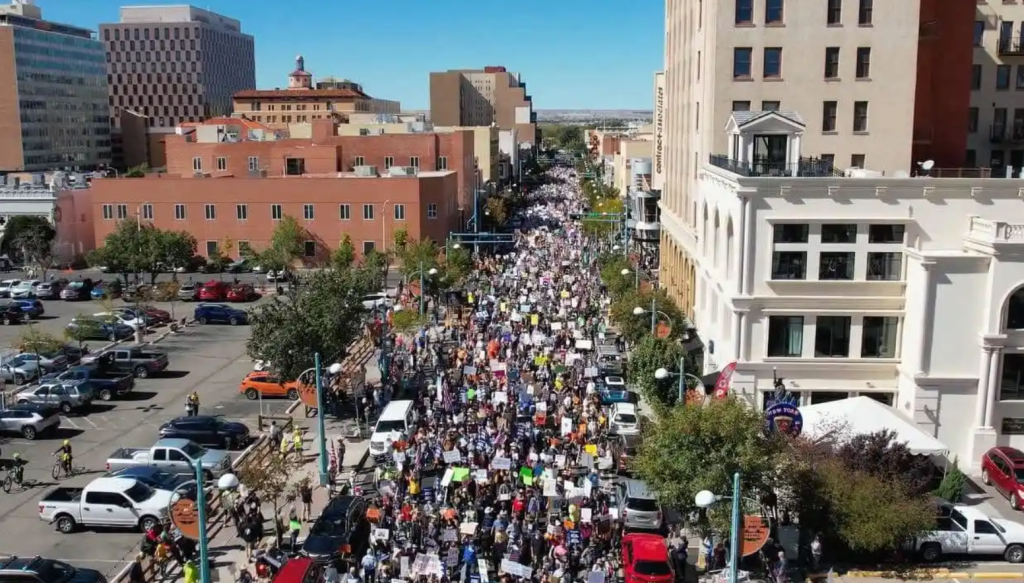
On Saturday, October 18th, up to 45,000 people gathered in Downtown Albuquerque under the banner of the No Kings protest. “Thousands of New Mexicans gathered in downtown Albuquerque … expressing concerns over democracy and human rights,” reported KOAT. “As thousands walked, streets became closed off, and drivers stepped out of their vehicles to witness what they called a piece of history.” (KOAT)
For a moment, Downtown came alive. The city’s heart became a shared civic stage, a space of expression, tension, and solidarity. And that alone is reason to pay attention.
Downtown Is the Measure of a City
The protest revealed something Albuquerque’s leaders too often forget: Downtown is not just a district. It’s a measure of civic health, a mirror of how much we still believe in the idea of a shared city.
When local officials talk about “revitalization,” they usually mean private development, parking garages, or boutique projects meant to attract visitors for a few hours. But Downtown’s value isn’t just transactional. It’s relational. It’s where democracy physically exists, the place we go when something matters enough to leave our screens and show up. There is no doubt we need more private investment: to turn vacant lots and empty buildings held by careless speculators into homes, shops, galleries, and gathering places. But that kind of renewal only endures when it’s rooted in civic infrastructure like good transit, walkability, and public space as well as in civic love, the shared belief that Downtown belongs to everyone. Without that foundation, development becomes extraction rather than growth.
A strong Downtown is not a luxury; it’s infrastructure for public life. If we allow it to empty out through disinvestment, suburban subsidies, or neglect, we erode the spaces where democracy breathes.
“The public sphere and public space were one and the same, and critical to achieving democratic self-government.” — Next City
The Totalitarian Suburb
It may sound strange to call R-1 zoning totalitarian, but look closely at its effects. By limiting nearly all new homes to single-family lots, it dictates not just land use but social order. It tells us where we may live, how we may interact, and who qualifies as a neighbor.
This quiet authoritarianism breeds fear and mistrust. Streets without sidewalks, neighborhoods without corner stores, cul-de-sacs without gathering spaces; these environments make us anxious about strangers and dependent on private space for belonging. In doing so, they hollow out the civic imagination that protests like No Kings depend on.
The suburban pattern fragments us. It leaves us with garage doors instead of front porches, drive-throughs instead of plazas, isolation instead of encounter. And when people are isolated, politics harden. Extremes thrive where there is no shared public ground.
Beyond Provincialism
Our City Council’s reluctance to treat Downtown as the city’s core isn’t just bad economics; it’s civic amnesia. Albuquerque’s public life cannot flourish through suburban annexation and car-centric zoning. The center of a city isn’t obsolete simply because it demands care, investment, and imagination.
When the No Kings protest filled Central Avenue, it exposed the small-town mindset that defines too much of our leadership. Council meetings that dismiss Downtown housing, transit, and safety as niche issues are missing the point: Downtown is where Albuquerque comes to know itself.
When councilors, Democrats and Republicans alike, treat Downtown as expendable, or as a special place that somehow gets “too much attention” at their district’s expense, they are playing into a project that quietly destroys the city’s social fabric. They ignore the simple fact that Downtown subsidizes their districts, economically and symbolically. By opposing amenities and investments, from flowers and benches to a performing arts center, they are not protecting their constituents; they are holding Albuquerque back, both from itself and from the outside world that sees a city only as strong as its heart.
A Shared Living Room
Every city needs a living room—a place to gather, grieve, celebrate, and debate. Downtown Albuquerque, at its best, can be that place. Its sidewalks and streets are not just infrastructure; they are invitations to connect.
The people who marched on October 18th reminded us that our democracy still has a home here. They reminded us that freedom is not an abstraction. It is a practice that depends on space, proximity, and the courage to meet each other in public.
The next time someone asks why Downtown matters, the answer is simple: because without it, we have no common ground.
 Reimagining Albuquerque
Leave a comment