
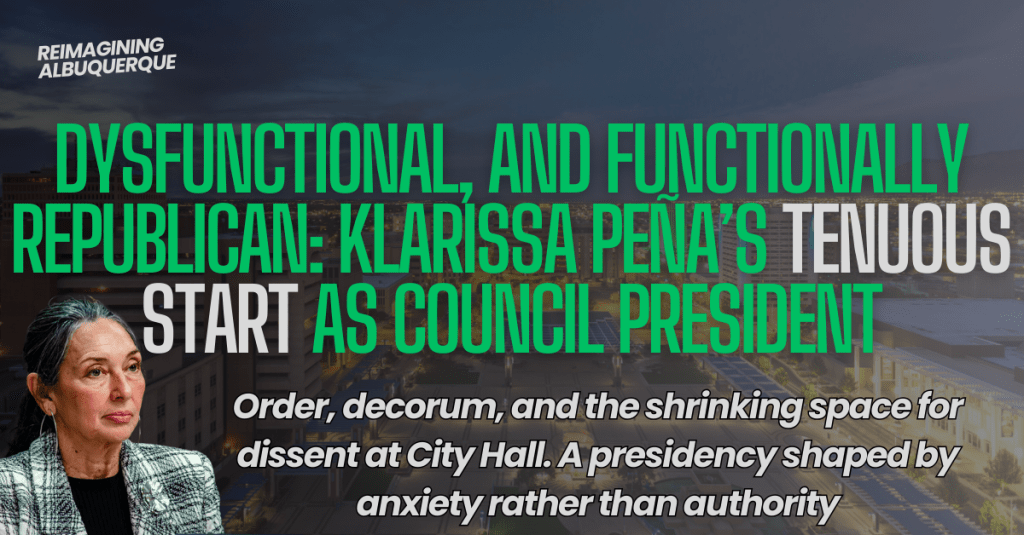
The first signal of a presidency is rarely a policy. It is posture. Does the gavel feel steady, or does it land with a little too much force? Does the chair invite participation, or does the room feel like it is being managed for silence?
From her first meetings as council president, Klarissa Peña has answered those questions clearly. Her tenure has opened not with confidence, but with containment. The tone has been nervous, thin-skinned, and oddly punitive, as though scrutiny itself were a hostile act rather than the price of public office.
Peña holds the presidency as a Democrat, elevated with the backing of the city’s Democratic establishment. She was endorsed by figures including Tim Keller and Melanie Stansbury, among others who framed her leadership as a continuation of progressive governance in Albuquerque. Yet her earliest structural decisions tell a different story. In practice, Peña has chosen to govern in close alignment with the council’s most conservative members, empowering them procedurally while sidelining the legislative priorities of the coalition that elevated her. Her presidency, in fact, was supported only by the Republican members of the council.
The most telling move has been the creation and deployment of what many advocates have begun calling “kill committees.” These committees function less as venues for refinement than as quiet holding pens where legislation can be delayed indefinitely, softened into irrelevance, or disposed of without a clear public vote. In a city where reform proposals already face long odds, the effect is unmistakable. Ideas do not fail in public anymore. They are rerouted, stalled, and eventually forgotten.
This is not neutral process, it is governance by attrition, and it benefits a very specific faction of the council: members hostile to housing reform, land use modernization, and expanded public participation. Peña has handed that faction a procedural veto while maintaining plausible deniability behind committee assignments and parliamentary language.
At the same time, the presidency has adopted an increasingly restrictive posture toward public input. Speakers have been cut off abruptly, and limited to one minute comments even from the start. Longtime activists have been removed from chambers. Public comment has been treated less as a civic right than as a disruption to be controlled. At a recent meeting, when a constituent raised allegations of abuse and corruption tied to a her tenure as a councilor, Peña paused the proceedings to ask city counsel whether she could sue the speaker for libel.
That moment crystallized the larger pattern: rather than allowing claims to be addressed, rebutted, or investigated through open channels, the instinct was to suppress, to threaten, and to retreat behind legal insulation. It was not the response of someone comfortable with scrutiny. It was the response of someone who sees questioning as insubordination and who lacks the fortitude to hold the gavel.
Peña has repeatedly invoked decorum to justify these actions. Decorum from the dais. Decorum from fellow councilors. Decorum from the public. Yet decorum, as currently enforced, flows in one direction. The public is expected to comply quietly, while the council president works to move uncomfortable questions into executive sessions closed to residents and press alike. Requests for information about the city’s administration are increasingly handled behind doors rather than in chambers.
Albuquerque does not lack mechanisms for openness. The council could choose to meet weekly, as many city councils do, creating space for longer deliberation, fuller agendas, and fewer procedural choke points. A regular Monday meeting would ease time pressure and reduce the impulse to silence speakers for the sake of efficiency. This option has been raised before. The council has repeatedly rejected it. Peña’s presidency has shown no interest in revisiting the idea.
Her discomfort with public participation extends beyond council chambers. Peña has been a vocal opponent of ranked-choice voting and runoff reforms, even invoking dubious racial arguments against these systems. During past council debates, those claims were directly challenged by Nichole Rogers, who pointed out the factual inaccuracies and the way such rhetoric misrepresents the actual impacts of expanded voting access. Peña did not retreat. She doubled down.
That resistance fits neatly with the rest of her governing approach. Ranked-choice voting disperses power. It rewards coalition-building and broad consent. It weakens gatekeeping. Peña’s presidency, by contrast, has moved decisively toward consolidation and control.
It is worth recalling how narrowly she arrived here. Peña posted the weakest electoral performance of any current councilor in the most recent election cycle, forced into a runoff and winning by a slim margin. That outcome could have prompted reflection, humility, and a renewed commitment to openness. Instead, it appears to have produced resentment. The lesson taken was not that trust needed to be earned, but that dissent needed to be managed.
None of this suggests a leader settling into the role of council president with confidence or caution. It suggests someone governing defensively, surrounding herself with procedural shields, and mistaking suppression for order. Albuquerque’s problems are real, complex, and urgent. They require leadership willing to absorb criticism, not muzzle it.
The city council does not suffer from a decorum crisis. It suffers from a leadership crisis. And at the moment, that crisis sits squarely behind the gavel.
 Reimagining Albuquerque
Leave a comment