Every time Albuquerque proposes an investment in public space, infrastructure, or urban revitalization, you can count on someone making the same argument: Why are we spending money on this when we have so many other problems to solve?
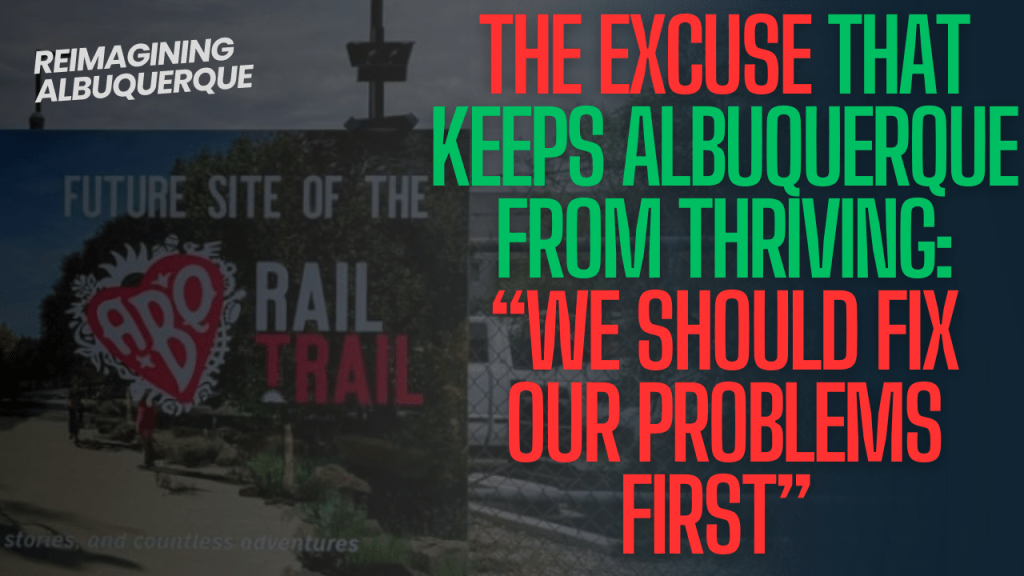
We’re seeing it now with the Rail Trail, a project that aims to transform an underutilized corridor into a walkable, vibrant public space. Opponents claim it’s a “boondoggle,” that the money would be better spent “solving homelessness,” and that, at best, it will be ignored, and at worst, it will be “taken over” by unhoused people.
This argument is alive and well in Albuquerque. Just today (March 11th), a letter to Downtown Albuquerque News made the case against federal funding for the Rail Trail:
“I hope the feds cut the grant off at the knees. The Albuquerque Rail Trail is a boondoggle and the money would be better spent solving our obvious and widespread problems with homelessness and vagrancy. Not for one minute do I believe all this speculative talk about uplifting underserved populations, attracting reams of tourists, and creating some family-and-picnic-friendly paradise. It is far more likely to become a magnet for homeless people or, at the very least, something the city will fail to properly maintain. A quick look at the state of other city infrastructure will confirm this.”
This argument is so common it feels scripted. It assumes:
- That Albuquerque can only solve one problem at a time.
- That investing in public space and infrastructure is a “boondoggle.”
- That every public space is doomed to failure because the city doesn’t maintain things properly.
It’s an argument that sounds reasonable at first—after all, homelessness, crime, and economic hardship are real problems in Albuquerque. But if we step back, we can see this for what it really is: an excuse to justify doing nothing and an argument that falls apart when we look at how cities really work.
The Chicken-and-Egg Problem of Disinvestment
One of the biggest myths about struggling areas—whether it’s Downtown, the International District, or other areas near Central Avenue—is that we shouldn’t invest in them until we “fix” all the other problems first. But this gets the cause and effect completely backward.
Disinvestment doesn’t happen by accident. Cities choose where to allocate resources. For decades, Albuquerque has drained investment from its core neighborhoods to subsidize sprawling developments on the edges of the metro. We built highways to Rio Rancho instead of fixing streets in Barelas. We let Downtown stagnate while throwing tax breaks at suburban shopping centers. We have chosen to neglect our most important places, then turned around and claimed they’re too far gone to fix.
And now, when we finally try to reverse this trend—whether it’s through the Rail Trail, the new International District Library, or street improvements—we hear the same argument: Why waste money on these areas? The truth is, investment is what lifts communities up. A vibrant, well-maintained Downtown attracts businesses, creates jobs, and supports safer streets. A public space that people want to use makes a neighborhood more welcoming for everyone, including the people who live there now.
This logic isn’t just coming from cranky people writing letters to the editor—it’s being used at higher levels by people like Doug Peterson, an Albuquerque real estate investor and conservative political figure who has been vocal in his opposition to a Business Improvement District (BID) for Downtown.
Peterson, who owns multiple properties—including high-end luxury homes—argues that we shouldn’t invest in Downtown until we solve problems like crime and homelessness. His talking points echo those of NIMBYs who oppose public projects like the Rail Trail: that investment is a waste, that nothing will improve, and that before we build anything, we must first somehow fix the very problems that disinvestment helped create.
But here’s the contradiction: disinvestment doesn’t solve crime or homelessness—it makes them worse.
- When cities refuse to invest in public space, infrastructure, and maintenance, Downtowns decay. Crime increases in neglected areas because they are neglected. Public safety improves when more people live, work, and spend time in an area.
- When private property owners sit on underutilized land, refuse to contribute to improvements, and actively oppose reinvestment, they are contributing to the very problems they claim to want solved.
And let’s be honest: Peterson’s opposition isn’t about making Downtown better—it’s about avoiding paying into its improvement.
BIDs exist in cities across the country as a way for property owners to reinvest in their own neighborhoods through targeted services, safety programs, and economic initiatives. Peterson benefits from Downtown as an investment, but he doesn’t want to contribute to making it better. Instead, he hides behind the same “we need to fix crime first” excuse that’s been used to block investment for decades.
This is a smokescreen. If we had followed Peterson’s logic in the past, we would have never built:
- The BioPark: The Zoo, Aquarium, and Botanical Gardens (why spend money on a zoo and gardens when we have crime?).
- These were built at a time when Albuquerque was regularly featured on Cops, ranked among the most dangerous cities in America, and had a poor national reputation. That didn’t stop us from investing in something great, and today, the BioPark is the most visited attraction in New Mexico, a cherished local institution, and a major economic driver.
- Civic Plaza (won’t it just attract homeless people?).
- For years, Civic Plaza was empty and underutilized, a massive open space that felt more like a dead zone than a city centerpiece. The design constraints of having a parking garage beneath it have made large-scale renovations difficult, but instead of throwing our hands up and saying it’s too hard, we’ve made small but meaningful investments to improve it.
- It now serves as an outdoor gathering space during large conventions, giving visitors a chance to experience the heart of Downtown.
- The splash pad attracts families from across the city, turning an otherwise empty space into a community hub.
- The pavilion hosts concerts and outdoor music festivals, bringing people Downtown for entertainment.
- The new playground stays active late into the night, showing that even small changes can create vibrancy.
- Is it perfect? Not at all. But these investments have added immense value to Civic Plaza, slowly chipping away at its reputation as a ghost town. If we had given up on it entirely, if we had said the engineering is too complicated or it’s too risky to invest here, we wouldn’t have any of these improvements. Instead, we committed to making Civic Plaza better, even if it wasn’t a total transformation overnight.
- For years, Civic Plaza was empty and underutilized, a massive open space that felt more like a dead zone than a city centerpiece. The design constraints of having a parking garage beneath it have made large-scale renovations difficult, but instead of throwing our hands up and saying it’s too hard, we’ve made small but meaningful investments to improve it.
- The Rail Yards Market (who’s going to visit that?).
- Despite skepticism, it is now a thriving community gathering space, drawing people from all over Albuquerque every weekend it hosts events. But the Rail Yards revitalization has been years in the making, spanning multiple mayoral administrations and requiring significant long-term vision and persistence. Imagine how much further along this amazing transformation would be if we weren’t constantly fighting off nay-sayers at every step. Instead of hand-wringing about whether it was “worth it,” we could have a fully revitalized Rail Yards District today—a hub of commerce, events, and public space—not just a work-in-progress.
And when it comes to the Rail Trail, we don’t have to guess whether projects like this can succeed—we already have proof from cities across the country. The Atlanta BeltLine started as an abandoned rail corridor and is now one of the most successful urban revitalization projects in the U.S—despite facing similar critiques. It connects multiple districts, integrates transit, features interactive public spaces, and has spurred billions in economic development—all while creating new parks, walking and biking trails, and gathering places.
Projects like the Rail Trail aren’t speculative pipe dreams. They work. The only question is whether Albuquerque will embrace the vision or let short-sighted opposition hold us back—again.
The truth is, successful cities don’t wait until everything is perfect to invest in themselves. They build, maintain, and adapt at the same time.
The False Choice: “We Can’t Solve Homelessness and Invest in Public Space”
The idea that Albuquerque can’t do multiple things at once is absurd. It’s not as if the money for the Rail Trail is being stolen from some hidden pot of fully funded housing programs. Cities function by investing in many things simultaneously—transportation, housing, public space, economic development, and social services.
And here’s the kicker: public investment in places like Downtown actually helps address homelessness.
- Creating walkable, mixed-use spaces brings more people downtown, increasing safety and economic activity.
- More investment leads to more housing development, which is the real solution to homelessness.
- The idea that every public space project should be scrapped unless it directly “fixes homelessness” is just a way to ensure we never build anything at all.
If we had followed this logic in the past, we wouldn’t have the BioPark. Imagine if we had listened to the people who said, Why are we spending millions on a zoo and aquarium when we have homelessness and crime? But today, the BioPark is the most visited attraction in the state. It improves quality of life, brings in tourism revenue, and makes Albuquerque a better place to live.
The Fear-Based Argument Against Public Space
Opponents of urban investment love to invoke fear. They assume any new public space will become a haven for crime, homelessness, and neglect. But history shows us the opposite: when we invest in spaces and maintain them, people use them.
We see it in places like:
- The Sawmill District, which transformed from an industrial wasteland into a walkable, mixed-use hub.
- The Rail Yards Market, which has become a major community gathering space after years of neglect.
Public spaces fail when we neglect them—not when we build them.
Austerity Won’t Save Albuquerque
At the heart of this argument is a deeply American problem: the belief that we don’t deserve nice things. That unless every single issue is solved, we shouldn’t invest in making the city better. That we must suffer through bad streets, dead public spaces, and disjointed infrastructure because anything else would be “wasteful.”
But cities that thrive aren’t the ones that wait until all their problems are fixed before they invest in themselves. They build, improve, and maintain—constantly. They recognize that investment creates opportunity, and opportunity improves lives.
If we want Albuquerque to be a place where people want to live, work, and stay, we can’t keep waiting for some imaginary perfect moment to start improving it. The time to invest in our city is now.

 Reimagining Albuquerque
Leave a comment