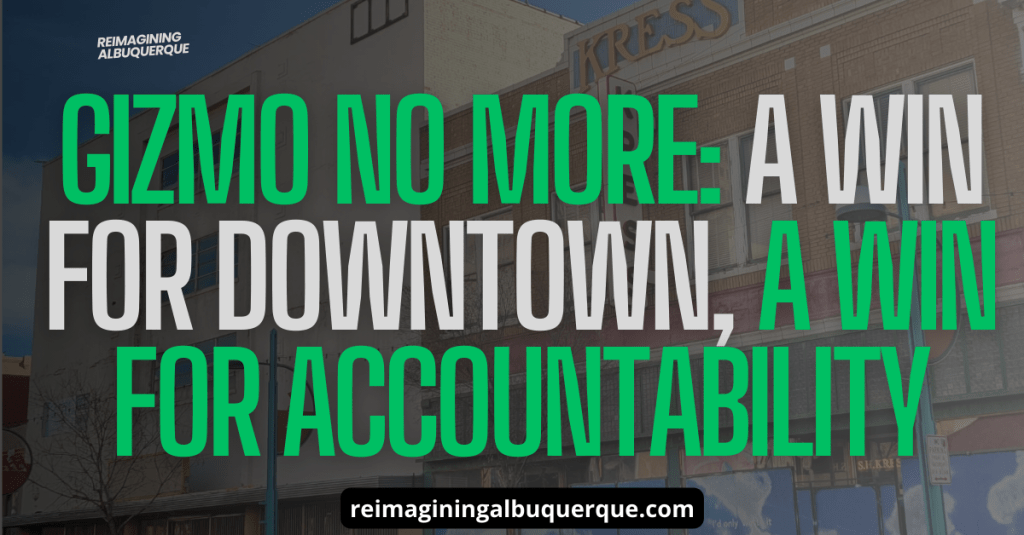
For nearly two decades, the Gizmo Building sat like a wound in the heart of Albuquerque.
Massive, centrally located, and conspicuously dead, the four-story, 53,000-square-foot hulk on Central Avenue between Fourth and Fifth loomed as a visual and psychological blight. It was never just a vacancy; it became the vacancy. An embodiment of inertia, a monument to what was wrong with Downtown. Its very existence, unused and uncared for, seemed to mock the idea of a vibrant, walkable city core.
But not anymore.
The sale of the Gizmo Building to artist, general contractor, and visionary Sheri Crider marks the beginning of a new era. Not just for the building itself, but for how Albuquerque deals with vacancy and decay. Crider, best known for the Sanitary Tortilla Factory, has plans that will transform the building into an arts-centered ecosystem: galleries, artist studios, transitional housing for returning citizens, and more. The building’s new life will be full of creation, connection, and care.
And it didn’t happen in a vacuum.
A New Tool for Accountability
The timing of the Gizmo sale, just three months after the Albuquerque City Council passed a new downtown vacancy ordinance, is more than a coincidence. It’s a demonstration of why these policies matter. Sponsored by Councilor Joaquín Baca, the ordinance requires owners of vacant Downtown buildings to register them with the city and create maintenance plans. Non-compliance can lead to steep fines of $500 a day.
This is more than bureaucratic box-checking. It represents a cultural shift.
For years, we’ve accepted the status quo of dead buildings dragging down the public realm. We’ve accepted that a small number of absentee owners could stall progress, deter investment, and erode morale without consequence. Baca’s ordinance challenges that mindset. It tells property owners that if you want to be part of Downtown, you have responsibilities. You don’t get to check out.
And for the first time in a long time, we’re seeing results.
The Gizmo Building is now the first major success story of this new chapter. It shows that policy can work, that pressure matters, and that public frustration, when channeled into good governance, can drive transformation. Councilor Baca called the property “an absolutely critical piece of real estate.” He was right.
We’re also seeing a broader lesson. In healthy cities, redevelopment is contagious. One project leads to another. Investment begets investment. It’s like a row of dominos; once the first falls, momentum builds.
This is why Albuquerque must take this ordinance further.
Beyond the Blocks: Expanding the Vacancy Ordinance
The first draft of the vacancy bill wisely aimed to cover the entire Downtown Core, not just the blocks immediately bordering Central between First and Eighth. But the final version was narrowed. It’s a good start, but just a start.
If we are serious about building a stronger, safer, and more just city, we must expand the ordinance beyond this limited zone. Vacancy is not just a Central Avenue problem. It plagues our other main streets too, historic corridors like Fourth Street, Bridge, Broadway, San Pedro, and beyond.
Wherever a vacant or blighted building sits untended, the surrounding businesses suffer. Walkability suffers. Safety suffers. Housing suffers. Hope suffers.
We must apply the same accountability mechanisms citywide and tighten enforcement, especially in Downtown where redevelopment opportunities are enormous but often blocked by surface parking lots and empty parcels held for speculation. These lots are not harmless placeholders. They actively undermine our city’s potential.
Let’s take the tools we’ve now proven can work and use them more broadly and boldly.
This Is the Minimum, and the Minimum Matters
Some critics may say this ordinance only requires property owners to do the bare minimum: keep their buildings clean, safe, and up to code. But in Albuquerque, even that bar has too often been missed. Councilor Baca’s insistence that we raise expectations, even to the legal baseline, is a long-overdue step.
Because here’s the truth: a city is only as strong as the standards it sets for itself, and the Gizmo sale shows what happens when someone chooses to believe in a better future.
Crider could have walked away, like so many before her. Instead, she invested. Not just financially, but with vision, sweat, and heart. As she put it herself, “They don’t build buildings like that anymore… it’s built like a tank.” Now it will house creative energy instead of dust.
That’s the kind of city we should be building.
We All Have a Role to Play
If we believe in justice, if we believe we deserve good things, if we believe in accountability, then this isn’t just about policy. It’s about culture and culture is made by all of us.
We cannot wait for someone else to fix it. We cannot assume that the city will suddenly change on its own. We can’t spend years wasting time trying to pass legislation that doesn’t step on toes and accomplishes nothing. We must be the ones who demand more, who support leaders like Baca, who champion ordinances like this, who invest like Crider, and who speak up when our neighborhoods are allowed to rot instead of thrive.
The Gizmo Building was once the poster child for disillusionment. Now it can be the symbol of a turnaround.
Let’s make sure it’s not the last domino to fall.
Let’s get the next one.
Want to help strengthen your city? Support expansion of the Downtown Vacancy Ordinance. Advocate for stronger enforcement. Attend your local council meetings. Let’s keep the dominos falling, one good decision at a time.

 Reimagining Albuquerque
Leave a reply to Carlos Cancel reply