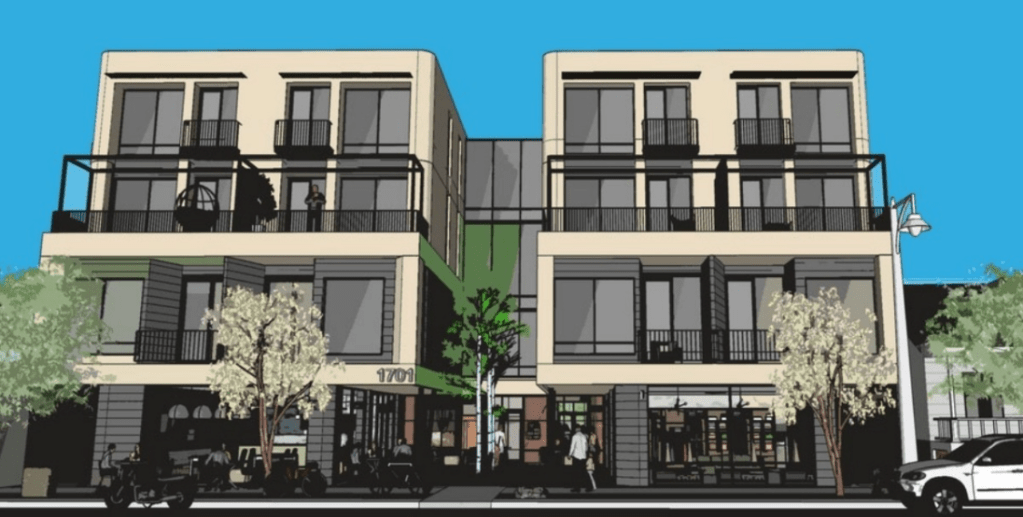
After years of delays, appeals, and regulatory acrobatics, construction has finally begun on The George, a 37-unit apartment development near Central and Laguna in West Downtown Albuquerque1. For anyone unfamiliar with the project’s tortured path to reality, this might look like a simple story: new housing, in a growing city, in a neighborhood that needs it.
But those who’ve followed the saga know better. What’s being built is a significantly altered version of what was initially proposed—still a promising addition to the city, but one marred by unnecessary compromises. The original design emphasized walkability, urban form, and alignment with city plans. The final version includes a car-oriented driveway and reduced street interaction. And it all happened because a small group of neighbors weaponized an obscure zoning overlay to block change.
This isn’t just the story of a single building—it’s a case study in how Albuquerque’s land use regime too often rewards obstruction, undermines its own policy goals, and delivers worse outcomes for everyone involved.
NIMBYs on Sixteenth Street
The opposition to The George came not from the broader city, or even from most of Downtown, but from a handful of residents on one block: Sixteenth Street, just north of Central. The street dead-ends into a quiet residential area, giving it the feel of a suburban cul-de-sac. And that’s exactly how many of its residents treated it—as a private, stable enclave immune from the pressures and promises of urban change.
But the truth is that Sixteenth Street isn’t suburban, and never was. It’s part of Downtown Albuquerque, located within a designated Metropolitan Redevelopment Area, and just steps from a high-frequency transit corridor. It’s surrounded by commercial and mixed-use buildings, and sits adjacent to the ART bus rapid transit line on Central.
Yet when developer Jay Rembe proposed routing residential vehicle access through Sixteenth Street, while keeping Central Avenue frontage dedicated to retail and pedestrian space, some neighbors saw it as a threat. They claimed it would create traffic, eliminate on-street parking, and make the street “unsafe.” At one point, opponents even demanded that the city guarantee that no future parking changes would ever occur. (The city, for its part, repeatedly assured the public that on-street parking would remain untouched and emergency access was fully compliant.)
The complaints weren’t really about technical issues. They were about change—about preserving a lifestyle and street pattern that no longer matches the reality of Downtown Albuquerque.
Rembe Did Everything Right—And Still Got Burned
In a more functional city, this would have been the end of it. The project complied with zoning. It followed the Comprehensive Plan. It earned approvals from the Development Review Board. Rembe engaged the public, made revisions, and even offered to write into tenant leases that they wouldn’t park on Sixteenth Street.
But instead of moving forward, the project was appealed thanks to a little-known feature of the zoning code called a Character Protection Overlay, or CPO.
The CPO covering this area requires that developments along Central west of Fourteenth use Central for “primary vehicular access.” But the definition of “primary” was ambiguous, and Rembe sought clarification. The city’s Zoning Enforcement Officer agreed that using Central for commercial and service access, while routing residents through Sixteenth, satisfied the rule.
The neighbors appealed. And Land Use Hearing Officer Steven Chávez overturned the ruling, calling the city’s interpretation a “theoretical fiction.” That decision forced Rembe to redesign the project—not to make it better, but to satisfy an outdated legal technicality.
The new version adds a driveway cutting from Central through to Sixteenth. Ironically, that means more access from Sixteenth, not less. Rembe also added three more apartments and slightly reduced parking—likely to make the altered project pencil out financially. But the greatest cost was to walkability and design: instead of eliminating curb cuts and prioritizing the pedestrian realm, the project now centers its circulation around cars.
When Preservation Becomes Exclusion
The problem isn’t just this ruling. It’s the structure that made it possible.
CPOs in Albuquerque are framed as tools to protect historic or cultural character. But in practice, they often function as hyperlocal veto points—used to block infill, density, and change. They can override the base zoning and even contradict the city’s long-term policy goals. In this case, the overlay forced a car-centric redesign in one of the few areas of the city where walkability is actually prioritized in law.
This isn’t a fluke—it’s a known outcome of how overlays have evolved nationwide.
As historian Yoni Appelbaum writes2, historic overlays have long been used to freeze neighborhoods in time—not to protect history, but to control who and what is allowed to change. Writing about Charleston, South Carolina’s first preservation district, Appelbaum explains that “instead of purchasing the properties they wanted to preserve, they would simply place restrictions on what the people who owned them could do with them, externalizing the costs.” Preservation efforts, he shows, were often tied up in nostalgia, power, and exclusion—maintaining “a place of charm for residence by substantial and cultured people.”
That dynamic still echoes in modern overlays. “The professional classes soon began using preservation as a new tool of exclusion,” Appelbaum writes. “The key criteria of significance turned out to be… how well organized its neighbors were and how odious they found the plan to replace it.”
Albuquerque’s CPOs are no exception. They allow small groups of residents to override citywide planning. They treat the past as a cudgel, not a context. And they often contradict the very values—walkability, equity, affordability—that the city claims to prioritize.
Lose-Lose Planning
The outcome of this process is telling. The NIMBYs who fought against Rembe’s plan still ended up with traffic on their street, arguably more, even. The developer had to compromise on urban design. The city contradicted its own planning documents. And the public lost out on a better version of what could have been a flagship urban project.
This is not democracy. It’s dysfunction.
As Jerusalem Demsas argues in The Atlantic3, land use in the U.S. is governed by “a legal regime stealthily enforcing an archaic set of aesthetic and moral preferences.” It’s not just about bad neighbors—it’s about a system designed to privilege those with the time, lawyers, and leverage to say no. “Land politics is insulated from democratic accountability,” she writes. And as long as we rely on endless appeals, overlays, and discretionary boards, we’ll keep getting watered-down outcomes like The George.
Still a Win—But It Should’ve Been More
Despite all this, The George is moving forward. Rembe didn’t walk away. He didn’t sue the city or abandon the project. He adapted, redesigned, and got it done. Albuquerque is still getting new homes in a location that desperately needs them. And the site, vacant for years, will finally contribute to the life of the street.
But let’s be honest: this isn’t how good cities function. A stronger code would have supported the original design. A better appeals process would have filtered out obstruction. A more unified planning system would have aligned overlay rules with broader city goals.
What we got isn’t a disaster. But it’s less than what we deserved.
Let The George be a wake-up call. Not just a celebration of resilience but a demand for reform.
Escaping the Localism Trap: What Albuquerque Must Demand of Its Zoning Commission
It’s not enough to build a good project. In cities like ours, even the best-designed, most policy-aligned developments can be delayed, diluted, or derailed entirely by process.
The problem lies not just in bad actors or isolated appeals. It lies in structural localism: a system that places enormous discretionary power in the hands of neighborhood-level boards and commissions, often composed of volunteer residents with little accountability and even less incentive to act in the public interest.
In a 2020 interview4 with Matthew Yglesias, political scientist Katherine Einstein, co-author of Neighborhood Defenders5, explains how these zoning boards operate. Many commissioners, she notes, “empathize with the neighbors” not because they’ve analyzed the policy merits or even agree with the opponents (they often don’t), but because they “see those people at soccer games.” These boards are hyperlocal in composition and incentive. Their decisions aren’t governed by long-term citywide plans or housing needs assessments—they’re shaped by social pressure, visibility, and the desire to avoid conflict. So, they approve that parking study, grant that delay, allow that appeal—one small concession at a time. It makes meeting at soccer games less awkward, but those concessions add up: in cost, time, and urban decay. And as we know and can see in Albuquerque, homelessness, long commutes, and fatal consequences.
This is precisely what happened with The George. What should have been a routine, walkable infill development in line with every major planning goal got held up by a few well-connected neighbors and a process unable, or unwilling, to challenge policies that enshrine bad outcomes.
As Demsas writes, this is not democracy—it’s dysfunction. It gives a loud, organized few the power to block progress that benefits the many. And it exposes a central flaw in how American cities govern land: “The politics of land should play out in the domain of democratic participation,” she argues, “instead of leaving it to zoning boards and courtrooms.”
Albuquerque is overdue for a reckoning with this kind of procedural obstruction. If we want a city that works—for renters, homeowners, families, businesses, and future generations—we must redesign the system. Here’s what we must demand:
1. Planning Commissions Must Follow the Plan
The Environmental Planning Commission (EPC) and other zoning commissions should never issue advice, rulings, or conditions that contradict Albuquerque’s Comprehensive Plan, ABQ Ride Forward Network, or Metropolitan Redevelopment Area priorities. These are adopted policies developed with community input. They should guide decisions—not be overridden by ad hoc judgment.
Recommendation: Amend the Integrated Development Ordinance (IDO) to mandate strict consistency with adopted city plans and disallow overlays or advisory decisions that conflict with them.
2. Adopt Clear, Form-Based Codes—And Make Them Final
The zoning code should be a clear, easy-to-understand contract, not a negotiation. If a project meets all criteria, especially in transit corridors and redevelopment areas, it should proceed by right. Commissioners are not designers, negotiators, or neighborhood therapists. Their job is to administer the code, not interpret vibes.
Recommendation: Fully adopt a form-based code framework for key corridors (Central, San Mateo, Menaul, but preferably the entire city) with objective standards that remove ambiguity from project review. The Character Protection Overlays create too much ambiguity, confusion, and as we see here, antagonism.
3. EPC Members Should Not Be Adjudicators
Volunteer boards dominated by neighborhood representatives are inherently conflicted. They should not serve as quasi-judicial bodies for appeals or site plan approvals. Their proximity to opposition, both socially and ideologically, makes impartiality nearly impossible.
Recommendation: Professionalize land-use decision-making. Move quasi-judicial responsibilities to staff planners or hearing officers with training and independence, and limit EPC’s role to policy review. These are functions that are performed inside planning departments in peer-countries, routinely, quickly, and fairly. We have no excuse to muddle on with such broken systems.
4. Eliminate the Default to Delay
Every appeal, every “additional parking study,” every demand for a second traffic review delays housing, adds cost, and disincentivizes infill. These should be rare exceptions—not routine tools of opposition.
Recommendation: Institute a harm-based standard for appeals: unless a project demonstrably violates public safety, legal requirements, or health standards, it must move forward. Institute a shock-clock as Minnesota has done. How often do we ask planners, engineers, or NIMBYs to study the economic impact of waiting? It is time we start!
5. Build a System That Can Actually Build
We can’t solve Albuquerque’s housing crisis, climate goals, or economic stagnation with a system built for stalling, not scaling. A modern city needs rules that invite investment, not a bureaucracy that discourages it. Rembe appears to be all-in on both Albuquerque and its Downtown. That’s great, but we should reward this attitude. Others aren’t as willing to roll with the punches, and as neighboring states continue to make development even easier, what is keeping our developers here other than love and belonging of place?
We need a city that houses people, a Downtown that is alive, and a system that builds sustainability, wealth, and opportunity for everyone—not just those with the time to show up to every meeting.
Final Demand: Codify a presumption in favor of housing and transit-aligned development. When in doubt, the rules should err on the side of yes. We echo the demands of California YIMBY – zoning boards, commissions, and officers must err toward yes, especially when a Comprehensive Plan demands it and yes, even when an existing zoning code or overlay conflicts.
Additional Reading and Listening:
- Downtown Albuquerque News, June 2nd, 2025 ↩︎
- https://www.penguinrandomhouse.com/books/700580/stuck-by-yoni-appelbaum/ ↩︎
- https://www.theatlantic.com/ideas/archive/2024/09/jerusalem-demsas-on-the-housing-crisis-book/679666/?utm_source=apple_news ↩︎
- https://podcasts.apple.com/us/podcast/neighborhood-defenders/id1042433083?i=1000461440534 ↩︎
- https://www.cambridge.org/core/books/neighborhood-defenders/0677F4F75667B490CBC7A98396DD527A ↩︎
 Reimagining Albuquerque
Leave a reply to All Eyes on Menaul: Why Albuquerque’s Next Transit Corridor Fight Matters – Reimagining Albuquerque Cancel reply