
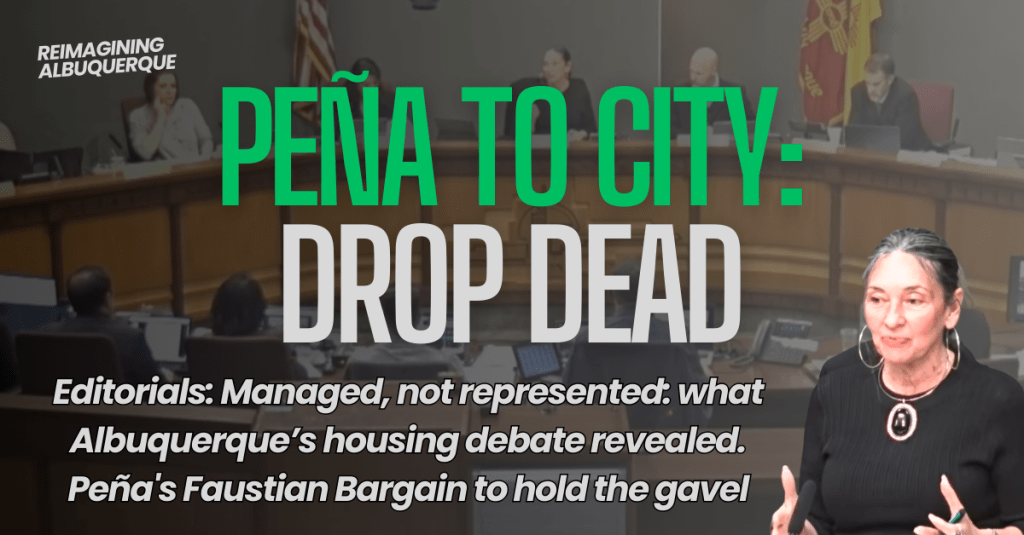
Editorials: Managed, not represented: what Albuquerque’s housing debate revealed. Peña’s Faustian Bargain to hold the gavel
There is a particular kind of civic cruelty that does not look like cruelty when it is happening, and does not announce itself as such. It looks like procedure, or patience, or a request for patience. It looks like a person with a gavel reminding you, in the calm voice of someone who believes she is being reasonable, that your minute is up. It looks like an elected official telling a room full of people asking for the ability to live here that tonight is not the night, that the day for that is another day, that the proper place for their grief and exhaustion and arithmetic is somewhere else. It sounds like someone telling young people to respect neighborhood leaders that abuse appeals and lawsuits to prevent those same young people from owning homes or having access to doctors. You can call it decorum if you want, or leadership, or a commitment to “process,” but anyone who has sat through enough of these meetings knows the feeling it produces. It is the feeling of being managed, not represented.
New York had its shorthand for this, once, a headline that outlived the event because it captured a mood, because it reduced a complicated political failure into a blunt little sentence people could carry around in their pockets. Albuquerque does not usually get shorthand. Albuquerque gets long meetings that run past any hour a functioning democracy would choose, with agenda items that move around like furniture, and speakers who practice for days to fit a human life into sixty seconds. Albuquerque gets the slow churn of decisions that are somehow always urgent and always deferred, as though delay were not itself a form of policy. Then, on the night the City Council finally took up the most basic question in front of a city with a housing shortage, whether it would allow modest, incremental housing options more widely and with fewer tripwires, we got something close to shorthand anyway. What we got, in practice if not in phrase, was Peña to City: drop dead.
The energy was already off before housing appeared on the screen. The room felt heavy, warm in the literal sense, restless in the way crowds become when they sense a meeting slipping away from its purpose. The council moved items around. Motions failed. One of the first of which was the council choosing to affirm a one-minute limit on public comment, starting the evening with contempt for their constituents. The mechanics of the night became the story, which is always a sign you are dealing with leadership that cannot hold a room steady. There is a way for a council president to keep a meeting grounded even when the votes are uncertain and the public is furious, and it begins with a simple premise that the people showing up in person are not an inconvenience but the point. There is also a way to do the opposite, to conduct a meeting like a siege, as though the goal were to endure the public rather than to listen to it, and to treat your authority as something you use to narrow what can be said and how long people are allowed to say it.
None of this emerged in a vacuum. The pattern has been visible since Peña took the gavel, a style of governance that leans toward control and correction rather than curiosity, a pattern we wrote about earlier this month, when it became clear that her start as council president was tenuous not because she lacked the votes to be elected but because she lacked the instincts to govern a chamber that is, by any honest measure, split and brittle. In a council that sits at 4–4 Democrat and Republican, with a Democratic mayor, the person who becomes the fifth vote does not just decide outcomes. That person sets the tone for what counts as reality in the room, whether a hearing about housing becomes a hearing about housing or a referendum on who gets to speak without being scolded. That person, if she wants, can use the chair as a bridge between factions. If she does not want, she can use it as a barricade, and then act surprised when the crowd starts shouting.
The housing package itself was never revolutionary. It was mild by the standards of the country and, frankly, mild by the standards of Albuquerque’s own history, a history the council president claims to know intimately and yet is happy to disrespect and dishonor through action. The package asked the city to make room again for housing forms that used to exist here, and for small, neighborhood-serving businesses that used to exist here, and for the ordinary idea that you should not need a committee and a consultant and an attorney and a small fortune to build a small accessory home for a parent. People came to say that in different ways, some calm, some furious, some funny because humor is one of the last tools left when seriousness gets swallowed by procedure and contempt for good governance. People came to say they wanted to stay in their home city. People came to say they wanted their kids to stay where they were raised. People came to say they were tired of being told to wait while rents and home prices did not. People came to say, with the kind of plain desperation that is hard to perform and harder to ignore, that this city is pushing working adults out and then acting shocked when the adults leave, not to mention the neighbors that have no options at all.
What Peña did, repeatedly, was replace that substance with theater, and not even the useful kind. She gave a long monologue about language, about how “bodega” was an offensive word to New Mexicans, and how “tiendita” should be used instead. It was the kind of speech that sounds, on paper, like cultural care and respect, as though the problem with Albuquerque’s small-business landscape were vocabulary, as though what the city needed most from its council president was a lecture about semantics. It might have even landed as a sincere aside if it had not been paired with what came next, a vote that moved in the opposite direction of the respect she claimed to defend. There is a particular type of official who loves symbolic correction because symbolic correction costs nothing. It does not require changing rules. It does not require giving up control. It does not require voting yes.
The same dynamic played out later in a more fraught register, when Peña engaged in a long exchange that tried to place Spanish New Mexican identity on an equivalent plane with Indigenous identity, an exchange that felt less like solidarity than like an insistence on being centered and erasing a history she, like most of us, plays a part in in the violent dispossesion of indigenous lands and cultures. Albuquerque’s civic life is full of these moments, where our state’s tricultural myth is used not as a way to understand complexity but as a way to blur power and history until the sharp edges disappear. Meanwhile, the thing people showed up for keeps inching toward another delay, another procedural exit ramp, another “not today.”
The traditions Peña invokes are not being preserved; they are being regulated out of existence. Albuquerque has perfected a style of politics in which heritage is performed in speeches while zoning codes quietly erase the ways of living that heritage once produced, a dynamic that turns identity into justification rather than protection. What results is not cultural defense but a familiar logic of NIMBYism, one that reinforces exclusion and reproduces the very patterns of extraction she, and by extension her allies in the “Historic Neighborhoods Alliance,” claim to oppose.
Moving beyond these smokescreens was newly inducted Councilor Stephanie Telles, who created the clearest moment of the night — one that fully stripped away the abstractions about housing and process and revealed what they really are: a set of rules that either help people care for each other or make that care harder. Councilor Telles spoke about trying to build a casita for her mother, who had dementia and has since passed away. This was not a speech about ideology or the theoretical merits of accessory dwelling units but a vulnerable and raw account of a real attempt to do a normal, loving thing in a city that claims to value family and tradition — money spent, permits chased, doors closed anyway. She described a system in which casitas are legal in name but impossible in practice, with the compressed clarity that comes from loss, when you do not have time to perform your pain politely because the clock is running out and the chair is watching.
Peña could not look at her.
This is the part people will want to soften, to treat as speculation, to say that eye contact is not policy and that personal demeanor is not governance. It is true that eye contact is not a line item in the IDO. It is also true that leadership is made of exactly these small human signals, the ones that tell a colleague whether her story is being received as real or being treated as an inconvenience. Peña did not look at her colleague, and then she voted against making casitas easier to build, and the room responded the way rooms respond when they realize they are being asked to accept a performance of empathy without the substance. People shouted, Peña lost composure. The gavel did what it always does in these moments, it tried to reassert control over reality.
What made the moment more brutal was how neatly it revealed the gap between rhetoric and action. Peña had spent time that night positioning herself as a defender of New Mexican cultural authenticity, policing language, invoking tradition, offering lectures about history to the “young people” in the room. Yet when faced with a story about one of the most traditional and culturally resonant housing forms we have, an accessory home meant to keep family close, she did not move toward it. She moved away. It is hard to avoid the conclusion that tradition, for some officials, is not a living practice but a prop. It is something you cite when you want authority, not something you honor when it requires a yes vote.
The “young people” comment landed with its own kind of absurdity. Peña told the young people in the room they should learn from their elders, as though the people showing up were teenagers who had wandered in from a civics class. Many of them were not. Many were in their 30s and 40s, even 50s and 60s, fully grown adults who work, pay taxes, and have been polite long enough to see politeness fail, and who are impacted viscerally by the failures of Peña and her council. This is one of the tragedies of Albuquerque’s neighborhood politics, the way it casts fully fledged adults as children whenever they demand change, and the way it treats the people who already own homes as the only legitimate adults in the room. It is not only condescending, It is strategically useful. If you can frame the reform constituency as inexperienced, you never have to answer their arguments. You can just instruct them to wait. Peña, perhaps, took offense at a growing number of people calling for accountability of this broken system (even citing this blog, thank you for reading Councilor Peña), because they have relied on the procedural smokescreen to shield them from the impacts of their actions.
Waiting is what Albuquerque has been doing and it is not neutral. Waiting is a choice, it is a policy. Waiting is how a city loses its nurses and its teachers and its early-career professionals and then spends a decade talking about brain drain like it is weather. Waiting is how we end up with a housing ladder that does not function, where renting is not a step toward ownership but a cul-de-sac, where a “starter home” is either a fantasy or a teardown priced like a prize.
The night ended with partial wins and bitter losses, with some reforms surviving and others failing, with the sense that the city is capable of moving forward even when the people in charge insist on dragging their feet. The work continues, everyone says, and they are right, and the phrase is both a comfort and a warning. But there is a reason the meeting felt so chaotic and so ugly and so emotionally exhausting. It was not only the stakes, it was the way the chair treated the stakes, and the way she treated the people who came to speak to them.
If you want a city that can actually solve hard problems, you do not pick leaders who respond to hard problems by scolding the public for showing up.
Peña’s Faustian Bargain
There is a story Albuquerque likes to tell itself about power. It is a story in which the city is fundamentally progressive, fundamentally compassionate, fundamentally aligned with a certain set of values, and in which the friction we experience is mostly a matter of personalities, or misunderstandings, or the inevitable noise of democracy. It is an attractive story because it allows everyone to feel like they are on the right side of history without having to ask who is actually exercising power and for what ends. It is also a story that collapses when you watch how a 4–4 council operates in real time.
In a split council, the hinge matters more than the labels. The hinge is not just a tie-breaker, it is is the operating system. If the hinge consistently aligns with the conservative bloc on land use, housing, homelessness, and the mechanics of public input, among other important topics, then the city is governed on those questions by a conservative majority, regardless of how anyone describes themselves on a voter guide.
Party labels blur easily in a split council. What remains visible are the choices, who expands possibility and who narrows it. The difference shows up in votes more than in speeches, in whether affordability is treated as a talking point or a set of decisions that reshape the city. They mean the difference between saying you care about affordability (or your “grandbabies”) and actually voting for the conditions that make affordability possible. They mean the difference between praising tradition and allowing the built forms of that tradition to be built. They mean the difference between saying you respect working families and immigrants and then preserving a system that makes it harder for working families and immigrants to stay.
Peña’s presents herself as a leader who understands equity and history. Yet her instincts in the chair tilt toward control and punishment, a fear of accountability, a sense others should know their place and fall in line, and her coalition behavior tilts toward the bloc that treats housing reform as an existential threat to the civic order. This creates a particular kind of cynicism in the room because it confuses the accountability story. With a Republican councilor, you at least know where the votes are likely to go. You can disagree, you can argue, you can still be disappointed, but you are not asked to pretend surprise. A blue-state Republican is often, essentially, the yappy chihuahua that brings nothing of value to the show, simply trying to be oppositional. With a Democrat who governs like a gatekeeper, you are asked to swallow two narratives at once, and the contradiction becomes its own form of disrespect.
It raises an uncomfortable question, which is the one we raise directly: what kind of bargain is this? In a split council, a council president is not elected by accident. She is elected through a set of agreements, explicit or implicit, about how the chair will be used and what priorities will be protected. Private discussions are had between councilors, concessions and deals made, and priorities traded. If Peña’s presidency depends on support from Republican councilors who do not particularly like her, then her leverage is fragile and her incentives are clear. She must keep the bloc together, she must keep control of the room and she must prove, again and again, that she will not allow the chamber to drift into a pro-housing majority, even when the public is demanding it.
After a stinging election in which Peña nearly lost, an election shaped in no small part by the backlash to the same NIMBY instincts that have defined her recent and past votes, she faced a choice that many politicians face and few acknowledge publicly. She could have leaned in to humility, widened her coalition, and treated the election as a signal that the city’s political center was shifting beneath her feet. Instead, she appears to have dug in. The path she chose did not require persuading the pro-housing public or rebuilding trust with a younger electorate that feels increasingly dismissed and uncared for. For her, It only required securing the gavel.
The cost of that choice is now becoming exceedingly visible. In accepting the support necessary to become council president in a chamber split down the middle, Peña did not merely gain power. She accepted a role in which the Republican bloc no longer bears the full weight of accountability for conservative outcomes on land use, housing, homelessness, or public process. The hinge has become their shield. The person holding the gavel absorbs the consequences of decisions that, in another configuration, might have been laid squarely at the feet of those who openly oppose reform. This is the essence of a Faustian bargain, trading something intangible and difficult to reclaim, legitimacy, for something immediate and visible, authority.
And like most Faustian bargains, the price compounds over time. Each vote that aligns with obstruction rather than reform reinforces the perception that the gavel was secured not to guide the council toward consensus but to prevent the council from drifting toward change. Each time public comment is reduced or redirected, the chair signals that a false stability matters more than listening, that order matters more than responsiveness. The irony is that the very coalition that elevated her is unlikely to defend her when the public anger continues to intensify, because the bloc’s power has already been secured. What remains exposed is Peña herself, positioned between a conservative minority that distrusts her and a Democratic base that increasingly feels betrayed.
This shift also changes the broader political narrative in Albuquerque. For years, councilors frustrated with the direction of the city have pointed toward the mayor as the source of dysfunction, blaming executive leadership for stagnation while preserving their own insulation from blame. Perhaps the most costly aspect of Peña’s Faustian Bargain is that the buck no longer stops with Mayor Keller, it stops with her. When you run the meeting, when you shape the agenda, when you decide how voices are heard and how long they are allowed to speak, you become the face of the institution. The buck stops with the chair, who currently represents a minority faction of the city’s political establishment. If the council fails to respond to a housing crisis that is visible in every rent increase and every stalled permit, in every domestic violence survivor sleeping behind a Walgreens, and in every young person taking a job far away because we can’t allow opportunity here, it is no longer sufficient to gesture toward the mayor’s office or to hide behind the fiction that nothing meaningful can happen without executive initiative. The public more and more sees where power sits, and they will remember who used it and how. The Faustian Bargain in whole? In holding the gavel, and trading her ethical spine, political coalition, and morals for that gavel, she now carries the responsibility of all good in the city – and more importantly, all bad. Given her lack of composure, knowledge, and preparedness, she is not prepared for the weight of this cost.
When public comment is reduced, when the meeting is run as an endurance test, when people are admonished instead of answered, it is not merely poor management. It is strategy. A long meeting is a filter. A one-minute limit is a filter. A chair who lectures rather than listens is a filter. Over time, the only people left speaking are the ones who have the stamina, the flexibility, and the money to keep showing up. Everyone else goes home and is replaced, in the public record, by the people who are retired, already housed, and already comfortable with the status quo.
This is why the demographic tension we name here is important. We don’t see it as being about age as a culture war (though it could be), we see It as being about material position. The people who already own homes can afford to treat housing as a slow conversation, a matter of neighborhood feel and long-range hypotheticals. The people trying to buy a first home cannot. The people trying to build a casita so their parent can age with dignity cannot. The people trying to stay in Albuquerque without watching half their income vanish into rent cannot. When a chair tells those people to calm down and learn history, she is not offering wisdom. She is asking them to accept a civic order that is built for someone else, and as we explored the Myth of New Mexico’s Tricultural heritage, and how it is even weaponized against Black and Indigenous New Mexicans, was on display on Wednesday night.
During the evening, she stated that she has grandbabies who are also making the same arguments as she heard that night and that it is important. Peña’s remark about her “grandbabies” should have been a bridge. It should have been an opening, a recognition that the desires being expressed in the room were not radical demands but ordinary human ones, to live near work, to build a life, to afford a home, to keep family close. Instead it landed as something else, a way to gesture at empathy without being moved by it. If your grandbabies are saying the same things as the people in that room, then the obvious conclusion is not that the room needs more lectures. The conclusion is that you, and the political ecosystem you are protecting, are out of step with your own future. If the response is to “sit back and learn from the elders,” without any reflection on what the elders’ policies have created, the respect demanded is not being given in return.
There is also the question of how Peña handles uglier currents when they surface in the room. When public comment or audience outbursts veer into racist or demeaning territory, the chair has special discretion. The chair can set a standard. The chair can draw a line. On February 18, the perception in the room was that Peña’s line was not consistently drawn against cruelty, especially when leveled against her colleagues, and particularly when leveled against her colleagues of color. It was drawn against dissent, against interruption, against anything that threatened her control of the narrative. That is why people walked away furious not only about votes but about legitimacy. It is one thing to lose a vote but It is another to watch the chair fail at the basic job of keeping a public body worthy of the public. If Peña wonders why the public at Council is increasingly agitated, she might reflect on how she and her colleagues have failed to set the standard.
And yet, for all of it, the night contained its own strange counterpoint. New councilors asked sharper questions and demonstrated better command of the material than even veterans of the council. Some members of the body showed signs of trying to learn the material rather than recite talking points, even if clumsily. People gave public comment that was, even in sixty seconds, intelligent and brave, and far outnumbered NIMBY detractors, and signaled the winds have turned against the impulses of white-supremacist land use patterns. The city moved forward in some ways even as it refused to move forward in others. The problem is that incremental progress under a hostile chair is not a stable model for governance. It produces wins by exhaustion, and then expects the public to be grateful for whatever survives.
What the city needs, at minimum, is not a council president who can deliver monologues. It needs a council president who can do the opposite, who can keep meetings coherent, treat the public as more than a nuisance, and exercise authority with humility rather than grievance. It needs someone who understands that the “strong groups” and the neighborhood associations and the inherited civic gatekeepers are not the only constituencies that matter, and that a city cannot claim to care about equity while protecting systems that ration opportunity to the already housed.
If Peña wants to argue that she represents the people, she can start by looking them in the eye when they tell her what the city is doing to them. She could start in listening to her grandbabies and taking on the responsibility of her actions as well as acknowledge that her political choices are putting other people’s grandbabies on the street to die. She could even start with her colleagues sitting next to her, if she has the courage to do so.
Because the alternative, the message delivered through procedure and deflection and “another day,” is the one people heard on February 18, and they heard it clearly. Albuquerque did get shorthand that night.
They heard drop dead.

 Reimagining Albuquerque
Leave a reply to pdaviswillson Cancel reply