There is a specific type of yard sign you see in every neighborhood in Albuquerque.
You know the one.
It sits in front of a carefully restored home in Huning Castle or the North Valley, framed by mature trees and a wrought iron fence, announcing in bold, reassuring typography that no one is illegal, water is life, science is real. A politics of empathy, rendered in weather-resistant vinyl.
And then, at a public meeting, the same homeowner stands up to oppose a duplex, a bodega, and new neighbors.
“Well, we just can’t stand for that,” as stated by Huning Castle Neighborhood Association President Brenda Marks at the IDO Planning & Zoning Hearing on January 28th.
The sentence lands softly, almost apologetically, but it carries the full weight of Albuquerque’s housing crisis. What sits underneath this statement is not confusion, or even disagreement. It is a worldview, or at least a belief that the city, as it currently exists—from who lives where, what gets built, and what doesn’t—has already reached its finished, complete form. A belief that change is something that happens elsewhere, to other neighborhoods, for other people.
This is an ideology that has come to define much of Albuquerque’s political leadership. It’s not conservatism, exactly, nor is it progressivism, either. Something more comfortable than both.
Call it luxury boomer communism.
It is a politics of protection, of managed scarcity, of public language about equity paired with private systems that preserve advantage. It speaks fluently about justice while ensuring that very little actually changes. Defined, we can say that luxury boomer communism is a system where housing scarcity and political processes are collectively enforced to protect the wealth, stability, and preferences of incumbent homeowners and leaders while limiting access for younger and future residents, while falling hardest on their backs. In short, the young are increasingly subsidizing the comfort of those that simply don’t care about them.
You can hear it in the City Council chambers, every other Monday, starting promptly at 5:00pm.
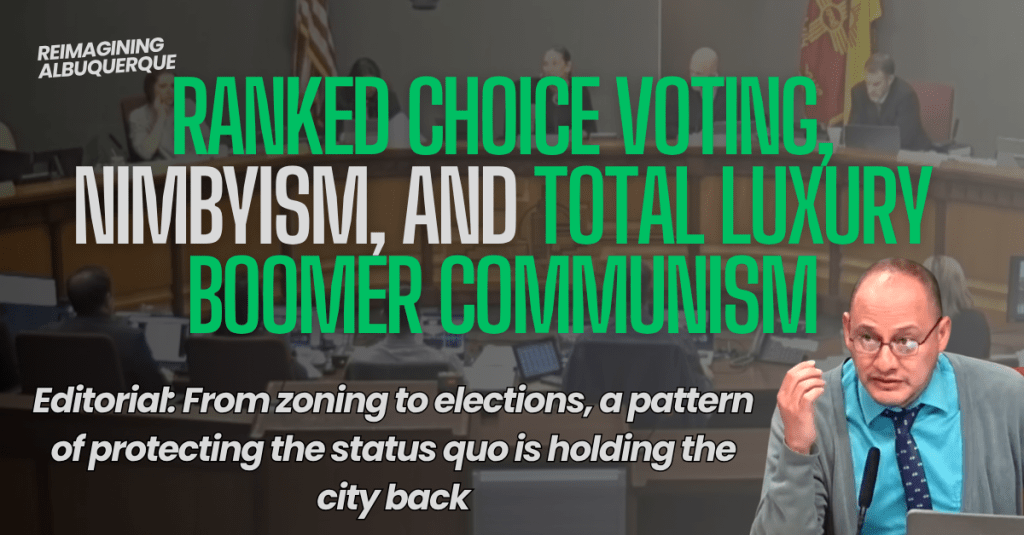
Ranked Choice Voting
When Ranked Choice Voting came forward again, it did not fail because it was incomprehensible. It failed because it threatened to rearrange incentives, to introduce a little more competition, a little more uncertainty, and a little more accountability into a system that has grown accustomed to operating without them.
Council President Klarissa Peña framed her opposition in the last debates about ranked choice voting in familiar terms—concern for “veijitos,” for voters who might find the system confusing. It was an argument that presents itself as protective, even compassionate. It also carries an implication that is harder to ignore: that some voters are too fragile, or too limited, or even too dumb, to participate in a system that cities like Santa Fe and Las Cruces have already adopted and navigated.
It is a strange kind of empathy that underestimates the very people it claims to defend.
If the concern was confusion, it was not obvious in the room.
By the time the item came up, dozens of people had already signed up to speak. Forty-seven, officially, on the agenda. More still had used general comment earlier in the evening, waiting through hours of unrelated items for their turn at the microphone. From the video of the hearing, the imbalance was difficult to miss. Roughly fifty-four people spoke in favor of Ranked Choice Voting. Around ten spoke against it.
Some speakers referenced polling suggesting the reform already enjoys broad support in the city, more than 60%, in fact. Others didn’t bother with data at all, relying instead on lived experiences, such as the sense that the current system narrows choices rather than expanding them.
A few of the first speakers were public school teachers who described introducing the concept to their students and just how quickly it clicked, how naturally people understood ranking preferences when it was presented plainly, and that we all do this regularly in our daily lives.
The speakers themselves skewed younger. High school students, recent graduates, people early in their careers. The first speaker, Cesar Marquez, a senior organizer with local group Common Cause, laid out the reasoning for a change and how it would improve our city’s democratic elections.
But they were not alone, older Burqueños stepped forward too.
Some spoke in alignment with their younger neighbors, describing the need for systems to evolve alongside the city. Others framed it more personally, sharing frustration at being forced, election after election, to vote against candidates they disliked rather than for someone they actually supported.
For a city politics often mired between young versus old, it complicates an easy story because this is not simply young versus old. It is not generational in the way it is often described, It is something more structural than that.
There are older Albuquerque residents who understand, clearly, that the system is narrowing around them as well. There are others, often those who arrived earlier, bought earlier, secured their position earlier, for whom the current system still works exactly as intended.
There were familiar faces in the room as well. People who, in other contexts, have been reliable opponents of zoning reform and housing change. Here, they were asking for something different: a system that allowed more expression, not less. Many Native New Mexicans spoke, some in Spanish. They spoke about fairness, about representation, about wanting a city that reflected the full range of its people.
Last time this proposal came forward, Peña suggested it would not be good for the community. This time, the community showed up anyway.
At the dais, the conversation moved in a different register.
At one point, Conservative Westside Councilor Dan Lewis engaged directly with Mr. Marquez, pressing on the mechanics of the system and attempting to draw out its implications. The exchange briefly opened space for clarification but ultimately circled back toward a preference for the existing system.
Elsewhere, councilors like Tammy Fiebelkorn allowed Mr. Marquez to fully respond, treating the exchange less as a test than as a conversation. Before the debate, Nob Hill/International District Councilor Nichole Rogers laid out the groundwork of the issue, and the debate was closed by Westside Councilor Stephanie Telles, who surgically dissected the misinformation and talking points of opponents of Ranked Choice Voting.
The difference in approach was subtle, but it shaped the tone of the evening.
Peña’s desire for a community roundtable
For a moment, it resembled the kind of civic exchange Peña herself had called for months earlier at the February 18th IDO Hearing. That evening, she stated a desire for young advocates, YIMBYs, Neighborhood Association stalwarts, and industry leaders to come together and work on something together. Given the incredible diversity of those speaking on this topic, spectators would be led to think this was that moment.
And it could have been that moment, but it wasn’t.
Peña was quieter this time, but her vote did not change. She still opposed these reforms.
The context around that vote is difficult to ignore. For a council president who narrowly avoided a loss in her last election, the structure of elections is not an abstract concern. A system like Ranked Choice Voting would not guarantee a different outcome but it would introduce variables that do not currently exist such as more candidates, broader coalitions, and a greater need to appeal beyond a narrow base. For her, too, was the concern that this system would increase accountability. Council President Peña has never been a fan of such a concept.
Situating it within this context, the language of caution begins to look less like concern for voters and more like a preference for stability, to maintain a gavel and a seat, and an ability to ignore the needs of her district and city.
More interestingly did the vote of Joaquin Baca change. Having twice voted before in favor of ranked choice voting, his turn of opinion was quite a surprise for many.
Baca has often positioned himself as a voice for a more dynamic Albuquerque, a city that does things, builds things, and works to expand the city’s ability to bring more people into the envelope.
This made his reversal difficult to reconcile. To argue for systems change while stepping away from a reform that expands participation creates a contradiction that does not resolve itself through caution.
And beyond rhetoric, there are structural realities.
Campaigns are built around predictability. A system like Ranked Choice Voting introduces uncertainty—one that allows more candidates to remain viable, one that reshapes how coalitions form. Even without assigning intent, the alignment is difficult to ignore, particularly as his campaign manager, Neri Holguin, has taken to lobbying against these reforms, as we head into an election year that includes his seat.
However, the contradiction runs deeper than that.
Recently, Councilor Baca attempted to pass a tax to fund more quality-of-life improvements in the city. It was stripped down through amendments, reduced piece by piece, and ultimately failed to survive the very body he serves in. He has voiced frustration with this process—frustration with being told, in effect, that the city cannot do the things it needs to do.
For a councilor who has experienced that refrain firsthand, who has seen his own proposals hollowed out by the same instinct toward caution and control, it is difficult not to notice the parallel.
“We just can’t have that.”
And yet, on Ranked Choice Voting, he found himself on the other side of that same instinct.
What ties these moments together is not just disagreement over policy. It is a shared instinct about who the system is for. Is it for Neri Holguin, Klarissa Peña, and the landed gentry of the North Valley? Or is it for a broader civic community wishing to escape the doldrums in which our city finds itself?
A growing body of YIMBY and urbanist writing has tried to describe this dynamic more precisely not as fear of change, but as a form of power.
Writers like Ned Resnikoff have framed land-use politics as a conflict between insiders and outsider: between those who already benefit from existing systems and those still trying to access them. Across cities, research has shown that homeowners, particularly older and wealthier ones, tend to dominate participation in local land-use decisions, shaping outcomes in ways that preserve stability for themselves while limiting access for others.
It is not hard to see how that logic extends beyond housing. A system that limits housing supply protects existing homeowners. A system that limits electoral competition protects existing officeholders.
Neither has to declare itself exclusionary. They simply maintain the conditions under which exclusion persists. On housing, the pattern repeats itself.
Former Bernalillo County Commissioner and Downtown/North Valley State Senator Debbie O’Malley has described younger advocates for mixed-income housing as naïve, suggesting that what worked in the 1980s for her should still be sufficient today. Young people should work hard, get married, buy into a mortgage, and put up their picket fence (now up to 5 feet tall thanks to her friend, Councilor Peña). Channeling a progressive NIMBYism that she shares with her Republican colleagues, the naïvité may in fact be calling from inside the house.
The conditions that made that path possible have been regulated out of existence, where young people are now increasingly finding it hard to follow O’Malley’s homeownership journey, but in an environment that is pushing families to live in their cars while historic overlays protect shades of stucco and carport design standards. And still, the response from our Council, from our Senators like O’Malley, and from NIMBY homeowners, is to manage scarcity rather than resolve it.
To fund affordability without allowing abundance. To preserve stability for those already inside, while others are told to wait.
Meanwhile, other cities move.
Tucson experiments. Las Cruces reforms. Santa Fe adapts.
Albuquerque watches. It studies—let us just see what happens five, or ten, or twenty years down the road in those cities. That Albuquerque might be falling behind Santa Fe on some issues is also a concern. Santa Fe, partly thanks to ranked choice voting, is finally making progress. For Albuquerque, for Joaquin Baca and Klarissa Peña, we need to hold our breath and count to 10.
And the consequences accumulate slowly.
A generation finds itself priced out, workers leave, and neighborhoods grow more exclusive. Would-be candidates try their luck elsewhere, bringing their talents to other cities.
Not by accident but by design, or at least by the refusal to design anything else.
There is no dramatic collapse. Just a series of small refusals. Death by a thousand cuts.
“We just can’t stand for that.”
But the city that emerges from those refusals is not neutral. It is structured to serve those who arrived earlier. Luxury, in this sense, is not about extravagance. It is about insulation.
And the question facing Albuquerque now is not whether change will come. At the dais, facing colleague Councilor Tammy Fiebelkorn, Councilor Baca said this issue will not come back up. It will, and change will come.
Change already is coming.
The question is who it will be allowed to work for.
And whether the people who showed up—young and old, students and teachers, longtime residents and new arrivals—will continue to be told:
“We just can’t stand for that.”


Leave a Reply