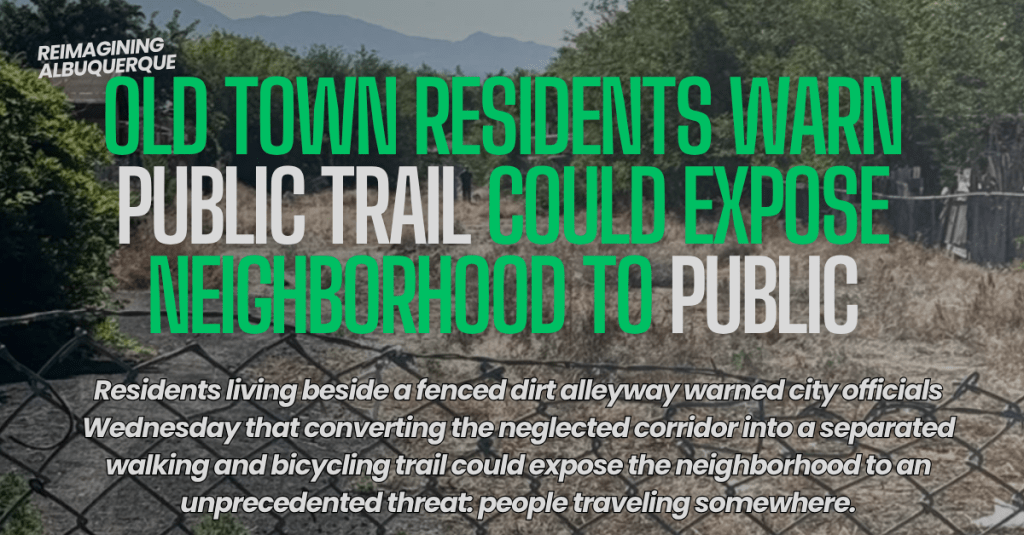
ALBUQUERQUE, N.M.— Residents living beside a fenced dirt alleyway warned city officials Wednesday that converting the neglected corridor into a separated walking and bicycling trail could expose the neighborhood to an unprecedented threat: people traveling somewhere.
“We understand that Sawmill Market, Old Town, and the BioPark are major public attractions,” said one concerned resident. “But we never imagined people from other parts of Albuquerque might attempt to reach them.”
The proposed section of the Albuquerque Rail Trail would replace the dirt corridor with a landscaped, accessible pathway connecting several of the city’s most heavily visited destinations. Residents cautioned that the improvement could force those living nearby to endure bicycles, pedestrians, families, and possibly individuals who do not already reside on the same block.
Several homeowners described the particular hardship of living in a highly desirable historic neighborhood surrounded by restaurants, museums, parks, cultural attractions, and recreational amenities, only to learn that the city intended to make those amenities accessible.
“We chose this area because everything is close by,” said one resident. “The problem is that the trail would make everything close by.”
Residents also warned that connecting the route to Albuquerque’s acclaimed Bosque trail system could reproduce the severe conditions along the city’s scenic river corridor, where the presence of other people enjoying the outdoors has already forced some residents indoors.
“I don’t even go to the bosque anymore because there are too many people outside,” said one resident, adding that she now often stays home. “I’m worried this trail would bring the same outdoor conditions to the area immediately outside my home.”
Opponents also questioned whether separated pedestrian and bicycle infrastructure was necessary, explaining that the existing streets were already perfectly safe for anyone sufficiently comfortable sharing them with several-ton automobiles traveling only a little over the speed limit.
“If somebody doesn’t feel safe walking in the road, there are other options,” one attendee said. “They can drive.”
Attendees displayed dozens of signs reading SAVE “OLD TOWN” FROM THE RAIL TRAIL, apparently seeking to protect the neighborhood while reserving judgment on whether “Old Town” is an authentic geographic location or a phrase recently fabricated by municipal planners.
The room contained nearly two signs per person, though most were placed face-up on tables or leaned against chairs rather than held, creating a strong visual presence primarily at table height. A tote bag filled with roughly a dozen unused signs sat in the corner for most of the meeting, ready for deployment if the room experienced a sudden surge of opposition.
Councilor Joaquín Baca convened the informational meeting after opponents requested additional information about the project. City employees stood beside displays covering landscaping, lighting, accessibility, traffic changes, and other design features, including a proposed “Braille Trail” intended to improve navigation for people with visual impairments. Attendees could register their preferences through a “dot-mocracy” on the presentation boards or speak individually with the employees responsible for planning and designing the trail.
Many opponents declined to participate in either process, explaining that they had come to demand more information and an opportunity to provide input.
“They gave us boards, project documents, and direct access to the people who know the answers,” said one attendee. “But they never gave us a chance to ask why nobody is listening to us.”
Baca later converted the informational session into an impromptu town hall so attendees could address him directly. Several residents used the opportunity to request a separate one-on-one meeting with the councilor where their concerns could receive public consideration in private.
“This format does not allow for meaningful dialogue,” said one resident during the dialogue.
The project’s documented outreach dates back to at least 2021, when the city reported five steering committee meetings, a public meeting attended by approximately 115 people, a survey distributed to more than 4,000 nearby residents and businesses, 456 survey responses, a public-sector working group, and five design charrettes.
“This is the first we are hearing about it,” said one attendee.
Residents also criticized a volunteer cleanup held in the alley the previous weekend, arguing that the city had endangered members of the public by “letting” them remove refuse from the fenced-off property. City personnel attended the cleanup and arranged professional disposal procedures for any sharps encountered, though no one at the meeting could confirm that any had been found.
Critics said the cleanup demonstrated precisely why the alley must remain inaccessible and unmaintained.
“If people start regularly walking through here, they’ll see who is dumping trash and what is going on back there,” said one resident. “That could fundamentally change the character of this abandoned dirt passage.”
At press time, residents were preparing additional signs warning that the trail could increase neighborhood congestion by allowing people to reach Old Town without first bringing a car into Old Town.
Thank you to Anon contributor, who wanted to share “quotes are a blend of real and ficticious though all of the sentiments I feel to be true to those in attendance”
 Reimagining Albuquerque
Leave a comment